


Then God said: Let us make human beings in our image, after our likeness.” – Genesis 1:26.
Theology is predominantly concerned with the nature of God. However, it is also concerned with theological anthropology, which is the study of human nature in the light of Divine revelation.
Within the Judeo-Christian tradition, the foundational claim about human beings, even beyond sin and redemption, is that humans are made in the image of God (imago Dei in Latin). What does it mean to be made in God’s image? This essay will explore four models or frameworks for understanding this somewhat mysterious concept.
The Sovereignty Of God – The Functional View
From a biblical Judeo-Christian understanding, God is seen as having ultimate authority and power over creation – including human beings. In the ancient world, monarchs would often display images of themselves to assert their power in a region (see, for example, the golden statue of Nebuchadnezzar, described in Daniel 3:1).
In turn, God delegates responsibility to some of His creation to human beings. “Let them have dominion over the fish of the sea, the birds of the air, the tame animals, all the wild animals, and all the creatures that crawl on the earth.” (Genesis 1:26).
Therefore, one way of viewing human beings as being in the image of God is to see humans as having dominion over what God has created. Nevertheless, the image of God as sovereign is intended to be a reminder of God’s authority over humanity. In addition to stewardship and dominion, this aspect of the image of God lends itself to three additional points.
It is only because human beings are moral agents, possessing conscience, reason, and the capacity to choose between right and wrong, that humans can have stewardship over nature and ultimately be accountable to God. Relatedly, humans are intended to reflect God’s attributes, such as love, justice, and holiness, and our failure to do so (sin) is a turning away from our intended purpose.
Finally, being made in God’s image establishes a unique relationship with God and makes human beings ultimately accountable to God. To what extent, then, do human beings possess a likeness to God?
The Substantial View – Human Likeness To God
First, it should go without saying that the concept of imago Dei is not suggestive of a physical correlation. That is, human beings do not possess any physical resemblance to God. So, in what way can we speak of a human likeness to God?
As a general principle, any human correspondence to God can be taken to refer to human reason and the rationality of God as creator. On this understanding, there is an intrinsic resonance between the structures of the world and human reasoning. This approach is set out with particular clarity in Saint Augustine’s writings on the Trinity. (Augustine, and Edmund Hill. On the Trinity. 2025).
Augustine argues that the image of the creator is to be found in the rational or intellectual soul of human beings. The human soul has been created according to the image of God so that it may use reason and intellect in order to apprehend and behold God.
For Augustine, we have been created with the intellectual resources to set us on the way to finding God by reflecting on creation. Augustine’s natural theology claims are mirrored in Scripture (e.g., Psalm 19:2).
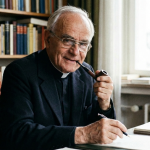
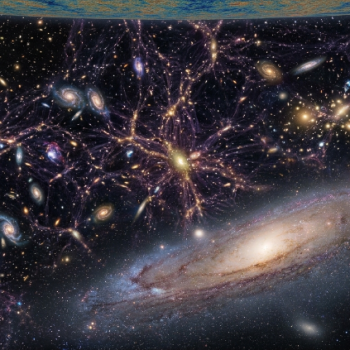
In recent years, the physicist and theologian John Polkinghorne, formerly a professor of theoretical physics at Cambridge University, has explored the importance of this point. Polkinghorne points out that some of the most beautiful patterns invented by mathematicians are actually found to occur in the structure of the physical world around us. There seems to be some deep-seated relationship between the reason within (the rationality of our minds – in this case, mathematics) and the reason without (the rational order and structure of the physical world around us). Said differently, the human mind seems perfectly adapted to understand a universe capable of being understood.
Furthermore, Doctor Polkinghorne argues that there seems to be a kind of “resonance” or “harmonization” between the ordering of the world and the human mind’s capacity to discern and represent it. “If the deep-seated congruence of the rationality present in our minds with the rationality present in the world is to find a true explanation, it must surely lie in some more profound reason which is the ground of both. Such a reason would be provided by the Rationality of the Creator.” (Polkinghorne, John C. Science and Creation. Templeton Foundation Press, 2009).
All of this further suggests that human beings are intended to relate to God.
The Relational View – Relating To God
The Holy Trinity is a relation of three persons. This relational aspect can be extended to human beings. The capacity of human beings to relate to others, or to enter into relationships, represents the third approach to understanding the concept of the imago Dei.
In this context, the term “image” expresses a teleology of sorts. The idea being that God has created human beings to enter into a relationship with Him. Such an approach seems to foster a Catholic spirituality that cultivates a relationship between the Creator and the created. One who took up this motif was C.S. Lewis.
Lewis argues that there is a God-shaped gap within us that only God can fill. Human beings have, consciously or not, a longing which is really for God, but which fallen and sinful humanity misreads, accidentally or deliberately, as a longing for things within the world. Of course, these things (frequently represented by money, power, pleasure, fame) ultimately fail to satisfy. If Lewis, and one may say Saint Augustine, are correct, then we are made for God, and God alone, and there is nothing else that will satisfy.
C.S. Lewis makes another important point. That is, this God-given sense of longing may be the key to answering the great questions of life that humanity has wrestled with.
Image As Storytelling
“Humans are storytelling animals, and they are drawn to narratives that resonate with their lived experience and vision for the future” -Quassim Cassam.
The last aspect to consider under the subject of the image of God involves storytelling. Perhaps one of the most characteristic features of human beings is that they tell stories. We do so in order to preserve memories, safeguard personal and communal identity, and make sense of the world around them. J.R.R. Tolkien argued that there was a theological basis for this capacity: we are created with some narrative template within us, which means that the image of God is imprinted and reflected in the stories we create. The human instinct to tell stories of meaning was grounded in a Christian doctrine of creation, and offered a theological explanation for our love of narration.
Tolkien suggested that our innate capacity and tendency to create stories is the result of being created in the image of God. He writes, “Fantasy remains a human right: we make in our measure and in our derivative mode, because we are made: and not only made, but made in the image and likeness of a Maker.”
Tolkien has been described as developing a “theology of sub-creation,” in that he holds that human beings create stories which are ultimately patterned on the “Grand Story” of God. We unconsciously tell stories which are patterned along the lines of this incredible story of creation and redemption, and which reflect our true destiny as lying with God.
Conclusion
Contained within the biblical worldview is the belief that human beings hold a special place within the created order. While it is true that every created thing possesses some trace of its Creator, only human beings are endowed with the imago Dei, the very image of God.
In this essay, I have examined four aspects in which the concept of the image of God may be understood.











 Ad-Free & Subscriber Log-In