
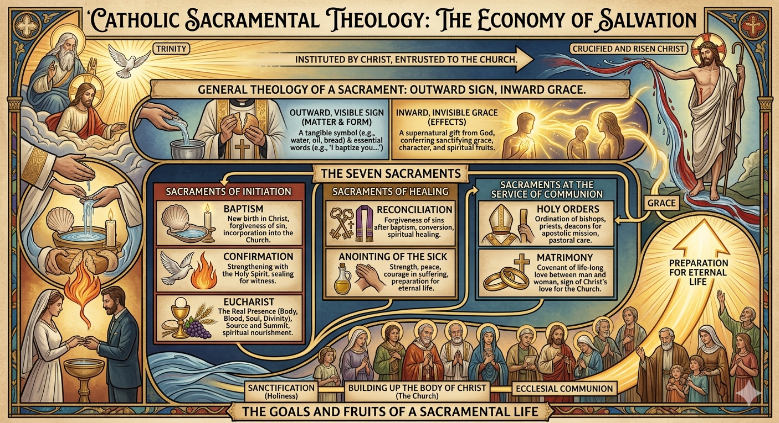
It may be impossible to overstate the significance of sacraments both theologically and doctrinally. Theologically, sacraments are signs and means by which God makes His grace available. From a doctrinal standpoint, sacraments serve as physical signs of invisible spiritual realities.
In this paper, I will examine the sacraments from both aspects by placing them in dialogue with the sacramental theology developed by Saints Augustine and Aquinas.
What Is A Sacrament?
Following Saint Augustine, the Catholic Church defines the sacraments as visible signs of invisible grace, instituted by Christ through which divine life is dispensed to believers. That is to say, sacraments are outward and visible signs of an inward and invisible grace.
Baptism exemplifies this doctrine. The visible signs include water, the sign of the cross, a white robe, candles, and chrism. The necessity of these physical things to confer spiritual grace is predicated on the fact that human beings are composed of a physical body as well as a spiritual soul. The physical signs satisfy the corporeal aspect of the person, while the invisible grace perfects the spiritual nature.
The signs are physical representations of metaphysical and spiritual truths. It is for this reason that the Church refers to these things as efficacious signs; they are visible manifestations of the invisible grace that the sacraments convey.
Sacramental Theology
Sacramental theology is a branch of Catholic theology that studies the nature, significance, and function of the sacraments in the life of the Church. More specifically, sacramental theology is the study of how God communicates His grace to human beings through his creation.
The Church teaches that divine grace can be encountered through specific, visible signs. These signs are ritual actions and elements that the Church identifies as instituted by Christ and as essential to the spiritual life. (Catechism of the Catholic Church, paragraph 1131).
As such, sacramental theology seeks to explain how material elements, such as water, bread, and oil, as well as prayers, can mediate divine reality and why these rites are considered necessary in Catholic practice.
In following Scripture, the Catholic Church recognises seven sacraments. They are Baptism, Eucharist, Confirmation, Penance, Anointing of the Sick, Holy Orders, and Matrimony. The sacraments are divided into categories: initiation, healing, and vocation. Sacramental theology provides the rationale for this structure.
The sacraments of initiation lay the foundations of the Christian life, mirroring the stages of natural life (birth, growth, nourishment).
The sacraments of healing recognize that the new life in Christ can be weakened or lost through sin or sickness. These sacraments exist to restore and strengthen the spiritual life.
The sacrament of Holy Orders is directed toward the salvation of others, while the sacrament of Matrimony helps build up the Church.
These divisions draw from Scripture, the Church Fathers, scholastic theology, and ongoing magisterial interpretation. While the sacraments themselves are based on Scripture (for example, baptism in Matthew 28:19), the seven sacraments were definitively established only at the Council of Trent (1545-1563).
Regardless, the underlying claim is that sacraments are not merely symbolic representations of grace, but actual means by which grace is communicated.
Sign And Reality
Within the broader horizon of sacramental theology, one can take a wide-angle approach to the sacraments. Doing so allows one to recognize that the sacraments serve ecclesial and commemorative purposes. That is, they build up the Church (the body of Christ), unite believers in worship, and serve as a memorial of Christ’s saving sacrifice on the cross.
We can also say four specific things about sacraments in general.
First, all of the sacraments have been instituted by Christ. This is to say that the sacraments are rooted in Christ’s commands and actions, continuing his work. Second, sacraments are visible signs of grace, making invisible spiritual realities tangible by illustrating God’s work of cleansing, nourishing, and renewing the soul. Third, and relatedly, the sacraments are not solely symbolic. Rather, they are efficacious signs that actually dispense the divine life and grace they signify. Finally, sacraments can be seen as seals of the New Covenant. This implies that the sacraments confirm and ratify God’s promises, marking believers as belonging to Christ.
Aquinas’s Three Dimensions
While Saint Augustine establishes the definition of the sign, Thomas Aquinas provides the metaphysical framework to understand how that sign functions internally.
Turning from an Augustinian to a Thomistic theology allows the sacraments to be viewed from three distinct yet related dimensions.
The first dimension is called the sacramentum tantum or the sign alone. This perspective is the external, visible rite, including the sacramental matter (e.g., water) and the form (words) used by the minister. It is the sign only that is considered in this dimension.
Res et sacramentum (reality and sign) doubles the data, so to speak. In addition to the sign, this perspective adds the reality of the sacrament. That is to say that it is both the sign of the sacrament and the reality or the intermediate, abiding effect of the sacrament. It is “reality” because it is a spiritual effect, but “sign” because it is a physical manifestation that points to the final grace.
The final dimension is called res tantum or reality alone. This perspective refers to the ultimate, interior, and spiritual fruit or grace of the sacrament. It is the “reality only” because it is not itself a sign of something else.
Owing to the rather abstract nature of sacramentum tantum, res et sacramentum, and res tantum, it is beneficial to include an example.
Beginning with baptism, the use of water and the stating of the trinitarian formula represent the sacramentum tantum (sign alone). The res et sacramentum (reality and sign) includes the baptismal character, which is the indelible mark upon the soul. Finally, the reality alone or rest tantum includes grace and the forgiveness of sins.
Conclusion
Sacramental theology outlines a vision of God’s grace as tangible and mediated, encountered not only through prayer or personal experience, but through ritual action performed under specific conditions.
To speak of the seven sacraments is to speak of the vehicles by which the ethereal, transcendent God communicates His grace to the corporeal, finite human being. For this reason, the Catholic Church teaches that the sacraments are not optional; they are necessary means of salvation.
By navigating the dimensions of sign and reality, one sees that the sacraments are more than mere rituals; they are the intersection of the corporeal and the divine, ensuring that the invisible grace of Augustine finds its perfected reality in the Thomistic soul.










 Ad-Free & Subscriber Log-In