

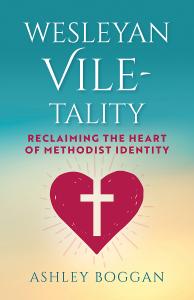
I have to admit, I am not part of the UMC, but this book caught my eye. As I’m sure it did for you, the idea of ‘vile’ Christianity did not sound like something that was worth reclaiming. However, Ashley Boggan, the current UMC General Secretary of the General Commission on Archives and History, puts forth a great argument for the United Methodist Church to become ‘vile’ again.
This book is well written, even with the historical focus. It brings the history of the UMC alive with captivating stories of people that are familiar as well as others most would probably not know. This book is just over 100 pages, making it easily digestible. The short nature of the book creates an extremely potent argument for Wesleyan ‘Vile-tality’.
‘Vile-tality’?!
I couldn’t imagine what was meant by this statement, which, of course, made me more curious and excited to read this book. Boggan points to a journal entry of John Wesley from his early days in Bristol. In this entry, he submits himself to be more ‘vile’. As many of us are aware, there are plenty of vile Christians in the world, but few who look to be more vile.
Ashley Boggan defines the concept of ‘Vile-tality’ in the preface of her book. She writes:
“Wesleyan vile-tality – a willingness to look beyond today’s acceptable practices, standards, and norms and bend the rules in order to ensure that more and more persons can be included within the Kin-dom of God. And also that all persons, no matter who they are, how they identify, whom they love, or how they live can know and experience the love of God, can know their own self-worth, and can grow to love themselves so that they can love others.” (VII)
Fortunately, we have a robust definition that flys in the face of expectation. Or, at least, my expectation upon receiving the book.
In this book, Boggan is calling the United Methodist Church back to their reforming days, the foundational moments of John Wesley’s ministry that bucked the norms of the Church of England by bringing the good news to the poor in the fields, bars, and coal mines. She calls the UMC to go back to bringing the Church to the ‘vile’ areas of society.
Early Accounts
Boggan goes into Wesley’s childhood, where his mother was atypical of women of her day – perhaps, ‘vile’. Both his parents were Puritans, his dad a priest in the Church of England. His mother Susanna would hold Sunday afternoon meetings that became known for the quality, variety, and engaging sermons. The Wesley house was anything but typical or standard.
John’s brother Charles began a small religious group while at Oxford that “focused on Scripture, the sacraments, and holding one another accountable to the practice of faith.” (28, emphasis original). Their group went out to the sick and preached to the prison, practices that were not typical. In fact, in 18th century England, it was a position of privilege to go to church. This meant you had transportation, clean clothes of proper quality, and did not have to work.
Vile Actions and ‘Vile-tality’
Much of this book centers around the ‘vile’ actions of John Wesley, early Methodists, and others who had the ‘Methodist spirit’. The United Methodist Church, like many denominations, is in the middle of a large fracture. Issues like women’s roles, LGBTQ+, and racial relations are at the heart of dissent. Ashley Boggan is calling for the UMC to remember their roots as ‘vile’ people who accepted those in the margins of society long before the mainstream.
She lists several notable Methodist women throughout this book. First, Sarah Ryan, the housekeeper of the first Methodist Room. As Boggan notes, this wouldn’t be what we think of as a housekeeper. A housekeeper was a manager, and in this way, Sarah was the manager of the building, hospitality to those who visited, as well as a spiritual leader. Her status as thrice married and thrice deserted put her in legal limbo, a social outcast. Wesley welcomed her in and put her in a position of great power and respect.
She also points out the interaction John had with an inmate named John Blair. Blair was in prison for alleged ‘sodomitical practices’ – a capital offense in the 18th century. Wesley visited him often and helped connect Blair with a lawyer. Wesley was at the trial where Blair was found guilty, but not executed. His fine was paid by Wesley through his connections with others. This was more than bizarre in that day. “when they [John Wesley and his Oxford friends] took up the advocacy of a man accused of homosexual crimes they crossed the boundary between… tolerable to the reprehensible.” (32)
Respectability and Racism
Boggan places the blame of the UMC’s loss of ‘vile-tality’ at the feet of respectability. Once the Church had a position of power, especially in the early days of the United States, the ability to be counter to the norm was lost. The Methodist Church became the normal. In this transformation, they lost their edge. Boggan writes, “The MEC [Methodist Episcopal Church] chose to abide by the state or to conform to social standards and not do the Wesleyan thing of challenging injustices, particularly those introduced by the state or widely adopted by society.” (44)
She notes several way in which the Methodist Episcopal Church (a subset of Methodism that was eventually absorbed by the UMC). First, racism and financial losses around slavery caused the Church to buckle under pressure. Because of their inability to stand firm for those without power – ‘vile’ by the standard of the day – it led to the fracturing of the Church. Further, the ways in which the Methodist Church organized their jurisdictions, it left all Black Methodist denominations in a single jurisdiction that was based on race rather than location. This 1939 decision was in effect until 1968.
Women and LGBTQ+
Women’s roles shrunk as power increased in the Methodist Church. While women were often charged with important roles in Methodism (like Sarah Ryan), they began to be pushed back into the shadows. During the 1888 General Conference, women lost the ability to sit or be elected as lay delegates due to a new reading of the male-only pronouns in the Book of Discipline. Furthermore, the Conference “rescinded the preaching licenses grant to [women] for the last decade!” (55)
Finally, the Methodist Church, at the 1972 General Conference, had a chance to radically alter the Church. At this Conference, the Study Commission on Social Principles put forth a paragraph called “human sexuality”. In this, they note that 1) sex is a gift from God, 2) sex may be exploitative outside or within marriage, 3) homosexuals are are “no less than heterosexuals” in need of “sacred worth”, and 4) homosexuals are entitles to human and civil rights. While the concept of sexual harm within marriage was groundbreaking, they could not confirm the stance on the queer community. They added a clause at the end claiming that homosexuality was incompatible with Christianity – pulling the teeth from a revolutionary document.
You Don’t Have to be Methodist
This book is powerful in its history, story, and message. Because of this, you certainly do not have to be Methodist to find this book engaging! There is so much in here that reminds us that all people are worthy of our love and respect. The radical actions of John Wesley and those like him remind us that our work is done outside the walls of the church, in the vile areas of life.
Let us never forget that Jesus was the most vile – eating with tax collectors, fraternizing with women, murdered on the cross as humiliation.
If you’re looking for more…
Wesleyan Vile-Tality on Bookshop










 Ad-Free & Subscriber Log-In