

The “reindeer rule” is an informal name given to a U.S. Supreme Court ruling about public Christmas displays. It’s also sometimes called the “three plastic animals” rule or the “Rudoph rule.” The issue addressed by the reindeer rule is whether Christmas displays in government buildings and the decorations erected by local governments along many Main Streets are a violation of the establishment clause of the First Amendment of the Constitution — “Congress shall make no law respecting an establishment of religion.”
In the 18th century, when the Constitution was written, an “established” religion was the official religion of a nation or state. Established churches received government endorsements and tax money. Several of the founding fathers — including James Madison and Thomas Jefferson — were very much opposed to established religion. They wanted the government to treat all religions equally. And note that James Madison was the chief author of the First Amendment. The Amendment originally only applied to the U.S. Congress. Several states still had established religions for some time. Much later the Supreme Court ruled that the Fourteenth Amendment, ratified in 1868, had expanded the establishment clause to apply to state and local governments as well. Very basically, no level of government in the U.S. may endorse one religion or denomination over others.
However, it was never the case that government was called to be hostile to religion, or to ban all religious expression from the public square. The point is that no favoritism be shown to any one religious tradition. The First Baptist Church may be allowed to hold an event in a public park, for example. But if so, the use of the park for similar events cannot be denied to the local Catholic church, or Jewish synagogue, or Sikh gurdwara. It’s important to remember that in the First Amendment the establishment clause is followed by the “free exercise” clause — “Congress shall make no law respecting an establishment of religion, or prohibiting the free exercise thereof.”
The Reindeer Rule: Lynch v. Donnelly
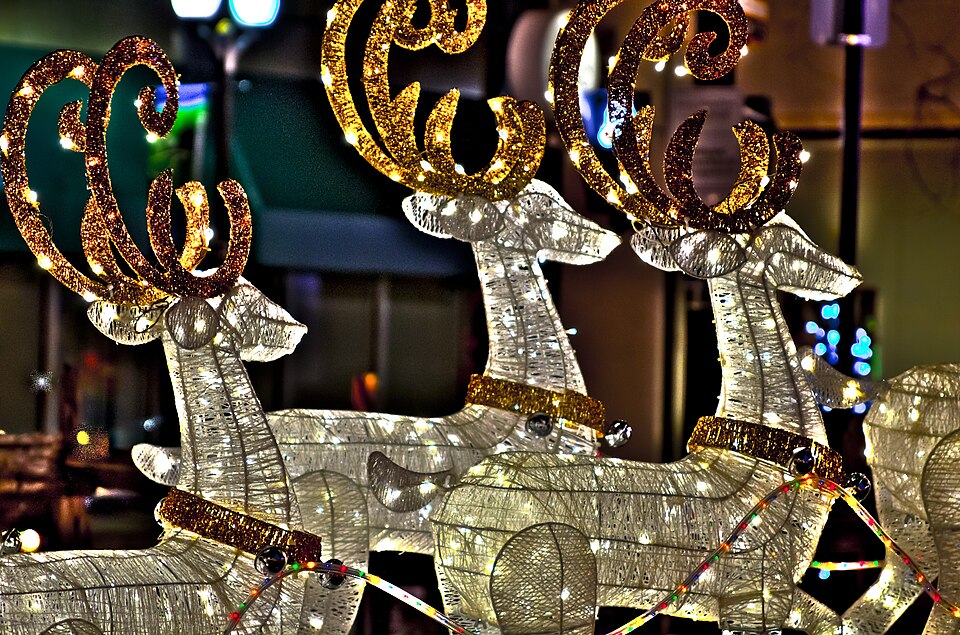
The “reindeer rule” case originated in Pawtucket, Rhode Island. As is common throughout the U.S., every Christmas season the city government of Pawtuckett decorated the main shopping district with Christmas-themed lights and displays. For several years the displays included a Christmas tree, a Santa Clause house, and models of Santa’s reindeer. It also included a nativity scene, or crèche, portraying the Holy Family with baby Jesus in a manger. The American Civil Liberties Union challenged the crèche as a violation of the establishment clause. The lead plaintiff was ACLU member Daniel Donnelly. The lead defendant was the mayor of Pawtucket, Dennis Lynch. The case was first heard in the U.S. District Court of Rhode Island, which enjoined Pawtucket from displaying the crèche. In 1981 the case went to a U.S. Court of Appeals, which upheld the District Court’s ruling. The crèche was a violation of the establishment clause, the courts said.
But in 1984 the U.S. Supreme Court reversed the lower courts’ ruling. Chief Justice Warren Burger wrote in the majority opinion that the purpose of the establishment and free exercise clauses in the First Amendment was to prevent church and state from intruding on each other. But total separation is not possible in an absolute sense, he said. The Constitution “affirmatively mandates accommodation, not merely tolerance, of all religions, and forbids hostility toward any.” Those accommodations include the hiring of chaplains for those in military service and the religious art displayed in taxpayer-supported museums. For that matter, Christmas itself is a national holiday.
Chief Justice Burger’s Reindeer Rule
In addressing whether the crèche promoted Christianity over other religions, the Chief Justice wrote,
The display celebrates a public holiday, and no one contends that declaration of that holiday is understood to be an endorsement of religion. The holiday itself has very strong secular components and traditions. Government celebration of the holiday, which is extremely common, generally is not understood to endorse the religious content of the holiday, just as government celebration of Thanksgiving is not so understood. The creche is a traditional symbol of the holiday that is very commonly displayed along with purely secular symbols, as it was in Pawtucket.
In other words, he said, look at the context of the display. A crèche by itself would have been objectionable. But a crèche surrounded by secular symbols of Christmas, such as Santa and his reindeer, can be understood as pointing to the historic origin of the holiday and not necessarily to promoting religion.
This same principle has been applied to displays of the Ten Commandments. In 2005 the same Court approved a display of the Ten Commandments on the grounds of the Texas State Capitol (Van Orden v. Perry) but did not approve displays of the Ten Commandments in Kentucky courthouses (McCreary County v. ACLU). In context, the justices said, the Texas example could reflect the moral and historical traditions of Texas. But the Kentucky example clearly was about promoting particular religious beliefs.








 Ad-Free & Subscriber Log-In