

I have been delving into my old musicological roots recently. I had the opportunity to interview some up-and-coming reggae artists, which brought me back to a style I often overlook in my musical history. I took up the question, “Where are the Christian reggae artists?” Knowing the popularity of this genre, I knew there had to be some. My mind went to the few I already knew, which was enough to encourage a deeper investigation of this style and its relationship to faith-based music.
Starting the research, it was easy to fall into the pit of researching Rastafarianism. The connections with Christianity have been discussed elsewhere. I intend to review Christian reggae as a vehicle for faith-based expression. This is different than presenting a review of Rastafarianism and using music as an extension. Taking hold of a theomusicological discipline, I present an analysis of the reggae work and artists to see how they contextualize their work with Christianity/faith-based music. Including points of how Rastafarianism has or is influencing a particular work will be invested, but not a central focus. Rather, I work as a theomusicologist to uncover the realities and faith-based expressions of the selected artists.
From an Island to the World.
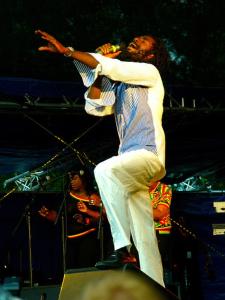
Reggae has its start in Kingston, Jamaica. The rude boy (rude boi) culture captured the street and club culture. The import of electronic devices from around the world served as entertainment and work for the socio-economically suppressed community. This gave way to the emcee (MC) and the disc jockey (DJ). Performing together in the dancehalls at night, the longer the tracks could be played, the more the audiences would enjoy themselves, and spend time in the clubs. This became an economic platform for club owners. Soon, friendly battles would unfold between MCs and DJs. The core was to see who had the loudest sound system and could integrate the most varied music to rouse an audience to dance all night. The exploration of different music fused with African drum style (and memory), where the “chunk” became central. This upbeat pulse is the staple in reggae music and the most recognizable feature.
Reggae was later exported around the world. Coming from the oppressed community of Jamaica, the social justice and resistance elements were attractive to other communities facing similar situations. This non-musical attitude was further exploited and used as an anthem for social justice. The origins of reggae come through the African diasporic expressive arts. The popularity of reggae comes through a marketing-industrial complex profiting from this rich sonic legacy.
The prominent use of reggae in pop culture points back to the “chunk.” The evolving globalization of reggae has reached all areas around the world. The colors have lost their meaning. The culture has been reduced and packaged, profiting off stereotypes of the culture. This is the area that most know about reggae, the stereotyped identity.
The connection of reggae’s faith history has relationships with Christianity that have been and remain controversial. The musical legacy is worth noting.
“Rastafarian music is one of the most recognizable aspects of the movement, and is heavily influenced by Jamaican popular music, particularly Mento and Reggae. Music and ritual are used to invoke a spiritual experience, often invoking communal prayer and communion. The presence of drums and other traditional African instruments also demonstrates the importance of these influences” (Johnson, Jennifer, Is Rastafarian A Form Of Christianity?, Believers Pray, November 2023).
From the African diasporic tradition, reggae was to make contact with Christianity. Colonial agents, missionaries, the black church, and the globalization of Christianity each played a part in exposing those knowledgeable of reggae to Christianity. Not following the faith context of Rastafarianism, artists who chose to follow Christianity were tasked with influencing their musical preference, reggae, with their faith, Christianity, and overstepping the stereotyped, cultural signifiers of Rastafarianism. Though not an easy task, this direction proved to be fruitful. Christianity could use the popular presence of reggae to communicate scripture and testimony to wide audiences, thus becoming a tool of evangelism. This allowed for the possibility of discipleship through music. Each of these points, testimony, scripture-based lyrics, discipleship, and evangelism, correctly aligns reggae as a cousin to Hip Hop culture. This connection remains present today, with Christian/faith-based reggae borrowing these elements from Christian Hip Hop to articulate a Christian reggae discourse.

Marketing To Make Christian Reggae
There are several reggae artist around the world who are creating new tracks based on their Christian faith. The most popular band is Christafari.
The complication with Christafari is their reliance on the pop culture aspects of reggae. The band performs popular Christian songs with a “reggae sound.” I argue that this borders on trivializing Christianity by way of essentializing reggae. Christafari, I argue, minimizes the cultural and spiritual importance of both Christianity and reggae in exchange for popularity. The sound of the band is highly produced. Roots reggae endures rough sonic elements, emphasizing community involvement over a highly polished sound. Chritafari switches this vernacular. For those outside of the reggae sphere but who are interested in reggae music, Christafari will be the first, and possibly, the only faith-based band they contact. The minimal exposure of alternative faith-based reggae bands helps secure Christafari’s prominent position while simultaneously pushing others away from audience attention.
An example of Christafari is the track “Yeshua” (My Beloved).
Filmed on location in Hawaii in 2022, the band used their 50-state tour to include this video. The glamour and elegance of the work are visually stunning. Yet, this is outside of the context from which reggae originated. Visually speaking, this promotes Christian reggae as a pop representation. The codified package of the track, lyrics, sound, and image all point to pre-packaged merchandise for audience consumption. Based on these elements, there is no coincidence that Christafari has a near monopoly on Christian reggae.
I argue that Christafari is less focused on the core elements of Christian reggae-Hip Hop than on promoting a popular status. First, absent is the testimonial. This is glossed over throughout their works. Only in live performances are such points raised. Even here, the presentation is framed around a sermon. The lived experience noted elsewhere is lacking. Scripture-centered lyrics are used sparingly, most notably when the band covers another artist and the scripture is already integrated. The band does engage in evangelism by way of their tours. In other examples, evangelism is seen in a grassroots context. For Christafari, evangelism is linked to their marketing brand (visible in their music descriptions). The element of discipleship is far from being visible. It could be stated that by contributing to their “cause” this would qualify as discipleship. However, that may be a bit of a stretch.
Christafari serves the purpose for those interested in learning about Christian reggae, but who are not comfortable with going deeper into the genre. The popularity of the band shows no slowing down.
Speaking to the Masses
Content-rich reggae sounds can be heard in two examples from Damian Marley and Kevin Downswell. Both of these names are no strangers to reggae and Christian reggae. Those in this sphere of influence call these “gospel reggae,” or “reggae gospel,” as they are centered on a positive delivery of the gospel. Each of these includes the four core elements binding reggae to Hip Hop: testimony, evangelism, scripture-centered lyrics, and discipleship.
What further separates these works from others is the environment of the visuals. They each take place in a community. The members may be central, but there is a strong presence of the community, which immediately speaks to evangelism and discipleship. Continuing to outline the remaining core elements, each of these examples involves a personal testimony and has references to scripture-centered lyrics. Turning to a sermonizing, Kevin Downswell takes up this role at the close of his work.
A staple name, Damian Marley presents a visually stunning work, which starts with a testimony. The track is about salvation. The lyrics walk through the transformation from defeat to belief, faith, and eventual salvation. There is a strong undercurrent of repentance in the work. Taking the viewer through city streets, prayer meetings, and even a baptism, this work completes all points of the gospel in a musical presentation. Engaging a classic reggae style, this work updates a roots reggae identity. The track without the visuals could easily be a powerful force. The included images escalate the intent of the work. The pretext listing on the video states, “The MOST POWERFUL Reggae Gospel Song Ever.” Taking each of these points together, the song certainly is a contender for this title.
This is a live performance that perfectly articulates the point. Each of the binding core elements of reggae-Hip Hop is expressed. Testimony, scripture-centered lyrics, evangelism, and discipleship are each stated throughout. Kevin Downswell takes to offering a short sermon at the end of the track. This is more of an extended testimony to the audience. Kevin Downswell takes advantage of the energy in the context to push the audience further. The ongoing hook, “God is there!” works in concert with the other scripture-centered lyrics stated throughout. The persistent calling on “My Shepherd” is another phrase that grounds the lyrics.
Where Damian Marley speaks to an audience for evangelism and his faith-based message, Kevin Downswell speaks with an audience for his evangelism and faith-based message. These two works bookend the discourse, showing both sides of the same coin. A strong integration of scripture-centered lyrics, energetic evangelism, a powerful testimony, and a call for discipleship, these two examples contextualize the value and power that reggae provides as a faith-based expression of Christianity.

Movement For The People
Bob Marley coined the phrase “Movement of Jah People” in his powerful track Exodus.
Taking this call to arms, Gospel Reggae is moving people toward the gospel in multiple ways. Those within the genre will find comfort with a roots reggae band. Those outside the genre but who enjoy reggae music will find commercialized bands to satisfy them. In both cases, the value is the Word being shared, moved. Regardless of how one engages scripture through music, in this case, reggae, there is a band to help support the walk in faith.
The transposition of reggae through a Christian doctrine is impressive to realize. The methodology of these artists is to install faith-based lyrics to encourage a movement of the people. The success of these works is based on the success of the four core binding elements between reggae-Hip Hop: testimony, scripture-centered lyrics, evangelism, and discipleship. The more founded these are in a work, the stronger the song will speak to the listener; the more depth the scripture will be expressed. Bob Marley’s call to action, “Move the People” (“Move Jah People”), is being promoted.
The Great Commission (Matthew 28:16-20) is being performed, in this case, through reggae. A stereotyped reggae identity will not end anytime soon. This is far from the case when discussing faith-based reggae. Gospel Reggae holds firm on the mandate of the Great Commission and attaches this to the call to action from Bob Marley to move the people through an Exodus (read: the self-titled album) to “move the Jah people” (read: follow God, follow Christ).










 Ad-Free & Subscriber Log-In