

Protest music is not limited to the street. The sounds of the People have been ringing through worship for over a millennium.
“But in your hearts honor Christ the Lord as holy, always being prepared to make a defense to anyone who asks you for a reason for the hope that is in you; yet do it with gentleness and respect” (1 Peter 3:15 NKJV).

Contemporary popular music (read: pop music) can function not only in a secular, non-faith-based culture, but also as an apologetic, theological music.
Merriam-Webster defines “Apologetics” as such:
- Systematic argumentative discourse in defense (as of a doctrine), and 2. a branch of theology devoted to the defense of the divine origin and authority of Christianity (“Apologetics.” Merriam-Webster.com Dictionary, Accessed 28 Feb. 2026).
Can these definitions be applied to music? Theological music? The rhetorical answer is “Yes.” In doing so, expressive discourse is expanded. Music is not limited to a singular vehicle of worship. Music involves a larger meaning and intent. Music can, and does, serve as a defense of faith, expressively, and as a devoted discipline.
Theological music is an expression of apologetics. Secular music can be inverted to expose a subcurrent of expressive faith. In doing so, music that is recognized outside of Christian faith, a faith-based life, has the potential to speak to a non-faith-based population. Music articulates gospel discipline and teaching. Secular music, when read through an apologetic, inverts the narrative of the work, and is recontextualized to acknowledge and teach elements of the gospel: truth, living, discipline, and building faith.
Defending faith, an apologetic in music, opens the door for conversation and inquiry into the grounding principles of theomusiclology (personal testimony, discipleship, biblically-centered lyrics, evangelism, community, and activism).
When secular music is framed as an apologetic, most refer to this genre as “protest music.” However, the music is “for” a purpose, not “against” a purpose. When music is sectionalized as the voice of a protest, the critical tenor, value, and importance of the meaning of the work is limited to an oppositional tool; an agent of aggression. Rather, if music is expanded to mark an expressive lived experience, a dynamic of the self, the work is activated on multiple levels.
The phrase, “Silence is Golden,” is a fallacy. “Silence” is submission, and music, an expressed cultural agent, when viewed as a critical apologetic theomusicological tool, is not submission. It is viscerally active, charging faith.
Apologetics In Secular Music
An understanding of Christian apologetics helps see how music serves as a tool for apologetic discourse.
Bible Hub provides useful outlines of the different forms of Christian apologetics. Carefully seeing how these forms and the history of the apologetics frame the application of music, both secular and sacred, as an apologetic.
“Christian Apologetics is the field dedicated to explaining and defending the truths of the Christian faith, addressing both the reasons why believers hold their convictions and the questions or objections posed by skeptics. The term “apologetics” comes from the Greek word apologia, meaning a ‘defense’ or ‘answer.’ This concept can be seen in 1 Peter 3:15: ‘But in your hearts sanctify Christ as Lord. Always be prepared to give a defense to everyone who asks you the reason for the hope that is in you…’ The ultimate aim is to remove intellectual stumbling blocks and invite people into deeper understanding, rather than to ‘win arguments’ merely for the sake of victory” (Bible Hub, n.d.).
From here, we can see how the point is not to “win” but rather to “invite.” Music as agency is based on the reading and application of the music. Secular music, when read theomusciologically, becomes the invitation to a non-faith-based listener toward an initial faith-based conversation.
If the point of apologetics is to “[defend] the truths of the Christian faith, addressing both the reasons why believers hold their convictions and the questions or objections posed by skeptics,” then the inclusion of secular music, when read theomusicologically, becomes an agent of Christian activism. There is no protest in the application. Rather, there is a dynamic implication of faith-based understanding to be addressed. This process may be more critical in application, where engaging protest, either for or against secular music as agency for Christian faith, the purpose of this epistemologically and theologically-centered reading is to invite a non-faith-based individual to entertain the possibility of biblical truth read in secular music. Limiting this process to use sacred music alone potentially shuts down the conversation.
Activating secular music, with an apologetic, theomusicological approach, averts protest to Christian faith with a deeper understanding and inclusive contact with a non-faith-based listener. Both the interlocuter and the individual audience endure an apologetic. The intent is to dismantle controversy or protest to the Christian faith and use secular music as an apologetic mechanism. Invitation, along with a sustained defense of faith, is the foundation. The roadblock articulated by the protest is to be disassembled and replaced with clear, applicable, and relational Christian faith discourse.
No Protest In Faith-Based Music
On June 26, 2020, NPR Music released the following review titled, We Insist: A Century Of Black Music Against State Violence (NPR 2020). The combined voices of Bobby Carter, Nate Chinen, Ann Powers, Shana L. Redmond, and Oliver Wang discuss what they see as the most significant African American protest music of the 20th century through the early 21st century.
Interesting that this listing from NPR was published on this date and time. A closer look at this moment highlights what may be the rationale behind National Public Radio (NPR) to move in this direction.
“On June 26, 2020, America was marked by significant political and social events. The U.S. House of Representatives approved a comprehensive police reform bill named after George Floyd, reflecting a bipartisan response to the nationwide protests against police brutality. The bill, which passed 236–181, proposed banning chokeholds, restricting no-knock warrants, and establishing a national database to track police misconduct. This legislation was a direct consequence of the tragic death of George Floyd and the subsequent protests that highlighted systemic racism and injustice” (On This Day, June 2020).
NPR sees the need to recognize racial injustice in the cultural fabric of the 20th/21st century. The reviewers rely on Black authors to speak on the institutionalized racism in America’s pop music identity, but discount the faith-based intent of selections on their list.
There is a scriptural command to defend Christian faith, no matter how minor the point may appear.
“The command to defend belief in God, His Word, and the redemptive work of Christ springs from Scripture itself. For instance, Philippians 1:7 speaks of believers taking part in “the defense and confirmation of the gospel.” The emphasis on biblical truth rests on the conviction that all Scripture is God-breathed (2 Timothy 3:16) and authoritative” (Bible Hub, n.d.).
The collected NPR music reviewers included works that have a faith-based core. Dismissing this point and singularly qualifying the music as a civil protest encourages division and disenfranchisement.
The artists/groups who do provide a faith-based narrative in their works should have had this point referenced. Instead, NPR leans toward difference. What this does is articulate a socio-religious divide in pop culture. The opportunity for these reviewers to give a voice to the inclusive faith-based narrative of selected works is passed over to not disturb non-faith-based readers, and state the obvious: music in the secular context can have a spiritual connection and, following an applied apologetic, function to encourage at best, inspire at least, a faith-based view of culture.
Secular To Sacred Music Examples
The selected works here are from the NPR We Insist: A Century Of Black Music Against State Violence listing (NPR 2020). The original comments and reviews are included to see how a non-faith-based review is made toward music, artists, and ensembles, which clearly identify a faith-based inclusion and trajectory. The NPR reviewers elect to frame these selections as examples of cultural protest, stoking the flames of antagonism. The work, when read theomusicologically, extinguishes these flames. There is no replacement reading needed when the works are read, noting the spirituality embedded in the works. The core elements of theomusicology (personal testimony, discipleship, evangelism, biblically-centered lyrics/narrative, community, and activism) are exemplified in these works, at varying levels and degrees. Yet, the works follow a theomusicological foundation, one which the NPR reviewers neglected to recognize.
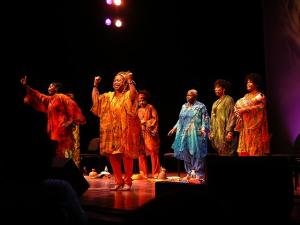
Sweet Honey in the Rock
“Joanne Little” (1976),
Beginning with the defiant and repeated line, “Who is this girl and what is she to you,” this song tells the story of Joan (pronounced Jo-ann) Little, a Black woman who, while being held in a North Carolina men’s jail in 1974, murdered a guard in self-defense against sexual assault. Her eventual trial drew the attention of prison abolitionists and women’s and civil rights organizations, as well as the high-profile support of Angela Y. Davis. Led by the voice of movement artist Bernice Johnson Reagon, the song by Black women’s a cappella group Sweet Honey in the Rock gives Little full dimension and answers the recurring question by naming her our sister, mama, lover and “the woman who’s gonna carry your child.” — Shana L. Redmond (NPR, All Songs Considered, June 26, 2020).
“The Bible affirms the inherent dignity and value of women, created in the image of God alongside men (Genesis 1:27). This foundational truth establishes a framework for understanding women’s roles as equal partners in God’s creation. Throughout scripture, women are portrayed not only as supporters but also as leaders and integral parts of God’s narrative, challenging traditional views that may diminish their significance” (Bible Hub, n.d.).
Though this work discusses a highly controversial issue of abuse against women, the intent of Sweet Honey in the Rock to present this work is to give value and emphasis to the importance of women when read biblically.
“…but we were gentle among you, like a mother caring for her little children” (1 Thessalonians 2:7 NJKV).
McIntosh County Shouters
“Wade the Water to My Knees” (1983),
It’s not an exaggeration to say that the stories of violence against Black people in America, preserved in music, are as old as the nation itself. This song is a variant of the familiar spiritual “Wade in the Water,” but its roots run even deeper, into the silty banks of Dunbar Creek at St. Simons Island, Ga. There, in 1803, a group of West Africans transported in the Middle Passage revolted at the end of their journey; both history and legend assert that they drowned themselves rather than remain captive. Such narratives were often buried between the lines of the spirituals and shout songs that form the foundation of African-American music. In the past half-century, musical preservationists like the Georgia Sea Islands group have revived the original meanings of these songs, reminding listeners that their messages are not piously universal, but hauntingly particular. — Ann Powers (NPR, All Songs Considered, June 26, 2020).
This work comes from a liturgical background and is only marginally noted. African American spirituals gave birth to Gospel music and set in motion the prolific profile of sermonizing. Without recreating songs such as these from the McIntosh County Shouters, the rich history of Gospel music, and its subsequent outgrowths (i.e., Soul, Hip Hop) would not exist.

Lauryn Hill
“Forgive Them Father” (1998),
Songs are open-ended things, their meanings adaptable to new historical moments, making necessary responses. Hill wrote this song as an invocation of Bob Marley’s spirit, interpolating the Wailers’ “Concrete Jungle” into her litany of call-outs that range from thoughtless men to capitalism itself. In recent years, however, she has made the message more pointed by extending the song’s ending in her performances and showing a montage of phone- and videocamera- captured incidents of police brutality as she sings. The song becomes a form of sanctified dissent, a cry for reconciliation and reparations, communicating compassion even as it unwaveringly seeks justice. — Ann Powers, NPR, All Songs Considered, June 26, 2020).
“Forgiveness is not optional for Christians; it is a command from God. Ephesians 4:32 instructs believers to ‘be kind and compassionate to one another, forgiving each other, just as in Christ God forgave you.’ This emphasizes that forgiveness is integral to the Christian faith and obedience to God’s will” (Seedword Christian, June 16, 2025).
If the original and revised versions of “Forgive Them Father” are to emphasize forgiveness from both an earthly and heavenly Father, the reviewers elected to frame this work as a site of resistance. This avoids the importance of forgiveness and misses the glaring implication of this in the title of the work.
“Forgiveness is essential for mending broken relationships. It fosters reconciliation and harmony, transforming conflicts into opportunities for growth and understanding. Colossians 3:13 urges believers to ‘bear with each other and forgive any complaint you may have against one another’” (Seedword Christian, June 16, 2025).
Giving forgiveness, as scripture states, is the first step in our own forgiveness. “Forgive Them Father” does not come across as a theomusicologically-centered work. But the intent and discipline are the foundations of the narrative.
Secular Music Apologetics
There is no doubt that secular music can and does serve as a lived apologetic for non-faith-based listeners. What is missing is not the scripture message in secular music. What is absent is the application, dedication to see/hear, and commitment to present and discuss these points with faith-based and non-faith-based audiences.
When Christian music fans and theomusicologists alike begin to operate on this level, the depth and breadth of invitations available to welcome and defend Christian faith in secular and sacred music will be mindblowing.












 Ad-Free & Subscriber Log-In