

I heard the voice of the Lord, saying:
“Whom shall I send,
And who will go for Us?”
Then I said, “Here am I! Send me.” (Isaiah 6:8 NKJV)
It was on Sunday, September 21, at the Charlie Kirk memorial that pointed words were expressed by Erika Kirk. Her comments do more than display humanity; these words frame the importance of the country to critically assess itself for substantial progress, change, and cooperation.
“By far the most striking moment of Turning Point, USA’s memorial event on Sunday, was Erika Kirk’s proclamation that she forgives her husband’s suspected assassin, quoting Jesus on the cross: ‘Father, forgive them, for they know not what they do.’
“I forgive him because it was what Christ did and is what Charlie would do,” she said. ‘The answer to hate is not hate. The answer we know from the Gospel is love and always love’” (The Hill, September 23).
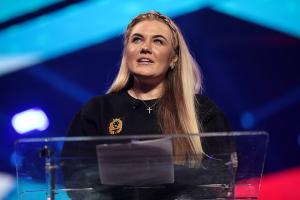
Erika Kirk: Exemplifying Strength
Christian Hip Hop’s Response
Healing culture through music is a guiding principle for Christian Hip Hop artists. Framing this process on the core elements of Christian Hip Hop (testimony, discipleship, evangelism, biblical-centered lyrics, community, and activism) gives these artists the ability to speak to highly sensitive issues. At this juncture in the cultural environment, when distrust between ideologies rang loud, the importance of a Christian Hip Hop voice could not be overlooked.
The response from the Christian Hip Hop community can be recognized in the call to action from Ephesians 3: 8-13,
The outpouring of response to this moment in time from the Christian Hip Hop community is a present recognition of faith over socio-political issues. Facing what could be potential backlash, and there were some episodes of this within the Christian Hip Hop community, artists took hold of their faith, coupled with their work, and articulated a multi-vocal narrative in support, equity, and a just representation of this sensitive moment in the cultural history.

Selected Videos
The selected videos included are from Christian Hip Hop or those loosely associated with the genre. There have been a large number of artificial intelligence-generated (AI) videos featuring known Hip Hop artists. The artist contributes a verse or two, and the remainder of the track is AI-produced. A few are included as an illustration of the contemporary direction of producers who use AI to contribute to this cultural response.
This is not an exhaustive listing of work which are centered on this topic. The collection is evidence of the breadth and depth of the involved artists and styles working with a single theme, and articulating the founding agents of Christian Hip Hop: testimony, discipleship, evangelism, biblical-centered lyrics, community, and activism.
“I made this Jesus Rap one week after Charlie Kirk was assassinated. Now Christian Conservatism is the new hip hop. The Bible is back now. Jesus is Punk Rock. Charlie Kirk getting shot and killed in public was such a brutal wake up call to the evils of the world that now more people are choosing to follow Jesus. I’m not a Christian rapper but This is a rap about Christianity and truth. I tried to be very genuine and respectful. The rise of political violence in this country is extremely scary. No civil war. This is divide and conquer, do not fall for it. No more hating your neighbor. I dont know what else to say except find Jesus, plant a garden, train and be with your family. Good luck out there everyone. This is not democrat vs republican its humanity vs insanity, good vs evil. People celebrating this public execution are insane. Dont listen to anyone not calling for peace and trying to deescalate Charlie Kirk getting killed is helping to bring make Christianity in a big way! Christianity is making a comeback in unexpected ways, influencing pop culture and sparking cultural commentary. This video dives into current events through a lens of faith, offering political commentary on the intersection of religion and modern society. Is Jesus Christ the new punk rock?” (Current Event Rap, YouTube, September 2025).
“DAX and Lil Wayne team up for “Heaven Heard Him First”, a powerful tribute honoring the life, voice, and legacy of Charlie Kirk. With raw verses from DAX and heartfelt bars from Lil Wayne, this emotional anthem carries a message of faith, courage, and eternal impact. Charlie Kirk’s mission, truth, and fire for the people will never be forgotten. This song is more than music—it’s a reminder that legends don’t die, their voices echo forever” (Sonic Sync, September 2025).
Servant Zero, I Am Charlie, September 17, 2025. https://youtu.be/Y9e52FrIrbE?si=PKPcGqPW__F4sLtM
“This emotional AI gospel-rap ballad is a heartfelt tribute to Charlie Kirk. Remember Me for My Faith is a powerful gospel-inspired pop-rap duet by Jelly Roll and Eminem, created to honor Charlie Kirk — the Christian preacher and activist whose life was tragically cut short by gun violence. The song blends Jelly Roll’s soulful, prayerful vocals with Eminem’s raw, urgent rap verses, capturing both the pain of loss and the hope of eternal life in Christ. It’s more than a tribute — it’s a call to remember Charlie not for battles or sorrow, but for his unshakable faith in Jesus. Through mournful piano, warm church organ, and cinematic gospel undertones, Remember Me for My Faith reminds us that Charlie’s legacy lives on. His voice may be silent, but his message still echoes: “Remember me… not for the pain, but for my faith. Remember me for Jesus” (Universal Music Group, YouTube, September 2025).

Finding A Way Back Home
The major contributions of Moses serve as an example, which are highlighted by the contributions of Christian Hip Hop artists at this juncture and time.
“Moses’ leadership is the important of adaptability. Throughout the exodus, he faced numerous unforeseen challenges, from logistical issues to spiritual crises. His ability to adapt and respond to these challenges, often through direct communication with the divine, ensured the survival and cohesion of the Israelite community. This adaptability, coupled with his steadfast faith, allowed him to navigate the complexities of leading a nascent nation through uncharted territory” (Divine Narratives, December 2024).
Moses holds seminal moments in Christian history; stable and flexible with expanded revision and application to unfolding times.
From the time of his birth, Moses was born during a violent time when Pharaoh declared all male babies to be killed. The gift of his mother to send him off down the Nile River, to be found and adopted by Pharaoh’s daughter, and raised in the royal court, is an account of God’s grace, mercy, and will being set in motion. For Christian Hip Hop artists at this point to make bold, expressive works on an issue that has divided as much as collected the social and political climate in America. Christian Hip Hop artists set themselves off, with uncertainty on the reception of their output to the culture, to be found and brought into the eyes and ears of populist and Christian, faith-based communities alike.
The burning bush moment is a testimony to God’s will, which Moses would fulfill.
“This divine interaction was not just a spectacle; it was a profound revelation that would redefine Moses’ understanding of his purpose. God disclosed the suffering of the Israelites and expressed the intention to deliver them from bondage. Moses was chosen as the instrument of this liberation, a role he initially resisted. The enormity of the task, coupled with his self-doubt, made him question his suitability. Yet, God reassured him, promising divine support and equipping him with signs to validate his mission” (Divine Narratives, December 2024).
Christian Hip Hop artists have returned time and again to the burning bush to gain strength and reassurance of their direction and work within this genre. There is a confidence needed at this time for these artists to produce work speaking to a highly sensitive issue, one shrouded in its own controversies. Yet, Christian Hip Hop artists have put their faith, trust, and confidence in their calling to explore Hip Hop to articulate Christian values. By this extension, they have and are being reassured by God on the direction of their work, specifically those who speak to this moment.
“Moses would come to lead his Jewish community into a wilderness, fraught with uncertainty, and the obvious lack of any sustainable resources. The exodus itself was a logistical and emotional challenge. Moses had to organize a mass departure, ensuring that an entire nation, weary and oppressed, could move swiftly and efficiently. The journey was not just a physical relocation but also a psychological shift from slavery to freedom” (Divine Narratives, December 2024).
The vast number of works coming from all areas of the Christian Hip Hop genre illustrates the urgency that this community sees and knows is important to share God’s word, testify, and make disciples. The similarity to the exodus lies in the collective venture of Christian Hip Hop to work in an unfavorable genre, Christian Hip Hop. Working in this capacity demands a logical change to comply with the overarching structure and styling of musical output within Christian Hip Hop. These artists work in what some see as a barren musical wasteland, a wilderness. Still, these artists remain faithful to their calling by not compromising and remaining devoted to God’s work and direction in this genre.
The Red Sea moment for Christian Hip Hop artists came as they had to decide on whether to produce a work to honor Charlie Kirk and face uncertain socio-political repercussions, or allow the moment to pass them by. The preponderance of Christian Hip Hop artists who followed their faith produced works, which have gained reasonable attention, did so in obedience to their faith-based discipline. The opposing socio-political forces challenged the Christian Hip Hop community to either pursue the path of their belief and remain aligned with the core tenets of Christian Hip Hop (testimony, discipleship, evangelism, biblical-centered lyrics, community, and activism) or succumb to external non-faith-based pressures and turn away from this moment. The decision to follow faith illuminated the work of those who voiced their support, which further fortified their work. Choosing to follow their faith gave these artists an additional layer of exposure to share, support, serve, and give back to the community, which sought comfort at this challenging moment. For these Christian Hip Hop artists, their strength was expanded in a time of fragility; they utilized their gift from God to lift the community through the core foundations of Christian Hip Hop (testimony, discipleship, evangelism, biblical-centered lyrics, community, and activism).
Moses receiving the Ten Commandments from God. Christian Hip Hop artists may not have received these commandments, but through their individual and collective works focused on this particular event and time, they articulate the values and intent of the commandments. By producing works that speak to the community, Christian Hip Hop artists bring into their work the foundations of these commandments, subtextually. Without pointing to any one commandment, but occupying this time with work that centered on this moment, Christian Hip Hop artists provide a contemporary application of the commandments and a subtextual call to return to these guidelines of faith. The non-verbal employment of the commandments in each of their works demonstrates the subtle yet necessary relevance of the commandments as guiding principles of how to live and recover when a traumatic event occurs. The heightened sensitivity with which these artists expose the basic importance of the commandments in our lives further illustrates how Christian Hip Hop can and does communicate faith-based values, biblical doctrine, fellowship, and discipline in a culture that operates against itself.
Like Moses, the country has reached its Red Sea moment. Only with a return to “home,” a re-focus on belief and faith can the country see beyond the current cultural division. Otherwise, the Red Sea moment will persist, absent any step forward for the culture, which is the call to action from Christian Hip Hop artists. The engagement of the core foundations of Christian Hip Hop gives leverage to Christian Hip Hop artists to function as a sounding board for faith and a voice to those seeking faith. The dynamics of testimony, discipleship, evangelism, biblical-centered lyrics, community, and activism, the core foundations of Christian Hip Hop, situate a posture to share, serve, support, and give back to the community, contemporary artistry, and a sound faith-based identity.
The culture, as a whole, needs to look beyond the limitations of politics at this moment. Healing is not taking place through negative rhetoric. Lest we forget the favored biblical phrase from Charlie Kirk, Isaiah 6:8,
I heard the voice of the Lord, saying:
“Whom shall I send,
And who will go for Us?”
Then I said, “Here am I! Send me.” (Isaiah 6:8 NKJV)













 Ad-Free & Subscriber Log-In