

This article takes a socio-religious, faith-based, Christian reading of the “No Kings” events on Saturday, October 18.
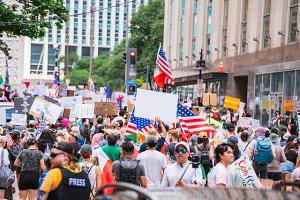
“No Kings.” The day took a turn to the absurd. Nearly 7 million people, covering more than 2,700 events across 50 states and internationally, including in London, Paris, Rome, and Lisbon, Portugal. Organized by multiple political action organizations such as the American Civil Liberties Union, American Federation of Teachers, 50501, Human Rights Campaign, Indivisible, and MoveOn. The point? Axios cites Katie Bethell from MoveOn with the following statement.
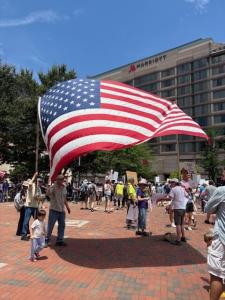
“‘Across cities and towns, large and small, rural and suburban, in red areas and in blue areas, millions of us are peacefully coming together for No Kings to send a clear and unmistakable message: the power belongs to the people,’ Katie Bethell, MoveOn executive director” (Axios, October 18).
The GOP refuted these protests, calling them “a hate America rally” (Axios, October 18).
‘They’re hitting a nerve’: Republicans dub anti-Trump protests as ‘hate America’ rallies, MSNBC, October 17.
George Conway TROLLS Trump at ‘No Kings’ protests, MSNBC, October 18.
The undercurrent theme stated by Bethell is problematic. In a country that claims to be built on Christian principles and has a recognized population that identifies with Christianity between 60% and 64% (Pew Research Center, February 2025) consistently, articulating the point of the “No Kings” protest rallies as being a power (read: political discourse and legal justification) that belongs to the people, neglects the socio-religious foundations of Christianity is inconsistent with the rallies.
One Country, One Constitution, One King
A reference to God is not explicitly noted in the U.S. Constitution. Rather, this foundational document notes the separation of church and state to protect the founding U.S. from government overruling the beliefs and religious freedom of individuals.
“The Constitution was written to be the United States’ fundamental law. It defines the organization of the democratic republic, separating itself from Great Britain’s colonial reign. The document lays out the powers and duties of the federal government and establishes the basic rights of American citizens.
“The U.S. Constitution never uses the words ‘God’ or ‘Creator.” Instead, it deliberately stays religiously neutral while the First Amendment guarantees free exercise of religion. Unlike the Declaration of Independence, the Constitution is considered a secular document because it does not mention God. The goal of the Constitution was to separate government and religion while protecting people’s religious beliefs and activities” (Christianity, October 2025).
The Declaration of Independence references God, in so many words, four times.
“When in the Course of human events, it becomes necessary for one people to dissolve the political bands which have connected them with another, and to assume among the powers of the earth, the separate and equal station to which the Laws of Nature and of Nature’s God entitle them, a decent respect to the opinions of mankind requires that they should declare the causes which impel them to the separation.”
“We hold these truths to be self-evident, that all men are created equal, that they are endowed by their Creator with certain unalienable Rights, that among these are Life, Liberty, and the pursuit of Happiness.”
“We, therefore, the Representatives of the United States of America, in General Congress Assembled, appealing to the Supreme Judge of the world for the rectitude of our intentions, do, in the Name, and by the Authority of the good People of these Colonies, solemnly publish and declare, That these United Colonies are, and of Right ought to be Free and Independent States…”
“And for the support of this Declaration, with a firm reliance on the protection of divine Providence, we mutually pledge to each other our Lives, our Fortunes, and our sacred Honor” (Christianity, n.d.).
In each of these areas, God is referenced in multiple ways. This points out the direction that the authors of the Constitution and Declaration of Independence saw as necessary to retain a separation of church and state, so the state (read: the government) does not overrule religious freedoms, and vice versa; the church/religious agenda does not overrule the government.
This balance may have become transparent in a fast-paced contemporary society. Neglecting this legislative reality defuses the importance of religious expression, making this a political tool due to the lack of recognition and careful reading of this declaration. In doing so, the door creeps open to alternative readings and applications of the country’s founding document.
Socio-religiously speaking, this further extends the progress of a counterfeit narrative on the importance and understanding of religion and faith for the country. More often, those who are knowledgeable of this embedded freedom and governmental balance of religion and politics are designated as being inconsistent with the current cultural trends, when the opposite is the case. Pointing out these penned and indoctrinated declarations, which operate as the pillars of the American socio-political identity, is not inconsistent. Rather, this voice speaks clearly to the valued importance of knowing the pillars of the American socio-political identity to secure, support, and retain religious freedom.
What’s The Valued Importance?
A simple reminder of the basic guidelines of Christianity, the Ten Commandments, clearly notes an inconsistency in the current cultural landscape.
- You shall have no other gods before Me.
- You shall make no idols.
- You shall not take the name of the Lord your God in vain.
- Keep the Sabbath day holy.
- Honor your father and your mother.
- You shall not murder.
- You shall not commit adultery.
- You shall not steal.
- You shall not bear false witness against your neighbor.
- You shall not covet. (Bible Info, n.d.)
Immediately, the first commandment, “You shall have no other gods before Me,” illustrates the inconsistency between the events of October 18 and America’s assumed and data-noted evidence that Christian principles are central to a majority of the U.S. population. A further reading of these Christian guideposts underscores the inconsistency between religious principles and political resistance. A socio-political inconsistency begins to take shape.
Scripture As Contemporary Discourse
Jeremiah, the prophet, writes in his book the following about the fall of Babylon under the punishment of God.
“For it [Babylon] is the land of carved images, And they are insane with their idols” (Jeremiah 50:38 NJKV).
Babylon was considered the center of the Old World, a civic oasis, a thriving center of commerce and culture. There is a similarity that sounds quite familiar with how the U.S. considers itself on the global stage.
Babylon eventually fell, painfully, due to turning away from God and celebrating other gods, and establishing idolatry as a basic cultural practice. The purge of this city eventually brought down the Old World with the necessity to turn to God, in faith and belief, relying on Him for all. Again, the similarity with the current socio-political and cultural landscape is worth a sobering note.
A little further, Jeremiah notes what happens to the lands when Babylon is overtaken.
“At the noise of the taking of Babylon, The earth trembles, And the cry is heard among the nations” (Jeremiah 50:46 NJKV).
These lines from Jeremiah read quite contemporarily. When Babylon fell, there was a “noise.” If the events of October 18 are read as the noise, can we see the slow decline of the U.S.? Central to the fall of Babylon from its importance in the Old World was the denial of God and placing belief and trust in man-made gods and idols.
Idols can be anything occupying one’s time and full attention. Seeing the expansive outpouring of those who participated in the protest events on October 18, it’s not a stretch to ascertain that belief and faith are less in God and more in man’s ability to rule his days and work.
The idol, in this case, is the events, and the socio-political discourse surrounding the cultural necessity to establish these events, locally, nationally, and globally. The idol is referenced through the events; the idol is political inconsistency. Given this reading, the “king” may be understood by event protestors as a person, but the “king” is actually a metaphor of the larger idol, political inconsistency, and the value placed in supporting and sustaining this position.
Participants need a personification of political inconsistency. The current administration is the referential point, which is elevated to the position of a “king” through socio-political growing imperialism and hegemonic expansion, but also as one promoted by those opposing this identity. Ironically, both political sides define the “king,” which was being celebrated through the protest movement expressions locally, nationally, and globally on October 18, as central to the political inconsistency; the current pan-cultural idol.
One Document, One King
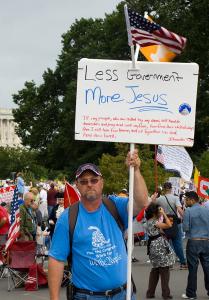
A country assuming and data qualified as being largely Christian is repeatedly turning from the true “King,” the Lord.
A short survey of biblical scripture illustrates how Christ is the Lord, the true King.
“Therefore, Pilate said to Him, “So You are a king?” Jesus answered, “You say correctly that I am a king. For this I have been born, and for this I have come into the world, to testify to the truth. Everyone who is of the truth hears My voice” (John 18:37 NJKV).
“Fear not, daughter of Zion; behold, your King is coming, seated on a donkey’s colt” (John 12:15 NJKV).
“These will wage war against the Lamb, and the Lamb will overcome them, because He is Lord of lords and King of kings, and those who are with Him are the called and chosen and faithful” (Revelation 17:14 NJKV).
“And on His robe and on His thigh He has a name written, ‘KING OF KINGS, AND LORD OF LORDS’” (Revelation 19:16 NJKV).
“He will bring about at the proper time — He who is the blessed and only Sovereign, the King of kings and Lord of lords,” (1 Timothy 6:15 NJKV).
If we, as a faith-based republic, have the legislative and constitutional right to exercise religious freedom, which the majority of the country claims to associate with Christianity, then turning away from these scriptural realities leans toward a steady decline in the republic. The events of October 18, celebrating a politically inconsistent idol, personified in the current administration, might be considered reviewing these scripture truths to build a socio-religious consciousness consistent with what the body republic states as their faith-based belief system.
How does the country, then, rectify these political inconsistencies? Returning to scripture and its basic themes, the government may find the resolution to the perpetual turbulent socio-political questions and instability needed for a country that is assumed and noted to be founded on Christian principles.
The valued importance may be less than organizing social protest events against a personified, politically inconsistent “king.” Rather, the valued importance may be to return to learning the founding document of the U.S., understand this document as a living entity designed to protect institutionalized freedoms, not to contest or revoke these freedoms, and see how these are balanced with what roughly 65% of the republic who identify as Christian should own, scripture. These interlocking points may not immediately reconcile the socio-political inconsistencies that the country, in general, finds a comfortable fit. Still, the process needs to begin at some point and time.
Those who participated in the protest events on October 18 seemed to be ready to gather to reify a false “king.” How much more would the country be, in general, if this same attention and projection were provided to reify the scripture-defined true “King”? The words of what happens to a country/nation that does not celebrate God or the true “King” are clear in scripture. Perhaps it’s time to make a joyful noise, celebrating a true “King” rather than hearing a noise like that which announced the fall of Babylon.









 Ad-Free & Subscriber Log-In