

Most Christians have some idea where they will be after the world ends.
Many Christians will say they believe that the Bible, including the book of Revelation, is the inerrant, inspired, and unquestionable word of God.
The truth is that most Christians have no real idea what the author of Revelation was writing about nor any real idea what it says or how it fits with the rest of the Bible.
Who is Bart D. Ehrman?
Dr. Bart Ehrman is a quite well known and highly respected Bible scholar who specializes in the New Testament and early Christian authors and texts. He is fluent in Hebrew, Greek and other languages. He has recently retired from his position at the University of North Carolina, Chapel Hill, where he was the James A. Gray Distinguished Professor.
In addition to lectures and speeches in a variety of venues and situations, Dr, Ehrman has written many popular books and textbooks, including six New York Times bestsellers.
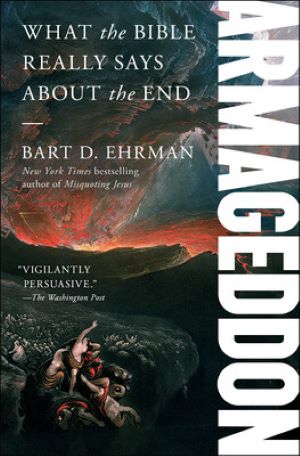
What follows are some insights and observations about Dr. Ehrman’s book, Armageddon: What the Bible Really Says about the End.
Why am I writing about Professor Ehrman’s book?
The book of Revelation in the Bible has puzzled scholars, theologians and lay readers for a very long time. Dr. Ehrman’s book interprets Revelation by close reading and historical and critical analysis from his expertise in the New Testament and early Christian writings. It is not written as an academic work but one that would be easily understood by a lay reader.
In it, Dr. Ehrman bypasses the dogmas that have been developed by churches in the past 2,000 years, along with common beliefs that have permeated Christian lay people’s beliefs in many different Christian denominations.
I am writing this article about his book because this book, more than any other I have seen, takes the text of Revelation at face value and explains how the author’s words fit into the contexts of literature, history and legend.
What kind of book is Revelation?
Revelation was written on the Island of Patmos by an author who says his name is John. This was a common name in first-century Judea. For many years, people assumed that the author was John, the son of Zebedee, who was a disciple of Jesus. Scholars have since shown that the style of the two writings in Greek is too dissimilar to have been written by the same author. We can also rule out John the Baptist. He was long dead when John of Patmos wrote Revelation, probably in the late First Century CE.
The theological vision in the book of Revelation differs sharply from the Biblical accounts of the theologies of Jesus and of Paul.
These differences are too numerous and many are too deep to be treated with fidelity in an article like this. Volumes have been written about these. Let us just say that Revelation draws on Hebrew Bible sources but describes the End Times differently from any other known text.
The book of Revelation fits into the category of apocalyptic literature, which, by definition, describes the end of days for humans. Other Biblical examples (from Wikipedia) include:
Daniel (especially chapters 7-12): The premier Old Testament example.
Revelation: The main New Testament apocalypse.
Isaiah 24-27: Often called the “Isaiah Apocalypse”.
Ezekiel 37-48: Contains visionary descriptions of restoration.
Matthew 24-25 (Olivet Discourse): Jesus’ teaching on the end times.
1 Thessalonians 4:13-18: Describes the end times/resurrection.
These books and verses give visions of the End of Days according to some of the prophets and Gospel authors.
What makes Bart Ehrman’s book different?
Instead of making an effort to harmonize or reconcile these different visions (and they are quite different) like so many have done, Ehrman takes the text of the book of Revelation at face value, exploring the time and context of its author’s world and makes sound judgments about the author’s meaning within that time and context, unpacking the symbolism of the book and making as much sense of its messages of both doom and hope.
Revelation has been seen as Resistance Literature or even as Revenge Fantasy by some scholars, including Dan McClellan.
Ehrman’s book examines these ideas in detail.
How does Revelation’s vision compare with the Gospels?
The Gospels, written anonymously by four different authors, none of whom can be shown to have been written by the author whose name church fathers added to the texts in later years. The Gospels are not first-person accounts by eyewitnesses but were written after Jesus’s time on Earth. They were likely written between 65 and 100 CE.
In the (canonical) Gospels, Jesus is portrayed as an itinerant preacher and healer who traveled around in Judea, preaching God’s word, interpreting the law of Moses, and healing the sick. He is even shown to have given dead people new life. The indelible impression is that Jesus is a merciful, loving, and generally gentle soul.
The Jesus of Revelation is most certainly not portrayed in this way.

How does Revelation’s vision compare with Paul’s letters?
Paul’s theology, which differs from the theology of Jesus as reported in the Gospels:
Gospel of Matthew 22: (quoting Jesus)
37 He said to him, “ ‘You shall love the Lord your God with all your heart and with all your soul and with all your mind.’ 38 This is the greatest and first commandment. 39 And a second is like it: ‘You shall love your neighbor as yourself.’ 40 On these two commandments hang all the Law and the Prophets.”
Jesus gave the rich man specific instructions on how to inherit the Kingdom of Heaven:
Gospel of Mark:
19 You know the commandments: ‘You shall not murder. You shall not commit adultery. You shall not steal. You shall not bear false witness. You shall not defraud. Honor your father and mother.’ ” 20 He said to him, “Teacher, I have kept all these since my youth.” 21 Jesus, looking at him, loved him and said, “You lack one thing; go, sell what you own, and give the money[d] to the poor, and you will have treasure in heaven; then come, follow me.”
These verses sum up Jesus’s theology as reported.
Paul’s theology is somewhat different. It much more complex and less straightforward. Where Jesus states his beliefs in simple terms, Paul states in his theology that salvation is achieved by belief in Jesus’s death and resurrection and its meaning for the human race:
Paul’s theology is fundamentally Christ-centered and salvation-historical, focusing on justification by grace through faith in the crucified and resurrected Jesus. He viewed Jesus as the Jewish Messiah who inaugurated a “new creation,” breaking the power of sin and death and offering salvation to both Jews and Gentiles apart from the Law.
Both Jesus and Paul believed that the End Times would come within the lifetime of those living while they preached and/or wrote.
The book of Revelation states that the details are more elaborate and frankly, much more violent than any statements made by Paul or attributed by the Gospel authors to Jesus.
For example:
Revelation 14:
17 Then another angel came out of the temple in heaven, and he, too, had a sharp sickle. 18 Then another angel came out from the altar, the angel who has authority over fire, and he called with a loud voice to him who had the sharp sickle, “Use your sharp sickle and gather the clusters of the vine of the earth, for its grapes are ripe.” 19 So the angel swung his sickle over the earth and gathered the vintage of the earth, and he threw it into the great winepress of the wrath of God. 20 And the winepress was trodden outside the city, and blood flowed from the winepress, as high as a horse’s bridle, for a distance of about one thousand six hundred stadia.
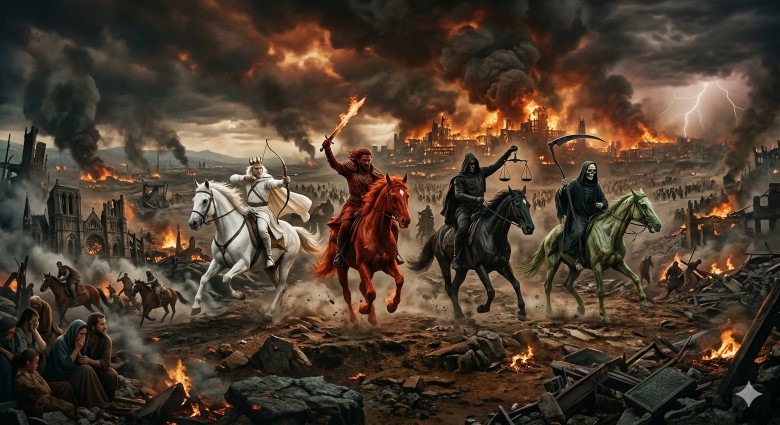
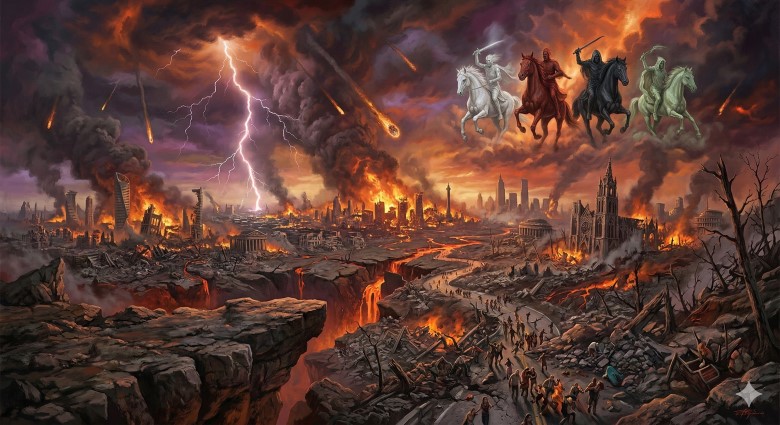
Another example (Jesus is the rider of the White Horse):
Revelation 19:
17 Then I saw an angel standing in the sun, and with a loud voice he called to all the birds that fly in midheaven, “Come, gather for the great supper of God, 18 to eat the flesh of kings, the flesh of captains, the flesh of the mighty, the flesh of horses and their riders—flesh of all, both free and slave, both small and great.” 19 Then I saw the beast and the kings of the earth with their armies gathered to wage war against the rider on the horse and against his army. 20 And the beast was captured, and with it the false prophet who had performed in its presence the signs by which he deceived those who had received the brand of the beast and those who worshiped its image. These two were thrown alive into the lake of fire that burns with sulfur. 21 And the rest were killed by the sword of the rider on the horse, the sword that came from his mouth, and all the birds were gorged with their flesh.
These visions of Jesus in John’s Revelation are certainly shown in sharp contrast to the portrayals of Jesus in the Gospels or in Paul’s letters.

What is Ehrman’s essential take on Revelation?
Professor Ehrman, a Bible scholar who, unlike many people, has no need to prove any pre-conceived notions about Jesus and God, takes a historical-critical approach. He sees the many visions in the book of Revelation as symbolic as do most modern scholars.
One of the biggest differences between Ehrman’s view and those of many modern Christian apologists is hat the book of Revelation was written for and about the people living in the First Century CE, not in any century since then.
He discusses at length the many preachers over the last 2,000 years who have envisioned the End Times in their own day. A few have even picked the exact date that the Apocalypse would begin.
Ehrman carefully and thoroughly outlines the symbolism in Revelation as he sees it and makes a convincing argument that the book is about the yoke of oppression imposed on Judea by the Roman occupation and the extraction of money and resources from Judeans who need them to survive.
The prophet John of Patmos has envisioned a Holy War in which Jesus Christ and his heavenly angels and army will “harvest” the Earth with a Holy sickle and will trample the “vineyard,” stomping the juice (blood) from the non-believers (there is a lot of blood). Without getting into too much detail (read Ehrman’s book), Christ in Revelation bears little resemblance to the Jesus of the Gospels or in the letters of Paul.
Ehrman shows clearly that John of Patmos was writing about First Century Judea and Rome and uses the symbol “Babylon” and the “Whore of Babylon” to refer to Rome and its emperors and graphically describes what God will do to humankind through Jesus and his armies.
In the final winnowing of mankind, a few “slaves” of God will be saved for eternity and will sit in the presence of God forever. The rest of all mankind, living and dead, will be thrown into the great “Lake of Fire,” where they will perish forever. There is no Hell with eternal torment in Revelation. Mankind’s torment will take place during the Holy war and the images it draws are terrifying.
Ehrman cites examples of writers who have tried to make Revelation about their own times, but he clearly shows how these claims have proved to be false as he grounds the book of Revelation in its own time and context. In Ehrman’s hands, we can find meaning for our world in Revelation but we must first accept that Revelation was not written about us or about our times. The simple fact that writers for 2,000 years have thought Revelation to be about them and their own times shows that mankind’s motivations have changed little in that interval. The idea or concept of what has come to be known as the Rapture is not found in Revelation (or at any other place in the Bible).

What are the main takeaways from Ehrman’s book?
We can distill some central points made by Professor Ehrman in his book:
-
- The Bible is not one book but is comprised of many books.
- The number of books varies by edition and is defined by the many church traditions.
- Not everything in the Bible agrees with everything else in the Bible.
- No person or family has any more right to interpret the Bible than any other.
- However, scholars and other close readers who possess deep knowledge of the languages of the Bible, can make informed judgments about the various Biblical authors’ meanings.
- The Rapture is an idea invented in 1833 by by John Nelson Darby, a British theologian. It has no defensible Biblical origin.
- The canonical Gospels’ reports of Jesus’s theology, Paul’s letters and the book of Revelation each propose a different view of Christ’s role in the final resurrection, unlike each other in many main points and details.
- In Revelation, there is no Hell. People not chosen by Jesus will be thrown into a “lake of fire” where they will perish. For most of mankind, there is no eternal existence anywhere.
- The book of Revelation was written using symbolism to describe the power that imposed the yoke of the Roman Empire on Judea and its people.
- The symbolism in Revelation is easily explained to modern readers by Bible scholars who take a historical-critical approach.
- The book of Revelation does not prescribe how a soul achieves everlasting life. Both Jesus (as reported in the Gospels) and Paul do so in some detail.
- Revelation does not depict things that have happened at any time after it was written.
- Some theologians and apologists still cling to the idea that Revelation is about the events in the current day.
- John of Patmos had no inkling whatsoever about what the world would be like in the 21st century.
Stay tuned to this account. My next topic will be the three New testament theologies: Jesus, Paul and John of Patmos (the Gospels, the letters and Revelation)
As always, I would appreciate any feedback and comments, positive or negative.












 Ad-Free & Subscriber Log-In