

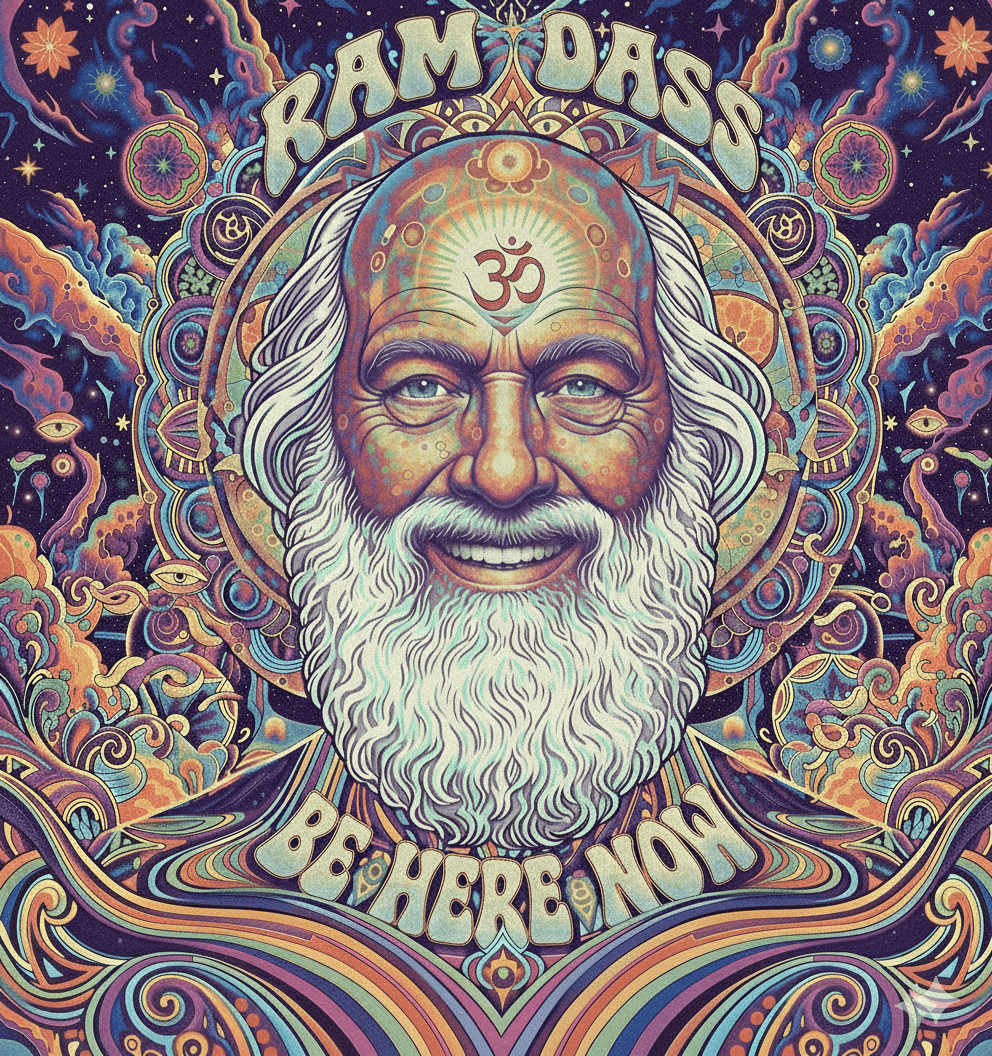
Ram Das is dead. Or is he?
While Ram Dass may have officially transitioned in 2019, he’s more present than ever. If he could speak to us now, I don’t doubt he would say that he has merely shed his body “like an old overcoat” and that his spirit is still with us. It’s this spirit that animates his posthumous book There Is No Other: The Way to Harmony and Wholeness.
Born Richard Alpert, Ram Dass was a hippie back when hippies were cool. As a Harvard professor in the early 1960s, he teamed up with Timothy Leary to conduct research (some of it first-hand) on LSD. He then relocated to India to study under a renowned Hindu guru. In 1971, he published the counter-culture classic Be Here Now and became a widely admired spiritual teacher himself.
His new book There Is No Other was edited by Parvati Markus and is a compilation of excerpts from Ram Dass’s unpublished writings and lectures. It serves as a spiritual guide, promoting ideas like “unconditional love” and “unity consciousness,” helping us realize the interconnectedness of all things.
After reading the book, I’ve pulled out my favorite bits, which I’ve lightly edited here. There was a time when these ideas would be called “groovy” and that term fits today. They encapsulate the powerful, timeless wisdom and spirit of Ram Dass.
4 Groovy Insights from Ram Dass
Insight #1. Instead of asking people, “what do you do?”, ask them “what are you into?”
While he didn’t use the precise language above, this was clearly Ram Dass’s intent. If you worked in the business world for decades like I did, it’s something you might relate to. Countless times in the past, I would attend meetings or social events and ask the same rote question: “What do you do?” I wanted to know the title on their business card or their responsibility at work.
As Ram Dass points out, most people identify with their social or professional role, and in turn identify others by the same criteria. His advice: “Don’t impose models on who everybody is … instead, listen afresh to hear whom you’re meeting.” Ask the people you meet what turns them on or what they really care about. That’s how you begin to see the whole person across from you and move the conversation from the superficial to something much deeper.
Insight #2. To be fully present, change your perspective from head to heart.
Most of the time we’re living in our minds, living in memories, plans, reflections, judgment. The mind is continually presenting thoughts and we’re buying them and then identifying with them. We lose the moment when we’re off with the thought. We’re not there at all.
As Ram Dass makes clear in the passage above, we often tend to dwell on what has happened in the past or what’s coming next. What we need to do is quiet the mind and keep returning to the present. He tells us that, “the quieter your mind becomes, the more fully you are here, appreciating the sheer richness of the present moment. There’s no need to rush off to the next thing, because every moment of life, no matter where you are, is equally rich.”
The best way to stay in the present moment? Move your focus from your head to your heart and follow your breath as it comes into your chest. When you make this act a regular practice, it becomes second nature to you. As a result, “you’re quieter, your mind is quieter,” and when that happens “the clearer that inner voice will get.” The idea is summed up in this quote:
The heart opens when the mind is quiet enough to hear what the soul has been saying all along. ~Ram Dass
Insight #3. God is everywhere. Look—and listen.
Who or what is God? For starters, Ram Dass tells us to “forget the image of the stern, bearded Old Testament figure.” He sees God as something to experience, a living presence we can access in the here and now. Here’s his description:
I see God as the formless energy that manifests itself into everything around us—all the forms and shapes we see. It’s also about that vastness of myself that’s usually hidden below the surface, like the massive part of an iceberg you don’t see. We’re talking about the part of our being that’s so deep we barely know it exists.
Ram Sass believes that we can experience the Divine just like the mystics of days long past. To his thinking, God is everywhere, including within our very souls. So how do we tune in to this fact and receive divine guidance? He advises:
You have to constantly tune in and listen for that inner voice. The quieter you manage to get your mind, the more clearly that voice comes through. Why? Because it’s not the voice of your intellect or your thinking mind; it’s much, much deeper. Sometimes in the West we call it the intuitive voice, but honestly, it’s something even more profound than that.
Insight #4. What’s the secret to life? Loving Awareness.
After suffering a debilitating stroke a few years before his death, Ram Dass drove deeper and deeper into his own being. He uncovered a teaching that he believed captured the true nature of reality and who we really are: “I am loving awareness.”
Loving awareness is an unconditional love that’s based not in the ego, but in the soul. To find it, start by accepting it is there and shift your awareness from your head to your spiritual heart. Ram Dass again suggests you “concentrate on your breath for a moment, in, out, in, out. Now move your concentration to the middle of your heart space, the point of loving awareness.” Do this and you may be able to achieve the same state-of-mind he did:
When you’re in this place, everybody you look at is your lover. When you are in love, you see love wherever you look. You get to the point where you walk down the street and somebody comes and it’s the most beautiful thing you have ever seen. You look and you look and you appreciate and you love.
Long live Ram Dass.

















 Ad-Free & Subscriber Log-In