

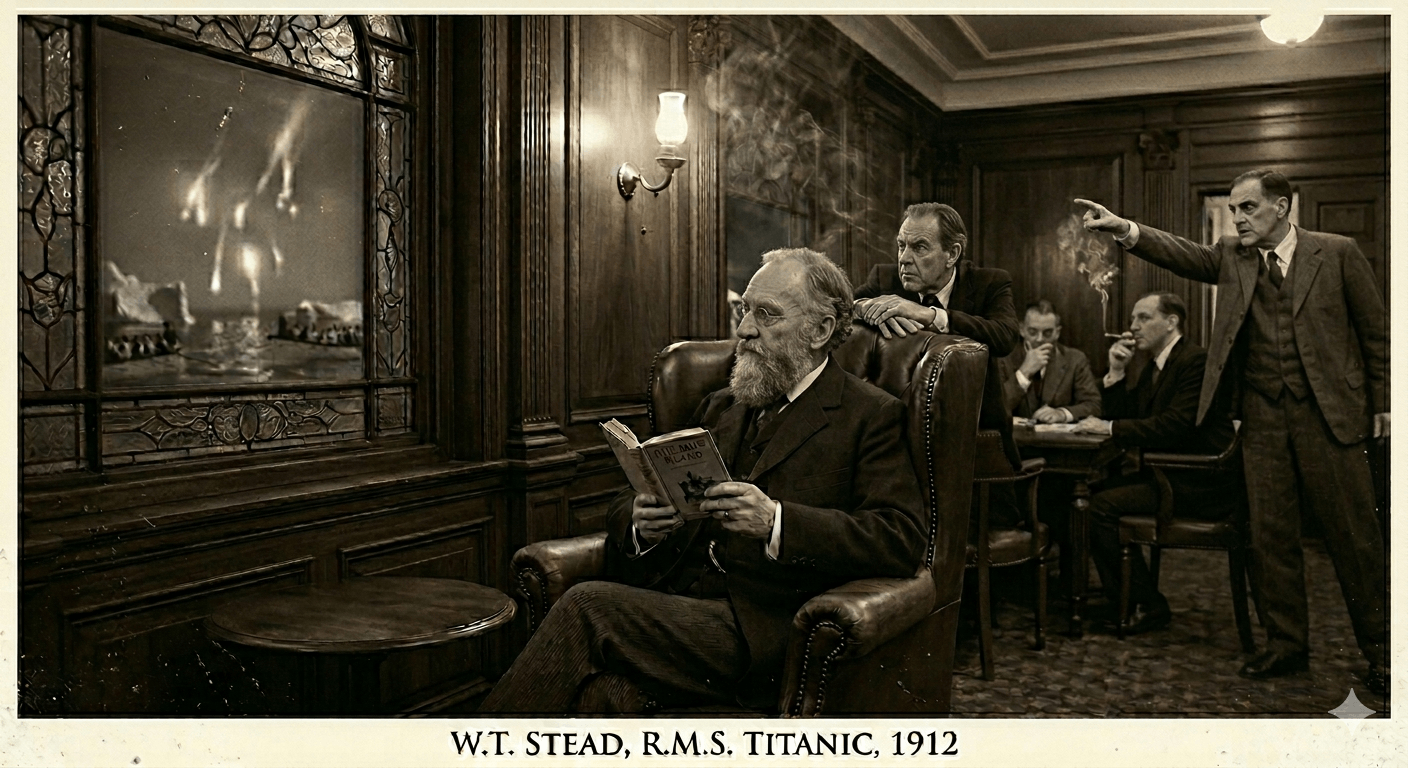
Was the Journalist W.T. Stead’s biggest story his dispatches from the afterlife?
William Thomas (W.T.) Stead was a pioneering Victorian-era journalist whose reporting on social issues earned him the reputation as the inventor of “New Journalism” in Britain. He was also one of the nearly 1,500 souls who perished when the Titanic struck an iceberg in the North Atlantic. But death would not stop his reporting.
On the night of April 14, 1912, Stead was on his way to speak at a peace congress at Carnegie Hall when the Titanic sunk. Survivors reported seeing Stead help women and children into lifeboats. Then, according to witnesses, he retreated to the First-Class smoking room. He was last seen sitting in a chair and reading a book. He made no further attempt to save himself, stoically accepting his fate.
It’s not the last time we would hear from W.T. Stead.
First, some background: In the final years of his life, Stead had become a devoted “spiritualist.” He believed the dead could communicate with the living through a process known as automatic writing—messages channeled to mediums while in a trance-like state. Stead himself was no stranger to the practice, having purportedly received dispatches from a dear departed friend.
Stead’s daughter, Estelle, a prominent Shakespearean actress in England, was also a spiritualist. While on tour in April 1912, she was approached by a friend and medium with a startling revelation. The medium informed her that her father had died at sea and made contact from the other side. It was the first of many occasions over the years when W.T. would communicate through the medium, sending a series of detailed observations about life after death.
Stead’s dispatches were published in a book titled The Blue Island.
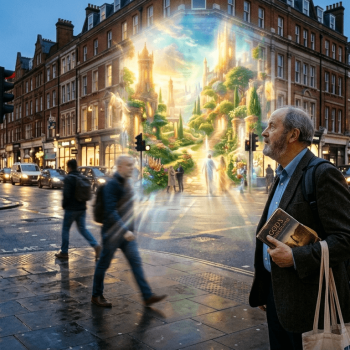
What Stead described wasn’t a realm of angelic harps and puffy white clouds, but a well-kept, blue-tinted island that bore a resemblance to the England he knew. More startling was the fact that his dispatches mirror, with eerie precision, the Near-Death Experience (NDE) stories we hear today, 100 years later.
In the book, Stead starts by recounting his experience of dying during the disaster and his subsequent arrival in the afterlife. As the sinking of the Titanic unfolded, he found the scene “indescribably pathetic,” some not even realizing they were dead. In his words:
Many, knowing what had occurred, were in agony of doubt as to their people left behind and as to their own future state. What would it hold for them? Would they be taken to see Him? What would their sentence be? Many, realizing their death had come, were enraged at their own powerlessness to save their valuables. They fought to save what they had on earth prized so much.
Stead found that upon his death, he was no longer floating in icy waters—but was in fact standing on top of the water. Moments later he went on a strange and “curious journey,” explaining:
We seemed to rise vertically into the air at terrific speed. I cannot tell how long our journey lasted, nor how far from the earth we were when we arrived, but it was a gloriously beautiful arrival. It was all lightness, brightness. Everything as physical and quite material in every way as the world we had just finished with.
Stead had arrived at a place he called the “Blue Island.”
He described it as a sort of transition zone or “arrival station” for souls who had recently left earth. It was a place where the newly deceased could recover from the shock of death and begin to understand their new environment. While he doesn’t mention water, Stead believed he was on an island, one with a distinctive blue tint.
He soon discovered the Blue Island was a temporary residence, “a land for acclimatizing the newcomer” with its chief purpose being “to get rid of unhappiness at parting from earth.” From there, you had the ability to travel to other places, though Stead says he “can and will return to the blue island, to meet newly arrived friends and associates.”
Stead’s account mirrors other NDE reports.
What’s fascinating is that Stead’s first-hand account, from a book very few people know about or have read, contains several anecdotes that parallel modern day NDE reports. For instance, Stead finds that his new environment is preferable over earth, noting that “the earth is only a reflection of this world,” a pale substitute. Like many who catch a glimpse of the afterlife, once he arrived, he had no desire to return home.
Unlike those who experience real life near-death experiences, Stead never did return home. But his dispatches, which stopped after a few years, shared many common themes with those who later lived to tell their tales. Six of those examples follow. Stead’s exact words are in italics and are lightly edited for clarity.
Dispatch #1: In some ways, death is not different from life.
I found myself in company with two old friends, one of them my father. He came to be with me, to help and generally show me around. There was nothing else so much as merely arriving in a foreign country and having a chum to go around with.
Upon his arrival, Stead finds himself greeted by people he knows. In most NDE reports, these include departed family members and friends. He wrote that “Death is only the doorway from one room to another, and both rooms are very similarly furnished and arranged.” Stead visited parks and stopped in buildings that reminded him of those found on earth.
Dispatch #2: You will appear as you did in the prime of your life.
My father and I, with my friend also, met up immediately. My father was considerably more active and younger than he was at the time of death. We looked more like brothers.
My cousin has glimpsed the other side and remarked that her father, who lived to age 90, appeared to her as he did in his 30s, healthy and vibrant. Yet while the dead appear physically different, they carry with them the same personal characteristics. As Stead points out, your personality stays the same, saying “As you are, so you will be when you come here.”
Dispatch #3: You will face a life review.
When you come to this land, your whole record has to be dealt with. Not by a judge and wig and gown pick, but by our own spirit self. The full and clear remembrance of your life occurs, and you are brought into a state of happiness or unhappiness, satisfaction or despair, depending on the life you lived on earth.
There’s no hiding from your record on earth—and frequent NDE reports say that you serve as both your judge and jury of your character while on earth. Your life review seems to go by in a flash. Every fleeting thought, secret kindness, and hidden resentment are suddenly compiled into a single, unchangeable record. Stead continues:
Your record contains everything. There is nothing overlooked. Each person is then interviewed by an advanced spirit being, with a minute analysis of all events, acts and thoughts of our lives. There is a sum to be paid for our thoughtlessness and our unkind acts and words.
Our every action, thought, and intention creates a permanent “record” or vibration. The “advanced spirit being” may be a kindly angel or a wise old sage, but they are there merely as guides. One recent report suggests that the guides are there to help you determine your next step, either returning to earth or continuing on in the afterlife.
Dispatch #4. You will be there to learn.
At a certain point the spirit desires knowledge and enlightenment he is drawn to the organization or house dealing with the subject in which he desires knowledge. When finished with one house, you can move to another and another. It is not compulsory information but information you want.
Stead refers to earth as “a training school,” a place for basic studies where our true purpose is the development of our character. Learning doesn’t end at death; it’s actually just the beginning. After your rest period is over, you can enter higher realms dedicated to disciplines like music, science, and philosophy, or whatever subject resonates with you. For Stead, it must have been the ultimate journalistic assignment, as he now had access to an infinite library of knowledge.
Dispatch #5. Love will dictate who you are with and what happens next.
The governing force is love. When you come through death, you are attracted by the ties of love to the set of people who vibrate the same affection. Thoughts are communicated from one mind to another without the need of vocal expression, although we can talk in an earthly manner at will.
It always comes down to love, doesn’t it? Stead believed that love acted as a magnetic force. Your internal vibrations of love would bring you together with the people you were meant to be with. Nowhere is this truer than in the afterlife.
Dispatch #6. Some have the option of returning to earth.
If your record has qualified to the point of allowing it, you will be given the choice of returning to earth again. Reincarnating. If your record does not qualify for choice in this matter, you will be directed either to return or to continue, according to what the teachers consider will afford you the most opportunity to recreate and cleanse yourself in the necessary way.
Only those who have reached a certain level of self-awareness and wisdom are granted the choice to return. This implies that our current life is essentially an audition for what happens next. The more we “master” our character here, the more freedom we have in the next phase of life.
Ultimately, Stead’s dispatches serve as a profound reminder: We determine our own future. Every act of kindness and moment of self-reflection is an investment in our soul’s next adventure. It helps ensure that when we reach “the Blue Island,” we’ll be ready for what comes next, looking forward with anticipation instead of backward with regret.












 Ad-Free & Subscriber Log-In