

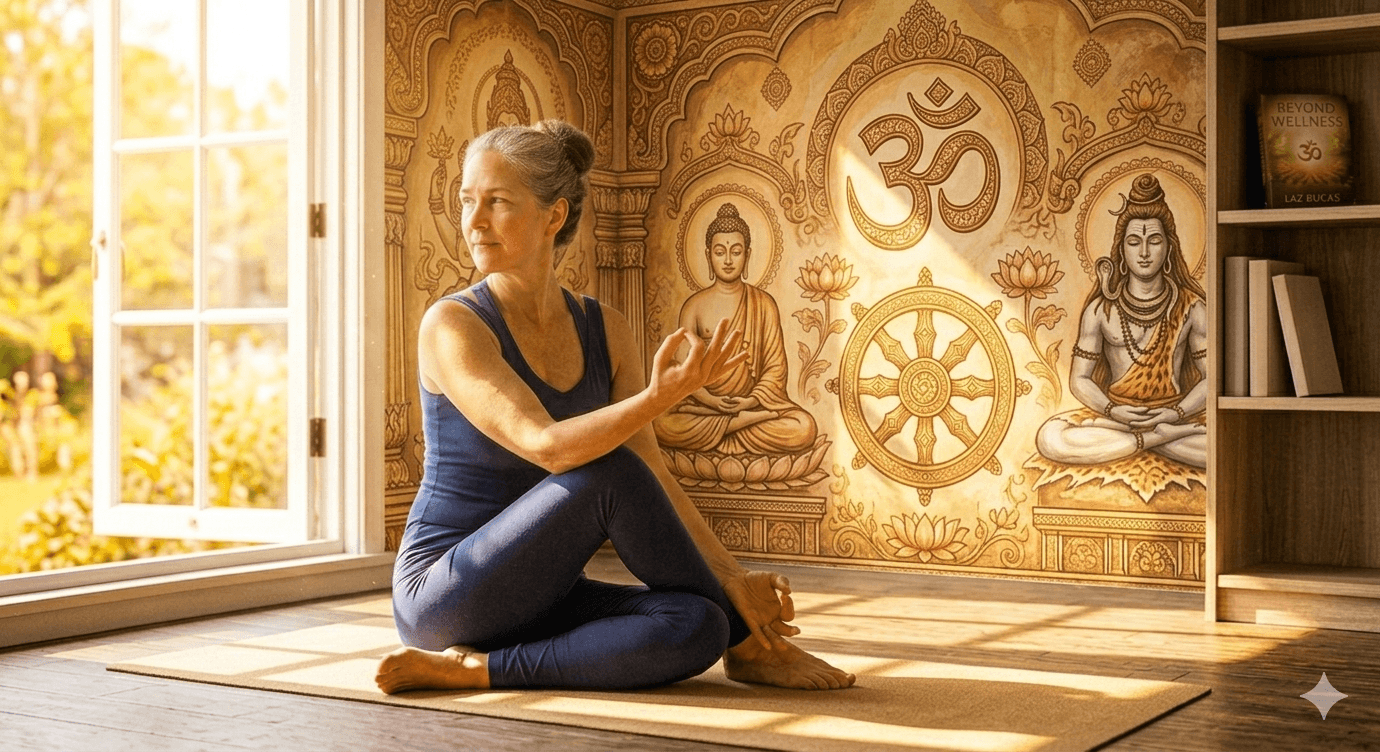
Finding God and Religion in Unexpected Places
What defines your spiritual practice? Whether it’s yoga, meditation, or a thrice-weekly exercise class that offers the same spiritual nourishment as going to church, Liz Bucar suggests you might be missing the full experience. In her view, the real power lies in uncovering the religious roots embedded in our modern routines.
Bucar is the woman behind one of my favorite spirituality blogs Religion Reimagined. In her new book Beyond Wellness, she points out that most of the spiritual practices we engage in have their roots in religion. When we’re able to reconnect our spiritual practices to these roots, it can help them become “more meaningful, more responsible, and more effective.”
For example, the modern yoga we know in the West is based on hatha yoga. It’s part of an ancient Hindu system of religious observance and meditation. Other forms include raja yoga, where the goal is self-understanding and spiritual purification. But Bucar finds the yoga we practice today in the U.S. has often been stripped of its religious framework and become merely a health and wellness practice.
Likewise, meditation and mindfulness are now used for “self-optimization,” ignoring their religious roots which are based in Buddhism. While Bucar calls mindfulness “undoubtedly the most widespread spiritual wellness practice in the United States,” we may not realize it is part of a group of Buddhism practices known as “the noble eightfold path.”
Bucar also finds religion in unexpected places: like AA.
I’ve never been to an Alcoholics Anonymous (AA) meeting and can’t say I know anyone who has. (Not that I don’t have my own relationship with drinking.) So, it surprised me a few years ago when I first learned about the group’s Christian underpinnings and wrote about in a story titled How AA Changed the Way We See God.
You’ve probably heard of the 12 steps of AA. What you may not know is that fully six of the twelve steps make a reference to God. They include recognizing “a power greater than ourselves that can restore us to sanity” and can “remove all defects of character.” The scripture according to AA states that through prayer and meditation, we can improve our conscious contact with God “as we understand him.”
That last phrase is key because AA does not preach a specific dogma or religious approach. There are no clerics or rituals. One of the founders of AA, Eugene Exman, stated that “God is not primarily a theological concept but a power in time of need.” He believed that “true religion is open rather than closed, broad rather than narrow, empathetic rather than judgmental.”
Bucar points out that a key concept behind AA is that “we must give up on the delusion that we’re in control,” thinking that we have all the answers. There is a greater source of guidance available to us and that source is “God”—if we can get the ego to accept the idea it’s in charge. She explains:
The first step of accepting a higher power is to recognize our own patterns of playing God. Because we all do it. Understanding that we are not God reduces our “main character energy” a bit, removes us from the center of the universe, and deflates our ego. It puts us in our place.
Could all our spiritual practices use a religious overlay?
Consider mindfulness. It’s often described as a simple state of awareness—the ability to be fully present from moment to moment, whether you’re eating breakfast, walking the dog, or grocery shopping. But staying in that state is harder than it sounds.
That’s why a formal meditation practice is vital. It serves as a training ground for the mind. The meditation expert and Waking Up host Sam Harris notes that without it, we spend our lives “carried away” by thought, almost never in the present moment. He explains, “Meditation becomes the tool that breaks that spell, allowing us to finally show up for our lives.”
It’s worth noting that Harris’s quote comes from his book Waking Up: A Guide to Spirituality Without Religion. In his view, meditation is a secular endeavor. He strips away the theology and dogma of the practice while keeping the insights at its core. For Harris, the practice isn’t about belief—it’s about the real benefits that come from paying attention to how your mind works and making adjustments as needed.
Is it okay to strip away the history behind a practice?
After all, you can listen to a deeply comforting guided meditation or experience the inner joy of a kick-ass hot yoga class, without knowing the history or lineage behind it. The same can be said for a walk through the woods, where we may experience the awe of nature and sense the divine, without knowing the names of the trees or wildlife around us. All of these activities have real world benefits, that extend well after the practice is over, without knowing the story behind them.
Personally, I find the most compelling spiritual practices are more about feeling than knowing. If a practice calms your mind or touches your soul, does the history really matter? Maybe, maybe not. Perhaps, as Bucar suggests, if we’re willing to look past the surface and acknowledge the roots behind each practice, we might find that there are even deeper layers and benefits waiting to be uncovered.















 Ad-Free & Subscriber Log-In