

One of the biggest newsmakers this weekend has been the news about Tiger Woods and his latest accident due to a DUI. The golfer has a long history with the area I live in. He won his first Masters in 1997, about a mile from a rehabilitation hospital I was in after my accident.
He has also done a lot of community and golf-related projects in the city of Augusta, Georgia, as well. Although he is not from the community, he is both well-respected and admired by locals. I will never forget hearing the crowds cheering as he won his first Masters in 1997.

Unfortunately, the golfer is also notorious for his drinking and fast lifestyle. He has quickly fallen from grace over the years with some fans. It is another harsh reminder of what happens when we let earthly success and pride blind us to our foolish ways (Obadiah 1:3, 1 Corinthians 10:12). The golfer’s life has been riddled with bad experiences over the past 20 years since his father died:
- DUIs
- Marital affairs
- Fraud
- DUI-related accidents
Despite Tigers’ many flaws and failings, which we all have, the golf community and the fans alike have continued to show him grace. Unfortunately, like many conservatives, Tiger has failed to learn and practice the power of biblical grace (Jude 1:4). It should humble us all if we know how much we need God’s grace.
Grace is not a license to continue sinning or doing whatever we choose. Grace is an important part of the Christian and Jewish faiths (Isaiah 1:18, Ephesians 2:8-9).
What Is Grace
Grace is something we will all need at some point in life, and not just spiritually. Grace can be applied to other facets of life, especially relationships. Because, regardless of what many of us think, none of us is perfect, not even conservatives in the South.
Grace is defined as “God-given help or kindness: approval, favor.” Grace is a way of helping those who cannot help themselves. You don’t have to be spiritual to give or receive grace. Either way, Grace is not earned (Ephesians 2:8).

All relationships require grace in some form to survive because flawed humans will make mistakes, despite their religious beliefs. God’s people must be willing to show grace because God has shown us so much (Matthew 6:14-15).
That is by the Bible has a lot to say about grace (Acts 4:33, Hebrews 4:16, James 4:6). Grace is an integral part of the Christian faith, because without it none of us will go to heaven (Titus 3:5-7).
By God’s grace, we are saved to do good works (Galatians 5:6, Ephesians 2:8-10, 2 Timothy 1:9, 1 Peter 2:12, James 2:14-17). The apostles remembered their Jewish education about God’s grace and why we all need it.
Ḥēn
The Torah tells us that after the fall, God showed mankind grace by killing an animal and covering man with its skin (Genesis 3:21). God had already warned mankind not to eat of the tree of the knowledge of good and evil and the consequences (Genesis 2:16-17).
Mankind chose to listen to their foolish, evil hearts and to the lie of Satan (Genesis 3:1-6). Because of their disobedience, God decided to show them grace out of His love for them.
The Hebrew word in the Old Testament for Grace is ḥēn, and it can also mean “Favor, pleasant, or gracious,” depending upon the context it is used in.
Even after God freed Israel from bondage in Egypt, like Adam and Eve, they continued to disobey God and needed His grace (Deuteronomy 9:7, 2 Chronicles 36:15-16, 1 Kings 11:9-13, Psalm 106:6-7). That is why Judaism emphasizes showing grace to others:
- Living in covenant
- Gratitude and action
- Prayer
- Repentance
- Appreciating life
- Saying grace after meals
- Acts of kindness
- Forgiving
Jesus taught His followers that they needed grace and must give grace (Matthew 6:14-15, John 1:16-17). Our Lord emphasized mercy over might (Matthew 5:7; 9:13, Luke 6:36).

Jesus showed grace to those whom God’s people shunned or looked down upon (Matthew 9:10-13, Mark 2:15-17, Luke 19:1-10, John 4:1-42). Our Lord showed that grace trumps greatness every time.
He rebuked the religious leaders for not showing grace (Matthew 23:23). Our Rabbi even extended grace to those who rejected and wanted to kill Him (Matthew 5:44, Luke 23:34).
Palm Sunday
As I write this, millions of believers are preparing to start Holy Week by celebrating Palm Sunday. Palm Sunday is tragic to me.
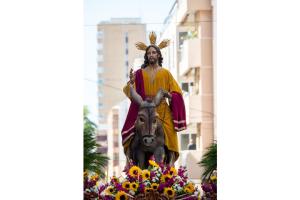
It has always amazed me how easily Jesus’ followers celebrated and worshiped Him on Palm Sunday, and five days later, many wanted Him dead because He didn’t do what they wanted their Messiah to do (Zachariah 9:9, John 12:14-16).
Sadly, God’s people became power-hungry and unloving like this fallen kingdom. No wonder Jesus declared His Kingdom is not of this world (John 18:36).
Jesus embodied grace on the cross, as God’s people revealed their worldly ways:
- Corrupt
- Unloving
- Violent
- Unforgiving
As we know 2000 years later, Jesus was the perfect man/sacrifice for humanity’s sins (Hebrews 10:10-14, 1 Peter 2:22-24). Jesus could have saved Himself and ruled this fallen kingdom, but He chose God’s way and plans over His own desires (Matthew 26:53, Luke 22:42).
Holy week isn’t holy because of God’s people or our traditions; it is holy because Jesus showed us what true holiness and greatness are. God’s people need to ask themselves if they want to be like the world or God; we cannot have it both ways (Matthew 6 19-24). That is why Palm Sunday shows us we all need God’s ḥēn!















 Ad-Free & Subscriber Log-In