


Part 2 of “Truth and Treason”
The real Karl-Heinz Schnibbe, not an actor, checked my temple recommend in the Salt Lake temple thirty years ago.
I had played Emma Huebener, the mother of Helmuth Huebener back in 1976 at a little theater–the Arena–on BYU campus. Written by Tom Rogers and directed by Ivan Crosland, “Huebener” became a BYU “moment.” Karl-Heinz, a co-conspirator along with Ruddi Wobbe, in Helmuth Huebner’s anti-Nazi resistance, attended every single performance. Before the cast took our bows, Karl-Heinz and Ruddi Wobbe stood on the stage, a spotlight shining on the empty spot where Helmuth should have been. He was beheaded as a traitor to Naziism in 1942.
I wonder what that was like for Wobbe and Schnibbe, to be remembered for their most heroic days–which surely did not feel heroic at the time. When they were captured and their families threatened, they had serious questions and even regrets. They asked their families to forgive them for bringing such trouble home.
Both Wobbe and Schnibbe spent years in prison camp–Schnibbe for twice as many years as Wobbe–and they certainly suffered trauma, which tends to echo throughout the rest of one’s life. In 1976, as we saw them lit up on the stage, glorious and exemplary, they became our personal heroes. Because of Alan Keele’s superb research and friendship with Schnibbe, we also know that his uncle described him as “a wild animal” after Karl-Heinz was released from the prison camp. The uncle took him to an organ concert, after which Schnibbe wept and wept. The music moved him, started melting his heart. In 1942, an organ had been audible when Karl-Heinz sat in his cell contemplating the sentences they had just received. He mused:
On the first Sunday after the trial I was lying in my cell, waiting to be transported. The cell was approximately thirty meters away from the prison chapel. Suddenly I heard the organ playing.» I began to cry, sobbing without stopping for hours. I was racked with guilt: “Helmuth must die and we get to live.” I wrote a letter to my parents in which I asked their forgiveness for having brought so much grief and sorrow to them. Many years later, organ music again caused a flood of tears and helped me to wash away all the pain and guilt of my ordeal.
Karl-Heinz Schnibbe had come face to face with the monsters we human beings can become, and knew that he, too, could become monstrous–a “wild animal.”
When his name was announced after our performances, it was cathartic for us all. The audience always stood before this invincible man and his companion, Rudi Wobbe (who attended the show three times). The very things which had ushered him into the tortures of prison and all its implications were now the evidence of his heroism.
During WWII, Schnibbe’s name had been spoken as an accusation. When the gestapo showed their badges at his door in 1942, their questions were weighted with possibilities. “Are you Karl-Heinz Schnibbe?” (The details of his arrest and subsequent imprisonment are found in Keele’s _When Truth was Treason_, available on the internet.) He answered, “Yes, I am,” and then was instructed simply, “Come with us.”
In the temple, he was dressed in white (as all temple patrons and workers are): white shirt, white jacket, white shoes, white tie. I am sure that he had seen some of the things I saw as a temple worker–people collapsing into tears in the Celestial Room, revealing some grief or pain nobody had suspected; people with desperate expressions, yearning for some answer to a tragedy, some assurance that it all meant something. As patrons filed up to Karl-Heinz Schnibbe, they certainly wouldn’t have guessed what pain he had known.
Karl-Heinz did his job at the desk in the temple, glancing at the signatures on my recommend, and smiled, signaling that I could proceed. I saw his name tag: Karl Heinz Schnibbe, and said, “I remember you. I played Emma Huebener in the play at BYU.”
He stared at me. “You played her?”
I nodded.
“Well,” he answered, “we all get older.”
Ouch, and true. I had performed in that play twenty years earlier. Since then, I had gotten married, had a baby, gotten divorced, and had three more babies. Apparently, I didn’t look like a college student anymore. I looked like a mom. And today, three days after seeing Truth and Treason, the story of these three co-conspirators, I look like a grandma, and happily claim the descriptor. One of my grandsons, Oliver, is now seventeen–the age Huebener was when he was beheaded after a verdict declared him to have the intelligence of a much older man. His youth would win him no mercy.
Karl-Heinz, newly remarried in 1976, spoke German to me after our performances. We cast members had used German accents, but I spoke no German, so I would have to remind him that I was merely ACTING like I did. It wasn’t real. He called me “Mutter Huebener.” I was happy to be her proxy for the run of the play.
Today, we don’t know who the heroes will be as we go through our various activities and debacles. We are in a moment now when heroes and villains are setting their trajectories, though neither we nor they can predict where their journey will end nor what names will be called at the finish line.

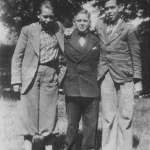
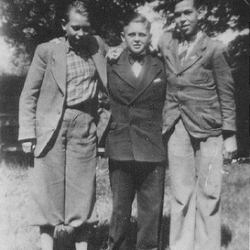
anti-Nazi “conspirators”, Wobbe, Schnibbe, Huebener








 Ad-Free & Subscriber Log-In