

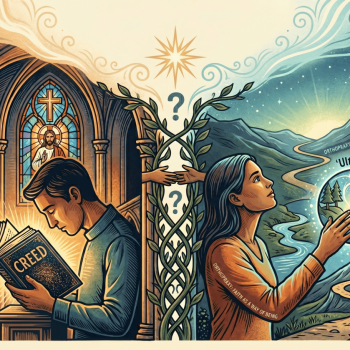
Today, fewer people believe in virgin births and physical resurrections, which were common beliefs in many ancient religions. And many of us believe different things about the nature of God. So, if (or when) we find that our beliefs conflict with our reality, do we change our beliefs to conform to our reality? Changing our minds, when warranted, is a good thing. NOT a bad thing.

Recently, I appeared as a guest on the “Funny You Say That” podcast with my good friend, Skeptical Scott. I have done several podcasts, and this was one of the best ones. Scott was engaging, and we had an interesting conversation that touched on many of the themes in my writing.
When I began to explore Christianity, I expected to confirm everything that I was taught as a child. As I told Scott, “There are 2 billion believers, the religion is 2000 years old, there’s a book… What could go wrong?” Soon, I realized that Christianity is not as absolute, authentic, original, rational, unchanging or universal as I had assumed.
Near the end of our conversation, Scott used the phrase “Believe responsibly,” which inspired this column. What does it mean to believe responsibly?
Fewer People Believe in Virgin Births and Physical Resurrections
Today, fewer people believe in virgin births and physical resurrections, which were common beliefs in many ancient religions. And many of us believe different things about the nature of God.
Christian philosopher Paul Tillich describes God as the “ground of being,” rather than a being. The Eastern religions describe an Ultimate Reality that interpenetrates everyone and everything. The mystics describe encounters with an impersonal force or presence, NOT a person. And science confirms that the physical universe is an interconnected field, NOT a bunch of discrete objects.
In The Way, I asked, “If Jesus was not born of a virgin, if he was not divine, if he was not resurrected, would the wisdom of his words and the power of his works lose their allure, or would we follow a historical Jesus as gladly as we follow a mythological Jesus?”
If the beginning of the Universe, the beginning of life, and the emergence of sentience all occurred naturally, would the amazing complexity and diversity and interconnectedness of the Universe be any less astonishing? Would we be any less grateful for an amazing world of natural, rather than supernatural, origin?
If all belief is speculation, and if we cannot know about the nature of God or the origins of the Universe, is it helpful to hold unambiguous (and unverified) beliefs about these kinds of questions? Or is the point of the human experience to manifest awe, gratitude, reverence and a sense of responsibility for Ultimate Reality and the Universe, no matter its nature or its origin?
Admit that We Don’t Know, and Change Our Minds, When Warranted
If we write down all that we “know” about God, we produce a blank piece of paper. We know nothing about God, including whether God exists. Barbara Brown Taylor, an Episcopal priest, asks, “What does any of us mean when we say ‘God’? We use the word as if it were made of steel instead of silk netting.”
All religion is cultural. Barren desert cultures are monotheistic, and fertile forest cultures are polytheistic. Hunter-gatherer cultures are patriarchal and shamanic, and agricultural cultures are matriarchal and communal. Patriarchal cultures worship male gods, and matriarchal cultures worship female gods.
All theology is speculation. No one can prove that God exists, that God is a person (or three persons), that God is intentional or that God watches over us. And no one can disprove any of that. Also, no one can prove that we have selves or souls or free will. We are products of conditioning and culture and chance. We perform functions like breathing and digesting without thinking about it.
Some anthropologists believe that humans create God in their own image, NOT vice versa. So, in The Way, I say, “Those who think that we are the culmination of creation or that we were singularly created in God’s image should take a longer view—only 50,000 years ago, homo sapiens were climbing trees for food, communicating in grunts, and coupling with Neanderthals.”
Last week, an astute commenter cited the Christian Bible as an authoritative, objective source. Maybe, I replied, but the Bible is NOT authoritative for 70% of the people in the world. In addition, whether we cite the Bible or the Koran or the Heart Sutra or the Tao Te Ching or the Upanishads, our choice of which authority to recognize is a subjective judgment, NOT a divine decree.
So if we find that our beliefs conflict with our reality, do we change our beliefs to conform to our reality? Changing our minds, when warranted, is a good thing. NOT a bad thing.
Do the Homework
I do NOT know anyone who has ever explored the great sacred and secular traditions and concluded that their own tradition is absolutely and uniquely true. Rather, the compassion of Christianity, the devotion of Islam, the intellectual rigor of Judaism, the earthy practicality of Buddhism, and the rich vocabulary of Hinduism are compelling to those who explore other traditions.
Religions are like languages, describing the same indescribable Ultimate Reality in different ways.
Most Christians rely on what our clergy and family told us, without questioning and without realizing that their clergy and family relied on what their clergy and family told them. Perhaps, for starters, we could spend a few minutes with Encyclopedia Britannica or Google or Wikipedia, and explore the origins and interpretations of fundamental Christian doctrine:
Christianity borrowed from the mythologies of the Greeks, the Romans, and others.
Christianity borrowed from Judaism and other religions.
The church was unstructured for the first 300 years of its history.
The writers of the Bible and other earliest writings reflect different theologies.
Many accounts changed between the first gospel and the last gospel.
Many doctrines were developed long after Jesus’ death.
Did you know that Mark, the first gospel, did NOT contain a virgin birth or any post-resurrection appearances? Did you know that eyewitnesses almost certainly did NOT write the gospels? Also, did you know that James led the Jewish Christian community for 30 years? Did you know that the doctrines of the Trinity, original sin, and substitutionary atonement are NOT biblical?
To succeed in any endeavor, we need to do the homework and test our assumptions, to adapt to newfound knowledge and recent experience. Can you imagine any other endeavor (such as business or law or medicine) that continues to rely on the findings of a fourth-century council convened by a Roman Emperor and attended by 300 Catholic bishops?
Think Critically, with Curiosity and Skepticism
There are 45,000 Christian denominations with different beliefs. This does NOT mean that Christian truth claims are untrue, only that they are largely unresolved and largely unsubstantiated.
Christianity benefited from 2,000 years of enthusiastic and (sometimes) violent evangelization. Today, we know much more about history, mythology, philosophy and science than we once knew. Consider Jesus, the later Gospel writers or the much later theologians. Would they have said all of the same things if they knew then what we know now?
Imagine that Christianity was lost to the ages, like so many other ancient religions. If our beliefs were not embedded in our culture for the last 2,000 years, would we accept at face value that Jesus was divine, that he was born of a virgin, and that he was resurrected from the dead, or would we conclude that Jesus was one of many ancient holy men who became mythologized?
During my conversation with Skeptical Scott, Scott pointed out that “skeptics” are NOT nay-sayers. They are critical thinkers. I wrote about my conversations with atheist Richard Dawkins here. And I wrote, “It seems to me that science involves a balance between imagination and wonder on one hand, and discipline and skepticism on the other.” In my opinion, spirituality does, too.
Today, fewer people believe in virgin births and physical resurrections, which were common beliefs in many ancient religions. And many of us believe different things about the nature of God. So, if (or when) we find that our beliefs conflict with our reality, do we change our beliefs to conform to our reality? Changing our minds, when warranted, is a good thing. NOT a bad thing.
If you want to keep up with the latest from You Might Be Right, please subscribe.
The Way received a 2024 Nautilus Book Award.
If you enjoyed this article, please leave a comment at the bottom of this page.
Thanks for reading You Might Be Right!!












 Ad-Free & Subscriber Log-In