

We try to balance our spiritual life and our spiritual practice. When we do that, we are really exploring how best to love our neighbors as ourselves, how best to be present to life.
I wrote about consciousness here. In the article, I quoted author Michael Pollan. Pollan wrote, “My time in the cave had shown me another way to look at consciousness: less as a scientific or philosophical puzzle to be solved and more as a practice, a way to once again be altogether here, present to life and to this vault of stars.”

Solving the Puzzle
Although Pollan and I agree that the essential part of the inquiry is how to be present to life, rather than how to solve the puzzle, his book and my article discuss various ways of solving the puzzle. That’s unavoidable, since how we are present to life depends on how we solve the puzzle.
I wrote about big questions here, suggesting that broad, universal questions, like “How did the Universe begin? How did life begin? How did sentience begin?” are more relevant to most people than narrow, theological questions like “Is the Bible the inspired word of God? Is Jesus God? Did Jesus die for our sins? Will we be tortured for eternity if we do not accept Jesus as our Savior?”
Several readers commented that even these broad, universal questions are NOT the most important, practical questions, like “How do we show up in the world? How do we treat our neighbors?” Of course, I agree. They are saying, as Pollan and I have said, that the essential part of the inquiry is how to be present to life, NOT how to solve the puzzle.
But how to be present to life is a much more difficult question than how to solve the puzzle. Imagine that I wrote articles about being a good person or loving our neighbors. Some people do that, and there is wisdom in much of their writing. Still, it can come across as simplistic, trite or vague when we encounter the ambiguities and uncertainties of everyday life.
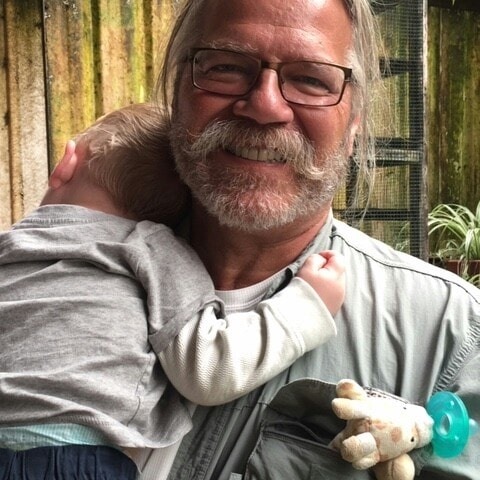
That’s unavoidable, too, since how we are present to life depends on our circumstances. For instance, I’m a married, middle-class, retired, straight, white grandfather who writes about spirituality. I certainly try to write for a diverse readership, but (unavoidably) my circumstances are NOT universal, and my ideas about being present to life can NOT be applied universally.
One advantage of faith deconstruction is experiencing freedom and realizing that we do NOT have to rely on anyone else, including religion, scripture or tradition, to find joy and meaning.
Spiritual Life and Spiritual Practice
I struggle with how to be “be altogether here, present to life.” My spirituality transformed me from a single-minded investment banker to an open-hearted and open-minded seeker. I cry more, and I laugh more. I have more joy and meaning in my life. And I have more friends and deeper friendships.
But do I present as a deeply spiritual person when I’m writing 50,000-word books every year and 1,000-word articles every week? Do I present as an open-hearted and open-minded person when I’m explaining myself to Facebook commenters, inquisitive readers or podcast hosts? What am I doing with all of these words if the universal language of spirituality is silence?
Mark Twain famously said, “I have never let my schooling interfere with my education.” Recently, I have been resolving not to let my spiritual practice interfere with my spiritual life. For example, I attended a week-long Zen retreat where I spent many hours every day, meditating on a cushion and studying koans with a teacher. Zen focuses on realizing our essential lack of separation.
At one point, I asked myself, “What would I be doing if I were not devoting a week to spiritual practice?” Well, I would be having lunch with my grandsons, participating in spiritual communities, talking to my elderly parents, visiting a friend in the hospital, volunteering as a tax preparer, and writing about spirituality.
Hmm, interesting. I asked myself, “Am I letting my spiritual practice interfere with my spiritual life? Am I altogether here, present to life, or have I taken myself out of circulation for this retreat? Am I more likely to realize our essential lack of separation by meditating for a week or by fully engaging in my everyday life?” These are challenging questions, and I do NOT have the answers.
The Bodhisattva Vows
We try to balance our spiritual life and our spiritual practice.
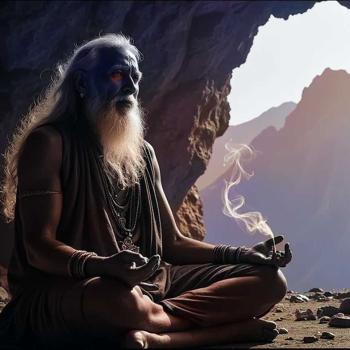
Sometimes, I talk about these questions of balancing spiritual life and spiritual practice with spiritual directors or Zen teachers. Often, they will remind me of the four vows of the bodhisattva. Mahayana traditions, like Zen, define a bodhisattva as someone who delays entering nirvana to help all other sentient beings escape suffering. In Zen, we regularly recite the four vows:
Sentient beings are numberless, I vow to free them;
Delusions are inexhaustible, I vow to end them;
The dharma gates are boundless, I vow to enter them;
The Enlightened Way is unsurpassable, I vow to embody it.
In the early years of my Zen practice, I thought that the four vows were hopelessly idealistic and practically unattainable. I still think so, but I realize that their actual attainability is NOT the point. The four vows involve balancing spiritual life and spiritual practice. As Buddhist teacher Jack Kornfield says, “Our highest happiness is connected with the well-being of others.”
Again, these are questions of balance. The “right” answer is usually NOT to abandon spiritual practice or to abandon spiritual life. Nor is it to focus only on our needs or only on others’ needs. Mindfulness is another tenet of Buddhist practice. When we focus on what is in front of us, we can discern the work that we need to do from the work that we do NOT need to do.
Often, I remind myself that our lives are marathons, not sprints, and that we each have unique roles to play. We can learn a lot from the bodhisattvas’ mindfulness and patience.
Balancing Spiritual Life and Spiritual Practice
Although the four vows express Buddhist concepts in Buddhist terms, they point to a more universal truth, much like the Golden Rule, which Jesus expressed as “Love your neighbor as yourself.” So, we try to balance our spiritual life and our spiritual practice. When we do that, we are really exploring how best to love our neighbors as ourselves, how best to be present to life.









 Ad-Free & Subscriber Log-In