
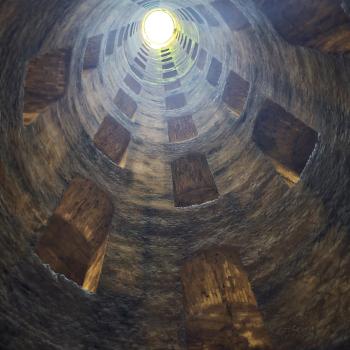
You may be familiar with stories about Popes in Rome (of course), or Popes in Avignon, or even Popes of a sort in Constantinople, but do you know the story about a Pope hanging out in Orvieto? Yes its true. The well, which in English called the well of St. Patrick (who knows why), was dug by Antonio da Sangallo, an architect and engineer from Florence who in 1527 was commissioned by Pope Clement VII after the sack of Rome,... Read more
There is a fair bit of statuary to see in Orvieto cathedral including this beautiful sculpture of St. John and the lion, right beneath the pulpit, because by tradition John’s Gospel was seen as the most heavenly, giving a birds eye view of the Gospel. Contrasting with the colorful scenes above the high altar, including the stained glass, at the back wall of the cathedral we see this– While this is not Michelangelo’s Pieta as found in St. Peter’s, it... Read more
If you found the detail on the outside of the cathedral mesmerizing, just wait until you see the inside. And we were fortunate enough to be inside during part of an organ recital of Widor’s Wonderful Toccata. I was moved to tears– as it was played at our daughter Christy’s funeral. The area around the high altar and the rose window can give you a permanent crick in your neck from staring up. Read more
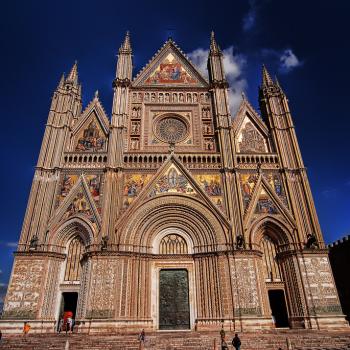
You could spend hours just studying what’s on the front of Orvieto’s cathedral. Here are a few close ups… Read more
There is a reason why the resurrection chapel to the right of the main altar and aisle has scenes that look strikingly like those in the Sistine Chapel. That’s because the one was modelled on the other. Luca Signorelli did these incredible paintings, and Michelangelo is said to have borrowed some of these images and copied them in the Sistine chapel (and in any case Signorelli himself had done a now lost section of the fresco in the Sistine Chapel. ... Read more
Certainly one of my very favorite places to visit in Italy is the hilltop town in Umbria, known as Orvieto which has one the most spectacular cathedrals anywhere in the world. This post will focus on the cathedral itself. Notice in the picture above the bronze (now green in color), just like the bronze doors on St. Peter’s basilica in Rome. Here you see on the side of the cathedral why it has been called the zebra cathedral– the black... Read more
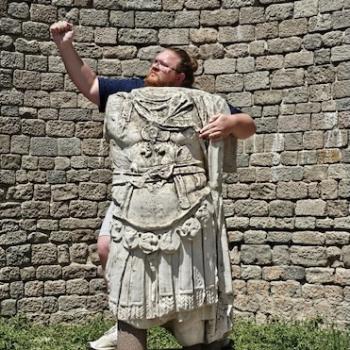
Apart from the bird stele above, it is not clear to me that any of this is grave art. It is more like permanent advertisements for the animal contests in the Roman arenas in which gladiators would fight animals in various places in the Empire, including in the province of Asia where these steles were found. The last one is probably meant to be Asclepius, since that is his symbol in the right part of the stone. Read more
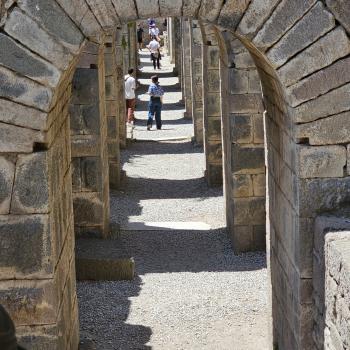
There were three sorts of stones referred to in the Bible that were of significance— a cornerstone, which in antiquity was not some showy thing at the corner of a building with the name of donors on it, or the founding date of the building. A second sort was ‘the head of the corner’ which was an L shaped stone which joined togerther two walls at the top, keeping them together and solid at the top. Finally there were keystones... Read more
The discussion of how this archaeological project came about is in itself worth studying. Here is a chart outside the slope houses chronicling things. Surprisingly, there is a high vaulted meeting or dining room on the ground floor of these apartments as seen above, which set this set of apartments apart from any other set from antiquity that I know of. Were these residents such snobs that they couldn’t be bothered to go out to dine or have public meetings?... Read more

Select your answer to see how you score.








 Ad-Free & Subscriber Log-In