2017-11-08T12:58:04-05:00

Ben. Let’s talk about the misunderstandings by the New Perspective on Paul advocates of the Reformers. The flash point seems to be justification, with various readers thinking Luther and Calvin had a forensic view of justification, involving perhaps a legal fiction. Why is this view wrong, and what is wrong with it? Is this just later misinterpretations of the Reformers predicated of them in some cases by their latter day advocates? Or is it only partially wrong? You seem to... Read more

2017-11-08T12:53:52-05:00

Ben. I would maintain that the phrase ‘the righteousness of God’ which is a major theme from the outset of Rom. 1 has to do with ‘the righteousness of God’, his character. This is made very clear from the next argument in Rom. 1.18-32 where one expression of the righteousness of God is his ‘orge’ against sin now revealed in the world. It does not have to do with ‘covenant faithfulness’ nor does it have a direct connection with ‘the... Read more

2017-11-08T12:48:23-05:00

Ben. It is a great irony to me that those who most trumpet covenantal theology don’t seem to understand either the ANE ways of looking at covenants, much less the early Jewish ones. And what I mean by this is that in that world when a sovereign made a treaty or a covenant, and the people broke it, the sovereign was not obligated any longer to keep that covenant. He could end the relationship, he could invoke the curse sanctions... Read more

2017-11-08T12:44:12-05:00

Ben. Both Melanchthon and Calvin in their Romans commentaries rely on rhetorical analysis of the structure of the letter. How important do you think understanding their use of rhetoric is to understanding their theological observations on things like justification? Stephen. There are some interesting differences between Melanchthon and Calvin in their rhetorical analysis, but there is no doubt that for each there is a relationship between it and their theological observations. Calvin’s analysis is simpler and has had the greater... Read more

2017-11-08T12:39:40-05:00

Ben. Perhaps it is just my not understanding your language, but at various points in Part One, you talk about ‘the Holy Spirit speaking through’ Paul or others. And, for instance, on p. 34 you say “the main event is thus not Paul’s thoughts as such, but rather what the Holy Spirit has said through Paul. The goal of theological interpretation of Scripture is to explicate that speaking of the Spirit.” It seems to me that the Spirit speaks ‘in’... Read more

2017-11-08T12:35:52-05:00

Ben. I took Romans with Stendahl at Harvard. What I’ve often wondered, since he was of Scandavian extract, is whether he read Paul through Kierkegaard, hence the Introspective Conscience stuff—- What do you think? Stephen. I confess I don’t know enough about Kierkegaard to be able to answer this question. I do know, however, what I believe is the fundamental problem with Stendahl’s focus on the introspective conscience. He claims that Luther’s struggles with his conscience have been projected back... Read more

2017-11-08T12:33:05-05:00

Ben: Full disclosure at the outset, I’m not persuaded by some of the major tenants of either Luther or Calvin about some of these things, but rather am a child of the Wesleys and the English revival of the 18th century. Nevertheless, I’ve spent a good deal of time in Luther and Calvin both at GCTS, and then I did Calvin and Luther with T.H.L. Parker at Durham when I was there. So’ I’m familiar with a good deal of... Read more

2017-11-08T12:26:49-05:00

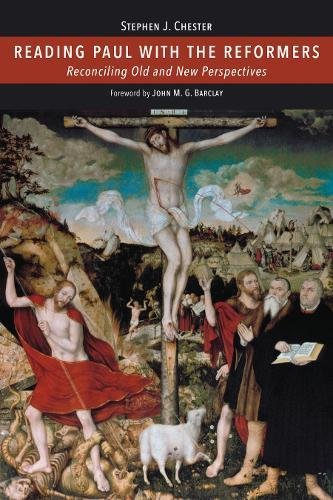
Certainly one of the best books of the year that deals with both the New Testament and Protestant Reformation theology is Stephen Chester’s excellent study— Reading Paul with the Reformers, (Eerdmans, 2017, 500 pages). What is especially impressive about this study is that Chester is equally skilled in two different disciplines. He’s no one trick pony. This post begins a dialogue that will carry on through the rest of this month. Enjoy— BW3 —- Ben: First of all thanks Stephen... Read more

2017-11-08T12:18:29-05:00

Some have viewed God as having to forfeit his righteous demands in order to be able to forgive. Nothing could be further from the truth. It is precisely because God will always do what he has promised and at the same time do and be what is right that he forgives. C.H. Dodd puts it quite eloquently: God’s attitude to us, His purposes for us, do not alter because we sin against Him. When we turn to Him again, we... Read more

2017-10-27T16:18:30-04:00

Just in case you forgot who won the National Championship last year and barely missed out winning two years ago as well—- Ram On! Read more

Follow Us!


TAKE THE
Religious Wisdom Quiz

In the Parable of the Ten Virgins, what were the wise ones prepared for?

Select your answer to see how you score.


Browse Our Archives