2015-03-13T22:52:10-04:00

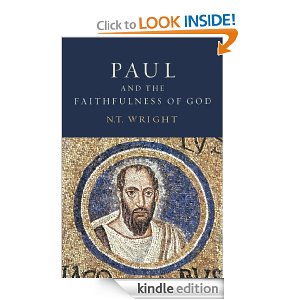
In Tom’s schema (see p. 1181) Rom. 9.6-29 is seen as parallel in the chiasm to 11.1-32, and so he enumerates several themes found in both sections—both focus on the patriarchs and the promises made to them, both focus on the call and mercy of God, neither being dependent on works, both focus on the patience of God but also his hardening of people. And he adds, both use the term Israel in more than one way. This latter point... Read more

2015-03-13T22:52:10-04:00

On any showing, Romans 10.4 is a crucial verse for understanding Paul’s thought world. The discussion on p. 1172 deserves a close look. Tom takes the verse is a rather narratological way– namely that Christ is the goal, the final destination of Torah, by which he means “This is where the narrative had been heading all along. Through the Messiah the prophecies have come true, the covenant has been re-established, exile is over, God himself has acted to unveil his... Read more

2015-03-13T22:52:10-04:00

On pp. 1166ff. Tom is arguing that in Rom. 10.9-13 we have the fullest and perhaps clearest most concentrated description of what reformulated monotheism, election, eschatology looks like to Paul. “It is all hear…the faithfulness of God, the work of the Messiah as the ground and basis for it all; belief in God’s raising of Jesus as the tell tale signal that precipitates the divine verdict ‘righteous’; and the confession of Jesus is Lord as the public, outward behaviour (signalling... Read more

2015-03-13T22:52:11-04:00

Tom does not tarry long over the controversial text in 1 Thess. 2.14-16. I have treated it at length in my Thessalonians commentary, and will not rehearse that here. Tom, I think, is right to conclude: 1) this is not a later interpolation; 2) it is not an anti-Semitic swipe at any and all Jews; 3) probably the term ‘Judaea’ in this case provides the clue that Judaioi here has a more restricted and geographical sense, namely Judeans, and not... Read more

2015-03-13T22:52:11-04:00

By way of reminder, the three gi-normous chapters in Tom’s magnum opus, that carry most of the freight of his argument focus on: 1) monotheism redefined; 2) election/ecclesiology redone; and 3) eschatology freshly re-envisioned. We are in the midst of working through the last of these three major subsections of the study, and we will be covering the discussion in pp. 1128-51 in this post. A good deal of this material has been already covered in earlier chapters (particularly in... Read more

2015-03-13T22:52:11-04:00

As Tom eloquently expresses it, the ethics of Paul is an eschatological ethic, that involves both the already and not yet of things. “The people who are called to stand at the crossroads of time, the strange interval between the now and the not yet, the present and the future, are also called to stand at the intersection of heaven and earth, sharing the pains and puzzles of the present creation, but sharing also in the newly inaugurated life of... Read more

2015-03-13T22:52:11-04:00

On p. 1095 Tom begins his discussion of two important topics when it comes to eschatology— ethics and ethnics, as he puts it, the latter having to do with the future of Israel. I think he is right that Paul is the first Jewish Christian to have to think through what these categories would look like between the time when Messiah first came and his return. Jesus, for example, says nothing about how Gentiles would fit into the people of... Read more

2015-03-13T22:52:12-04:00

Perhaps you thought I had forgotten about finishing the review of Tom’s Magnum Opus. You would be wrong. I just needed a break from wrestling with Leviathan. Perhaps you did as well. But this time we intend to haul in the rest of Moby Dick. You may remember that we left things, at the end of May, with Tom’s discussion of eschatology and more specifically how Romans 2.1ff. fits into the larger scheme of things. We are picking things back... Read more

2015-03-13T22:52:12-04:00

On p. 120 Ron Osborn attempts a metaphor to explain post-foundational approaches— he says this “If we think of Christian beliefs and practices as the planks that make up a vessel (the church), we can imagine these planks being replaced one by one during a long voyage so that by the end of the journey the entire boat has been transformed into a new ship that is still, paradoxically, the same ship that left port.” He talks about the flexibility... Read more

2015-03-13T22:52:12-04:00

Some books can be swallowed quickly, others require slower eating, and some need to chewed very carefully (and sometimes one must carefully spit out the indigestible bits). Ronald Osborn’s book is one of the latter sort. It is an excellent read, even eloquent in places, and it does a very good job of raising a lot of the right questions about creation science, intelligent design, and Biblical interpretation in those approaches to Genesis 1-3. Osborn is a Seven Day Adventist,... Read more

Follow Us!


TAKE THE
Religious Wisdom Quiz

Who was the Roman emperor during Jesus’ birth?

Select your answer to see how you score.


Browse Our Archives