

This week reminds us how quickly physical and verbal violence can rule headlines and hearts. When tragedy strikes, it matters how we respond.

Whether it’s another campus shooting, an attack on a house of worship, or a high-profile murder, politicians, pundits, and pastors jump on their soapboxes to use headlines to push their agendas. In polarized times like these, even condolences can get twisted into contempt and point-scoring. After the killings of filmmaker Rob Reiner and his wife, Michele Singer Reiner, Trump took the opportunity to get in his usual narcissistic digs. And some conservative Christians took notice, realizing how un-Christlike such a response can be.
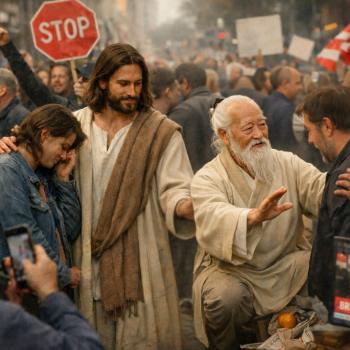
In my series, “Jesus & Lao Tzu,” I have been sitting down with these two spiritual giants to see where they agree and where they disagree. While they don’t resonate on all levels, they do join hands in an ancient warning that still shows its truth today: what we reach for in conflict—weapon or rhetoric—tends to come back.
Lao Tzu’s Tao Te Ching, Chapter 30
As a focus on divine presence shifts to domination and power, faithful people wonder about the consequences. Here, Christianity and Taoism dialogue about “necessary” force with an eye toward peace. Lao Tzu writes:
One who assists the ruler of men with the Way
does not use force of arms against all under heaven;
Such a course is likely to boomerang.
Where armies have been stationed, briars and brambles will grow.
A good general fulfills his purpose
and that is all.
He does not use force to seize for himself.
He fulfills his purpose, but is not proud;
He fulfills his purpose, but is not boastful;
He fulfills his purpose, but does not brag;
He fulfills his purpose only because he has no other choice.
This is called “fulfilling one’s purpose without using force.”
If something grows old while still in its prime,
This is called “not being in accord with the Way.”
Not being in accord with the Way leads to an early demise.
Nonviolence and Pacifism
Lao Tzu sets a standard for violence that falls short of pacifism yet does favor peace over destruction. Here many readers see Jesus embodying nonviolence as a way of being, while Lao Tzu allows force only when there is no other way. Both share the same goal of peace, yet Lao Tzu seems to follow Ecclesiastes’ observation that there is a time for war as well as a time for peace.
Boomerangs
Where Jesus and Lao Tzu agree is that violence has a way of boomeranging. The things we do in this world have repercussions. Call it “karma” if you will. Name it “the law of reciprocity,” if you prefer. “Sowing and reaping” sounds better to some. No matter how you label it, every great belief system shares the same concept: what we send into the world tends to return to us.
Jesus said that generosity returns in overflowing ways—and by the same measure you use. This is why he told people to practice the Golden Rule, treating others the way you want to be treated. Because he knew that you harvest what you plant, and you’re going to get what you give.
This applies to the good things we do for others. It also pertains to the harsh things that we do to others. Jesus said that those who choose the sword eventually get cut by it. So, if you’re going to follow the Way of Love, don’t use violence at all—or use it sparingly at most. (And if you want a quick gut-check for your words, too: if what you’re about to say treats someone’s suffering as fuel, it’s not the Way.)
This is why Taoist martial arts shun the use of brute force. Instead, they favor using the opponent’s inertia against the opponent. This way, the martial artist does not reap that karma upon herself. She simply deflects the blow and redirects the opponent’s energy. In this way, the opponent defeats himself. Taoist martial arts use force only as necessary and always seek peace first. Since violence is likely to boomerang, it’s best to avoid it altogether.
When Two Elephants Fight
Lao Tzu says, “Where armies have been stationed, briars and brambles will grow.” By this, he recognizes that violence not only does harm to one’s enemies but harms the earth as well. As the African proverb puts it, “When two elephants fight, it’s the grass that suffers.” News stories relate the devastating effects of landmines abandoned in fields, long after wars have ended. Science tells us of lingering radiation left by nuclear bombs, affecting people, wildlife, and landscapes for generations.
This is why Lao Tzu says, “A good general fulfills his purpose and that is all. He does not use force to seize for himself. He fulfills his purpose but is not proud; he fulfills his purpose, but is not boastful; He fulfills his purpose, but does not brag; he fulfills his purpose only because he has no other choice. This is called ‘fulfilling one’s purpose without using force.’” The military is an instrument of destruction. It should do its job just enough—but no more than necessary. It’s possible to fulfill your purpose too much. A general can do his job too well—with devastating results.
Never Glorify Violence
Followers of the Way must never glorify violence. They must never use it for gain or recognition. Lao Tzu’s good general who is not proud, boastful, or a braggart reminds the reader of Paul’s Way of Love that does not posture or swagger, keep score, or feed on harm. This is the kind of Love that endures. Simply put, Love does not love violence.
This is why Paul told his followers that, as far as it depended on them, they should live peacefully with all. Sometimes, conflict is unavoidable. Yet, as much as it depends on you, Jesus’s followers must conduct their conflict through the Way of Love. Not only does this apply to moments of physical violence—it applies to other aspects of conflict as well. The Way of Love is just as relevant in the boardroom as it is on the battlefield. Emails, meetings, budgets—each can either seed brambles or cultivate peace. (So can press conferences. So can posts.)
The Greater Threat Comes from Us
Lao Tzu writes, “If something grows old while still in its prime, this is called ‘not being in accord with the Way.’ Not being in accord with the Way leads to an early demise.” With these words, Lao Tzu cautions against being out of sync with the Tao. Too often, we become concerned about the threat of danger from external sources. Yet, the greater threat comes from us. The worst hazard is our tendency to get out of step with the Way. As a result, we grow old while we are still in our prime. We make ourselves vulnerable unnecessarily. The first step to winning any battle is avoiding conflict altogether. We do this when we learn to walk in harmony with the Way.
Pray…
O Gentle Way,
You teach us that love is stronger than hate,
peace is better than violence,
and that it is better to risk the grave than grip the sword.
For those who live by violence
will die by violence,
but beyond death lies resurrection.
You remind us to take the long view, and to remember
That briars and brambles grow today
where battles raged yesterday.
When we are tempted to violence of body or of spirit,
remind us that being in accord with the Way means recognizing
the sanctity of all life.
Therefore, Gentle Way,
while we live, let us live,
and promote life with each breath we take.
Amen.















 Ad-Free & Subscriber Log-In