


When Crisis Meets Courage: How New York Disaster Interfaith Services (NYDIS) Redeems Welcome Through Faith-Driven Migrant Support
In the concrete folds of New York City—where towers reflect ambition, and sidewalks echo hope—there is a story too seldom told: the story of how faith communities stepped in when the systems failed. One such story belongs to the faith-based coalition New York Disaster Interfaith Services (NYDIS). For decades, they’ve operated in the shadows of disasters—terror attacks, hurricanes, migration waves—showing up with a radical humility, faith in hand, and neighborhoods in their hearts.
The Stakes
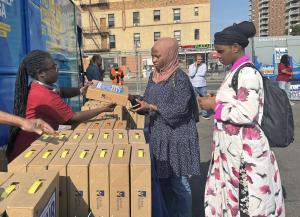
When the terrorist attacks of September 11, 2001, rocked New York, countless lives were shattered. Among the many consequences were immigrant families whose loved ones were detained or disappeared; lives spun offline. NYDIS emerged in that immediacy, not as a headline-grabber, but as a faith-driven responder building networks of support for communities too often invisible.
Fast forward to Hurricane Sandy, where they tirelessly served thousands of New Yorkers with aid and food and more recently the humanitarian challenge of tens of thousands of asylum-seekers arriving in NYC. In June 2023, the city announced a partnership: NYDIS coordinated a faith-based shelter program—up to 50 houses of worship offering shelter for 19 single adult men each, in faith spaces across the five boroughs.
The crisis was real: the city hosted more than 46,000 asylum-seekers, spending in the billions; yet federal support remained minimal. Into this gap stepped NYDIS, offering not only beds, but dignity; not only shelter, but spiritual and cultural care.
The Concrete Story of Impact
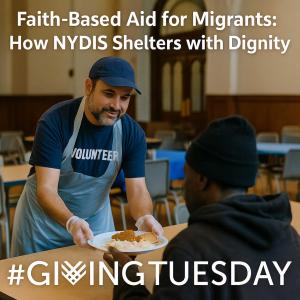
 Imagine a church in Brooklyn. At its heart, a prayer hall that mid-week becomes a shelter with halal meals, wudu (ablution) stations, quiet space to pray, multilingual intake forms, volunteers who know that to feed someone is also to say “you belong”. Volunteers who understood that a migrant carrying trauma doesn’t just need a bed—they need someone who sees their humanity. It is evidence that faith-based services aren’t only about charity—they are about capacity, coordination, and cultural competence. NYDIS provided Halal food, prayer space, and language access—these weren’t extras. They were safety nets for populations too often served by one-size-fits-all systems.
The Misunderstandings Journalists Keep Repeating
Misconception #1: “Faith organizations only respond in emergencies; they aren’t part of long-term infrastructure.” But NYDIS’s history shows otherwise—preparedness, recovery, planning.
Misconception #2: “Muslim or immigrant aid is only for the ingroup.” NYDIS’s model demonstrated inter-faith, immigrant-inclusive, culturally aware service.
Misconception #3: “Faith-based means ideology-first, service-second.” Actually, NYDIS leads in federally funded, city-backed programming, meaning they operate with rigorous standards and accountability.
Why Coverage Has Lagged

Because the default media frames for immigrants often dwell in crisis or conflict, not in the coil of everyday organizing and infrastructure-building. Because when a faith organization does this work quietly, it doesn’t tick the ‘flashy headline’ box. And because religious literacy is low: covering churches offering Halal meals and wudu stations for migrants? That complicates the “faith as outsider” narrative. It demands, instead, faith as a civic partner.
What This Model Teaches Us
- Faith spaces are community assets—not just for Sunday worship but as shelters, hubs, cultural anchors.
- Cultural competence matters. Migrants arriving from Latin America or West Africa need not only a cot, but respect for prayer rhythm, diet, language, and dignity.
- Partnerships unlock scale. City trust + faith community trust = resilience infrastructure.
- The media can shift the frame—from “aid to migrants” to “faith-led civic infrastructure supporting newcomers”.
- Metrics: number of beds; number of faith-spaces; cost-efficiency; length of stay; integration into neighbourhoods. NYDIS shows data via its website and program pages.
A Better Playbook for Media
Next time journalists cover immigrant influx or disaster-response in NYC, ask: who’s doing long-term, culturally-aware work? Who’s bridging faith, civic and service? Not just who’s on the ground today, but who anchored yesterday, today, tomorrow. NYDIS is that anchor.
Conclusion
In a city defined by its boldness, its skyline, its diversity—it’s too easy to overlook the quiet networks that hold us together. NYDIS, faith-led, immigrant-centered, crisis-ready, stands at that unseen intersection. They invite us to rethink what “community care” looks like: not just individual charity, but an infrastructure of dignity. As someone who cares about leadership, empowerment, business of service—this is a model worth watching and supporting.
Faith here isn’t an afterthought—it’s the first thought. Because when you offer someone a Halal meal after days of transit, when you clear space for prayer even as the floodwaters rise, when you say “we will house you, we will serve you, you are welcome”—you don’t just meet a need. You rebuild trust. You renew hope.
For this Giving Tuesday,
I encourage you to support NYDIS!














 Ad-Free & Subscriber Log-In