

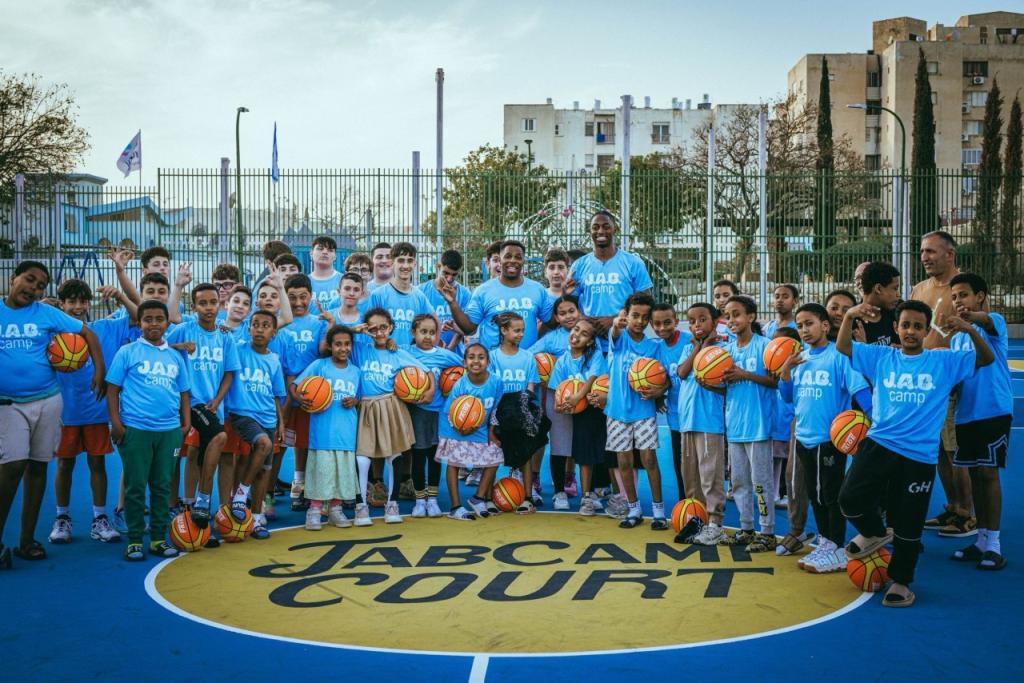
Why local media are essential to telling stories like Jared Armstrong’s—
where community, connection, and courage meet
A Vision Born from Two Worlds
When I first learned about JAB Camp, it was through a friend in the Jewish community who knew I was searching for programs that tackled the complex issues surrounding antisemitism. She told me about Jared Armstrong—a professional basketball player, educator, and proud Black Jewish man—whose vision was simple and powerful: to use basketball to break down walls of ignorance and hate.
More Than a Game
JAB Camp looks like an ordinary sports camp. Kids show up in sneakers and shorts, ready to play. But once the games start, it becomes clear that something bigger is happening. Between drills and scrimmages, young people from different backgrounds learn to see one another not as labels or stereotypes but as teammates. The court becomes a place where they talk openly about race, faith, and the things that divide us—and see what unites them instead.
Redefining Identity and Belonging
Armstrong created the camp because of his experiences navigating two worlds that people often think don’t overlap. Many are surprised when he says he is both Black and Jewish. That reaction reveals a quiet myth: that Jewish identity is white, and that Black identity can’t include Jewish faith. That misunderstanding doesn’t just get facts wrong—it erases people.
At JAB Camp, identity isn’t something to defend; it’s something to share. Kids learn that being different isn’t a barrier to belonging—it’s the beginning of friendship. Guest speakers—athletes, rabbis, and civic leaders—join the camp to discuss respect, faith, and how to stand up against hate and bring those lessons home.
Small Moments, Big Change
Since its founding in Philadelphia, JAB Camp has reached over a thousand children through summer sessions and community programs. Participants show stronger teamwork, curiosity about other cultures, and a willingness to challenge prejudice. But the real proof shows up in small, human moments: a Black teenager asking a Jewish camper about Shabbat, or a group of kids deciding to call out a racist joke instead of laughing along.
Few outside Philadelphia have heard of JAB Camp despite its impact. It doesn’t fit into easy national headlines or social-media soundbites. It’s not about crisis—it’s about connection. But in a time when hate crimes are rising and mistrust feels like the default, that kind of connection may be the most critical work of all.
Why Local Media Matters
This is where local media come in. Like that from Philadelphia’s ABC6, CBS, and community papers, local coverage has followed Jared’s journey from player to bridge-builder. In our age of 24-hour national networks and broad-brush stories, the smaller outlets—the neighborhood newspaper, the community radio show, the local website that knows every coach and every corner court—carry a unique power. Research shows that local news is trusted, binds a community, and helps us understand what’s happening at our doorsteps. Local coverage picks up the cues that national media often miss: the camp where children first talk about faith and difference and the interfaith moment on a basketball court.
Rebuilding a Frayed Bond
Right now, the relationship between the Black and Jewish communities is under strain—especially in the aftermath of 10/7 and the Gaza/Israel war. What once was a close bond, rooted in shared struggle and figures like Martin Luther King Jr. and the NAACP, is now frayed. Local connections like JAB Camp help rebuild those ties—and local media give them visibility. When a neighborhood reporter covers one of those sessions, the relationship doesn’t just happen—it’s witnessed, celebrated, and made real.
Where Change Truly Begins
We are reminded that the strength of local media lies not in chasing the following big national headline, but in lifting the small stories that measure the change happening quietly. It’s the story of a camp and two kids from different faiths setting aside what divides them and discovering a friendship created through a mutual love of sports. And in a moment when mistrust can feel overwhelming, these local stories — and the local media that tell them — become indispensable.












 Ad-Free & Subscriber Log-In