

When our family traveled halfway across the Pacific Ocean to visit one of our favorite spots in the world, I brought a bagful of books to read.
Sure, I would swim and snorkel and hike and walk, but I would also pull up a beach chair and read for long hours at a time, simply because I could.
I’d sworn off of social media and email for the week, mostly because I needed a break following the release of Church Camp two and a half months earlier – but also because it’s healthy to take a break from screens, in general. More often than not, reading is how I breathe.
What delight to hunker down with a book that’d been sitting on my shelf for a while, a book that surprised me with its humor, history, and depth.
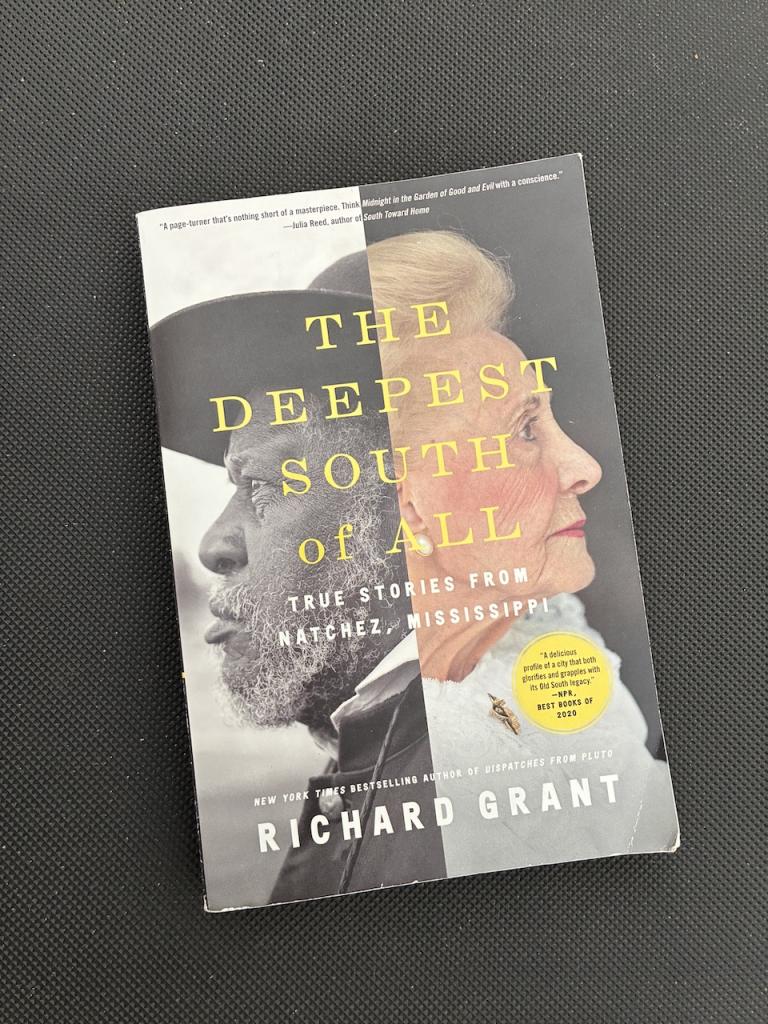
The Deepest South of All by Richard Grant is woven story of Natchez, Mississippi, a town that once boasted more millionaires per capita than anywhere else in America. As the back cover reads, “Today it has the greatest concentration of antebellum mansions in the South and a culture full of unexpected contradictions. Prominent white families dress up in hoop skirts and Confederate uniforms for ritual celebrations of the Old South, yet Natchez is also progressive enough to elect a gay black man for mayor with 91 percent of the vote.”
I’d picked up the book years ago, mostly because of a fascination with the state of Mississippi. My husband spent his formative years in the state and most of the extended family still calls the Magnolia State home (my reflections of which feature prominently in my first book, The Color of Life).
But Natchez was unlike any part of Mississippi I’ve ever visited. Just as antebellum mansions don’t feature as prominently in Jackson as they do almost two and a half hours away in Natchez, the fact is, “In Natchez, you only use the word home if it’s antebellum … If your house was built after the Civil War, it’s trashy to call it a home.”
Because little insights like this is exactly what Grant offers to readers along the way. A British writer, he gulps down the waters of the Deep South in a way only an outsider can muster, and ultimately, get away with.
Just as he observes customs of Mississippians meeting for the first time, he tells us what such meetings mean in this common form of exchange: “They want to know about each other’s ancestors, and which families they married into. If kinship ties can be established, so much the better. If there was a feud in the past, it could get awkward.” All outward Southern niceties aside, “They have to square their well-earned reputation for kindness and hospitality with their equally well-earned reputation for violence and bigotry.”

Along the way, readers learn about the history of the town, not only of its most famous enslaved man but also of a yearly play that put Natchez on the map (in both the best and the worst of ways). Of the play, one local muses, “We resurrected our history in order to sell tickets and make money from it, but it’s more powerful than we are. It’s like we resurrected a monster and now we can’t control it. Sometimes it feels like progress is impossible, because the dead are running the show.” With a black gay man (then) in the mayoral seat, it’s hard to believe the annual event still holds ground in the community. (At the time of publication in 2020, the event was rapidly losing its footing).
Just as readers get sucked into a town that feels bound by the customs of yesterday as it wrestles with the realities of today, Grant ushers a reminder that it’s not just Natchez (nor is it just the state or the South):
It’s not just Mississippi. The North is segregated too. This is work the whole country needs to do. White people need to understand the bitterness we feel about slavery. There’s pride that we survived the whole experience and came through it with dignity, and then successfully fought for our civil rights, but a lot of white people act like it’s no big deal, or we should be grateful for what we have now. They haven’t even begun to understand.
The work “the whole country needs to do” is evident today when racism has been granted permission to boast of hate, once again.
Might we not forget the work our history-makers did when they fought for civil rights, when they stood up for justice, when they called out the hate-mongers. Because when it feels like we’ve taken a thousand steps in the wrong direction, it’s time we hitch up our hiking boots and start marching in the right direction once again.
And in more ways than one, The Deepest South of All helps us do just that.
—
*Post contains Amazon Affiliate links. Every purchase you make kicks a few pennies my way!
















 Ad-Free & Subscriber Log-In