

In Acts 17:22-31, Paul says the “Unknown God” created everything. When we immerse ourselves in God’s Creation, we can know God in astounding ways.

Here are ideas for reading and preaching Acts 17:22-31, the story of Paul preaching at the Areopagus, and John 14:15-21, Jesus’s instruction to love and follow his commandments. This is part of the EcoPreacher 1-2-3 series to equip preachers and congregations for engaging the Bible through an ecological lens. These texts are assigned as part of the Revised Common Lectionary for the Sixth Sunday of Easter, Year A.
En espanol, clic aqui.
Eco-Exegesis
Eco-exegesis is a method of interpreting the biblical text through a green lens using the principles of ecological theology.
Acts 17:24-25
24The God who made the world and everything in it, he who is Lord of heaven and earth, does not live in shrines made by human hands, 25nor is he served by human hands, as though he needed anything, since he himself gives to all mortals life and breath and all things.”
Acts 17:22-31 shows Paul engaging with Greek scholars, poets, politicians, and philosophers in the public gathering place of the Areopagus to proclaim an important truth about God. There in Athens, surrounded by shrines, altars, and hand-crafted sculptures of deities, Paul challenged the idolatry he witnessed. It seemed that every aspect of life had its own god or goddess that required homage. And payment! The money given in homage to those gods benefited the makers and keepers of the idols as well as the rulers of the Roman Empire.
Interestingly, the Greeks had an altar to a nameless god.
To their credit, they recognized the mystery of whatever unknown deity might be out there. But Paul pointed out that the God whom they called “unknown” was, in fact, fully knowable. The way to know God is through the heavens and earth that God created. God reveals Godself through the very breath of life.
Acts 17:22-31 can connect our faith with God’s Creation. One way is by heeding its warning not to be fooled by those who construct systems that misdirect our worship away from God. Granted, the places where we gather to worship are important and necessary. However, they are not a substitute for encountering the Creator through nature and the cosmos.

We need only step outside to witness the grandeur of God’s Creation. But when we do that, we will also need to confront the ways we have desecrated it through our idolatry of wealth, relentless acquisition, and self-serving individualism. By respecting “the world and everything in it,” we are returning our focus to our Creator God.
John 14:15-16
15“If you love me, you will keep my commandments. 16And I will ask the Father, and he will give you another Advocate, to be with you forever.”
When Jesus used the word “love” in this farewell speech to his disciples, he was talking about a specific kind of love. It wasn’t romantic or the type of love between friends or family. In Greek, the word is agape; it means to love in a moral or ethical sense.
Agape love is unconditional, sacrificial, and selfless. Jesus emphasizes that following the commandments to love God and love neighbor are the way to love him. This kind of love requires us to seek the good of the community and the flourishing of everyone instead of focusing only on our selfish desires.
Practicing agape love for Creation
Today, our planet and human communities continue to suffer from pollution, climate change, and violence toward Earth and each other. When we practice agape love, however, we can redirect our energy toward cleaning up, restoring, and healing Earth and our communities.
Agape love compels us to protect fragile ecosystems to ensure life on this planet can continue. This love will sacrifice short-term profit in order to ensure long-term survival of our species. And this love reveals that our lives are inextricably bound together with our Earth kin.
The Paraclete
Fortunately, Jesus promised that this seemingly impossible call to selfless love comes with the divine presence that makes flourishing possible. In Greek, the word for this presence is paraclete, meaning “comforter” or “advocate.”
The Paraclete is another way to understand the Spirit named in verse 17. We can trust that the Spirit accompanies us as we come alongside others in our climate and environmental advocacy. The Paraclete abides with us as we seek healing, restoration, and reparations.
1 Eco-Idea
The Eco-Idea is one succinct statement that tells us who God is and/or what God does in relation to Creation and how we should respond as people of faith.
Knowing and loving God includes caring for God’s Creation and inspires us to protect this fragile yet magnificent planet.
2 Eco-Questions
Eco-Questions are what we can ask to help a congregation draw out the implications of the Eco-Exegesis and Eco-Idea.
1 – When thinking about Acts 17:22-31, where do you experience the presence of God in Creation? Invite the congregation to think about a place where they felt a connection between nature and the Divine. How did that place convey a sense of wonder, awe, majesty, simplicity, complexity? In what way does that place help them feel at home in the world? What would they do to protect the sacredness of that place?
2 – Regarding John 14:1-41, what does agape love look like in our relationships with our Earth kin? Can we pay closer attention with our eyes, ears, taste buds, hands, and hearts? Can we protect fragile ecosystems as they are supporting life on this planet? Does it look like introducing a child to the natural world and cultivating respect for the processes of life?
3 Eco-Actions
Eco-Actions are ways that a congregation might respond to the Eco-Idea and Eco-Questions. One of these possibilities may have salience for your ministry context.
1 – Preach and share stories
Tell your faith community about faith leaders who engage in the public square to advocate for protecting Earth, communities, and human health. The book Rooted and Rising: Voices of Courage in a Time of Climate Crisis, edited by Leah D. Schade and Margaret Bullitt-Jonas, has 21 chapters by spiritual leaders doing this work. Check out the chapters by Rabbi Mordechai Leibling, Green Muslims founder Huda Alkaff, Quaker activist Jay O’Hara, public health advocate Natasha DeJarnett, and youth climate activist Kiran Oommen for examples of faith in action.
2 – Plan an ecumenical or interfaith book study.
Read together the edited volume, All We Can Save: Truth, Courage, and Solutions for the Climate Crisis, by Ayana Elizabeth Johnson and Katharine K. Wilkinson. The 58 short essays are divided into eight sections with themes such as “advocate,” “persist,” “feel,” “nourish,” and “rise.” At the end of the study, plan one action your group can do together to live out your faith in the midst of God’s Creation.
3 – Order Bible Eco Infographics to display in your church.
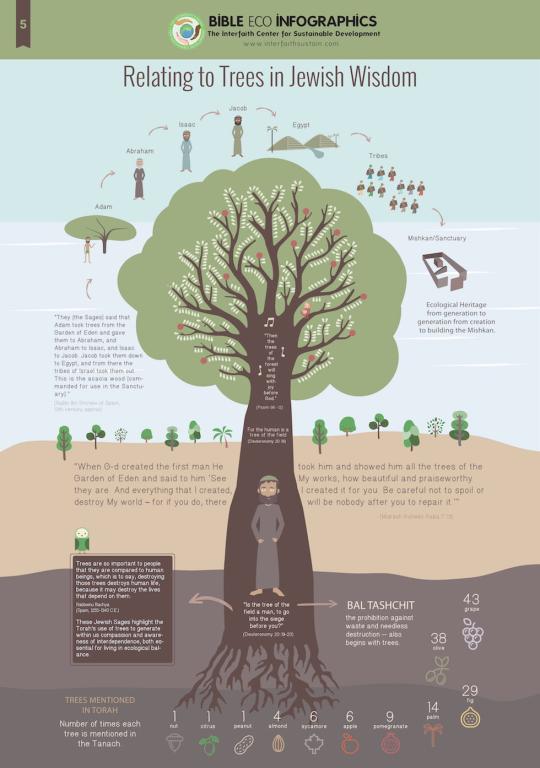
The Interfaith Center for Sustainable Development (ICSD) has developed seven attractive infographics on the Bible and ecology. The infographics help viewers visually understand Bible-ecological concepts in relation to biodiversity, animal welfare, food, and trees. The infographics are available for purchase as large ecologically-printed posters. As environmental concern increases within faith communities around the world, these Bible eco-infographics offer an innovative channel to convey biblical ecological teachings. To order the infographics click here.
Read also:
Can Preachers Talk About Climate Change?
For God So Loved the World: Creation and John 3:16
A Seed of Grief and Hope: Preaching Ideas for John 12:20-33
EcoPreacher 1-2-3
EcoPreacher 1-2-3 is a partnership between the Rev. Dr. Leah Schade and the Interfaith Center for Sustainable Development, publishers of Eco Bible, a Jewish ecological commentary on the Hebrew Scriptures. We provide Creation-centered sermon preparation that is short, accessible, and based on a solid biblical foundation. To see other EcoPreacher ideas and to sign up to receive future EcoPreacher 1-2-3 installments, click here.
The Rev. Dr. Leah D. Schade is a seminary professor, ordained minister, and grant director of Compelling Preaching in a Climate-Changed World, a partnership of Lexington Theological Seminary, Creation Justice Ministries, and The BTS Center. Her opinions are her own.
Leah is the author of Preaching and Social Issues: Tools and Tactics for Empowering Your Prophetic Voice (Rowman & Littlefield, 2024), Preaching in the Purple Zone: Ministry in the Red-Blue Divide (Rowman & Littlefield, 2019) and Creation-Crisis Preaching: Ecology, Theology, and the Pulpit (Chalice Press, 2015). She is the co-editor of Rooted and Rising: Voices of Courage in a Time of Climate Crisis (Rowman & Littlefield, 2019). Her book, Introduction to Preaching: Scripture, Theology, and Sermon Preparation, was co-authored with Jerry L. Sumney and Emily Askew (Rowman & Littlefield, 2023).













 Ad-Free & Subscriber Log-In