

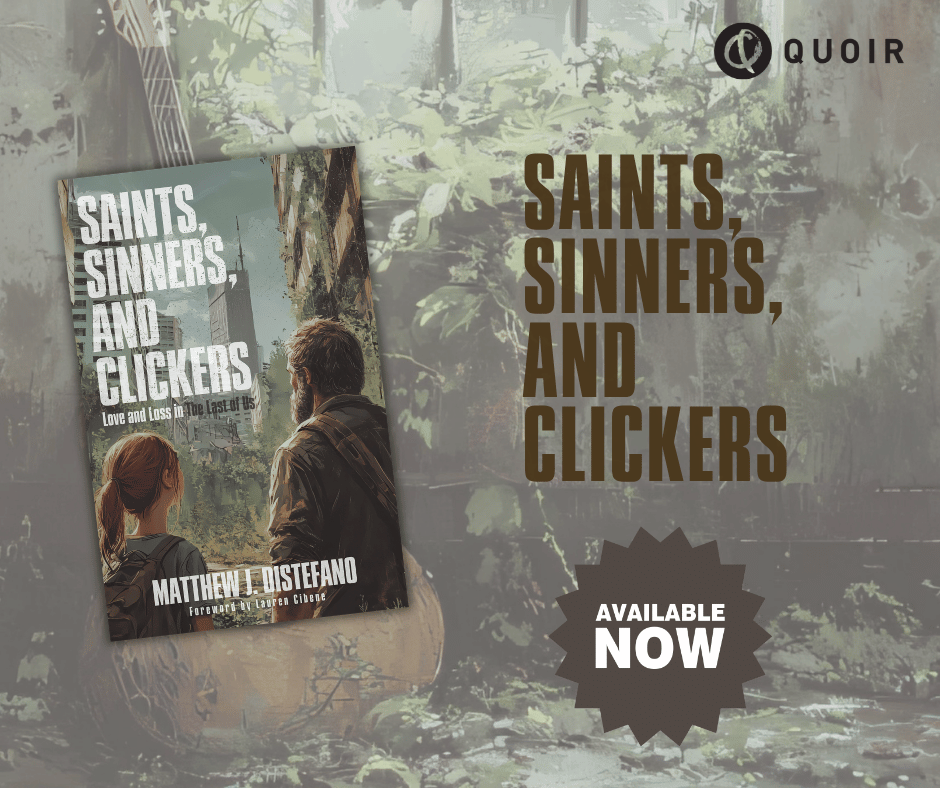
This week is launch week for Saints, Sinners, and Clickers. I should feel nothing but excitement. And I do, at least in part. Writing a book, finishing it, and releasing it into the world is no small accomplishment. This one is especially personal. It explores love, violence, community, and what it means to remain human when everything familiar has collapsed. It just happens to do all of that through the lens of an apocalyptic video game.
And that’s where the strange tension sets in. Because while I’m celebrating the release of a book about the end of the world, I’m also looking around and wondering how far off our own version of that story really is.
We don’t have cordyceps (a real fungus, by the way) turning people into Clickers. But we do have rising temperatures, collapsing ecosystems, and a global economy that seems determined to squeeze every last drop of life out of the planet before admitting something has gone terribly wrong. The slow creep of climate collapse doesn’t make for as cinematic a narrative, but it’s real in a way that fiction doesn’t have to be.
Writing this book has forced me to sit with that tension longer than I usually would. The Last of Us is compelling because it strips everything down to the essentials. When the systems collapse, when convenience disappears, and when survival becomes the central question, what kind of people do we become? What kind of communities do we build?
Those aren’t just hypothetical questions anymore.
If I’m honest, there are days when I feel a kind of quiet despair about where we’re headed. Not the dramatic, loud kind. The quieter version that settles in when you read one too many “breaking news” stories, or watch another fire season stretch longer than the last, or realize that the people with the most power to change things are often the least interested in doing so.
But that’s not the whole story. It can’t be. Because alongside that despair, something else has been growing.
As a regenerative farmer, I’ve seen firsthand that the narrative of inevitable collapse isn’t the only one available to us. The way we grow food matters. The way we treat the land matters. Practices like no-till farming, permaculture, and regenerative agriculture aren’t just trendy buzzwords, they are practical, tangible ways to restore ecosystems, rebuild soil, sequester carbon, and create systems that can actually sustain life rather than deplete it. No doubt, these philosophies aren’t silver bullets. They aren’t going to magically reverse everything overnight. But they are a piece of the puzzle, and meaningful ones.
What gives me hope is not the idea that we will suddenly wake up as a species and fix everything in time to avoid all suffering. I don’t think that’s realistic. History doesn’t suggest we’re that quick to change, especially when comfort and profit are on the line. What gives me hope is the possibility that even if things get as bad as many scientists are warning, there will still be people who learn, adapt, and rebuild differently.
There will be people who understand that the way forward is not domination of the land but partnership with it.
There will be people who reject extraction as the primary mode of existence and choose regeneration instead.
There will be communities that prioritize mutual care over endless consumption.
That hope is quieter than the kind we usually market. It doesn’t promise that everything will be okay for everyone. It doesn’t ignore the real suffering that is already happening and will continue to happen. But it does insist that the story doesn’t end with collapse.
In Saints, Sinners, and Clickers, one of the central questions is how we live with each other when the world we knew is gone. Not how we win. Not how we dominate. How we live. How we love. How we build something resembling community in the aftermath of unimaginable loss.
That question feels less like fiction to me now than it did when I started writing.
So, today is bittersweet.
I’m releasing a book that I know most people won’t read. It’s niche. It’s about a video game, even if it’s doing a lot more than that. I’m proud of it, but I’m also realistic about its reach.
At the same time, I’m standing in a moment where the themes of that book feel uncomfortably close to home. The idea of apocalypse isn’t just a storytelling device. It’s a lens through which we’re increasingly forced to view our own future.
And yet, given the “fool” I am—to paraphrase Tolkien—I’m hopeful.
Not because I think we’ll avoid all catastrophe, but because I believe in the stubbornness of life. I believe in the capacity of future generations to learn from our failures. I believe that what we are doing right now, in small, often overlooked ways, can become the seeds of something better.
Every regenerative practice, every restored patch of soil, every decision to work with the land instead of against it, is a kind of defiance. It’s a refusal to accept that destruction is the final word.
Maybe we don’t get to see the full harvest of that work. Maybe the worst predictions come true for many of us. But if there are people who come after us, and I think there will be, they won’t be starting from nothing. Instead, they’ll inherit both our mistakes and our wisdom. What we choose to pass on matters.
So I’m releasing this book into the world with that in mind. A story about an apocalypse. A reflection on our unveiling. And a quiet, stubborn hope that even in the midst of collapse, we can still learn how to grow something worth passing on.
Pick up Saints, Sinners, and Clickers today!
You can also explore my books—including Heretic!, The Wisdom of Hobbits, and others—right here: https://quoir.com/authors/matthew-j-distefano/
Thanks for reading. Thanks for thinking. And thanks for refusing to settle for easy answers.








 Ad-Free & Subscriber Log-In