

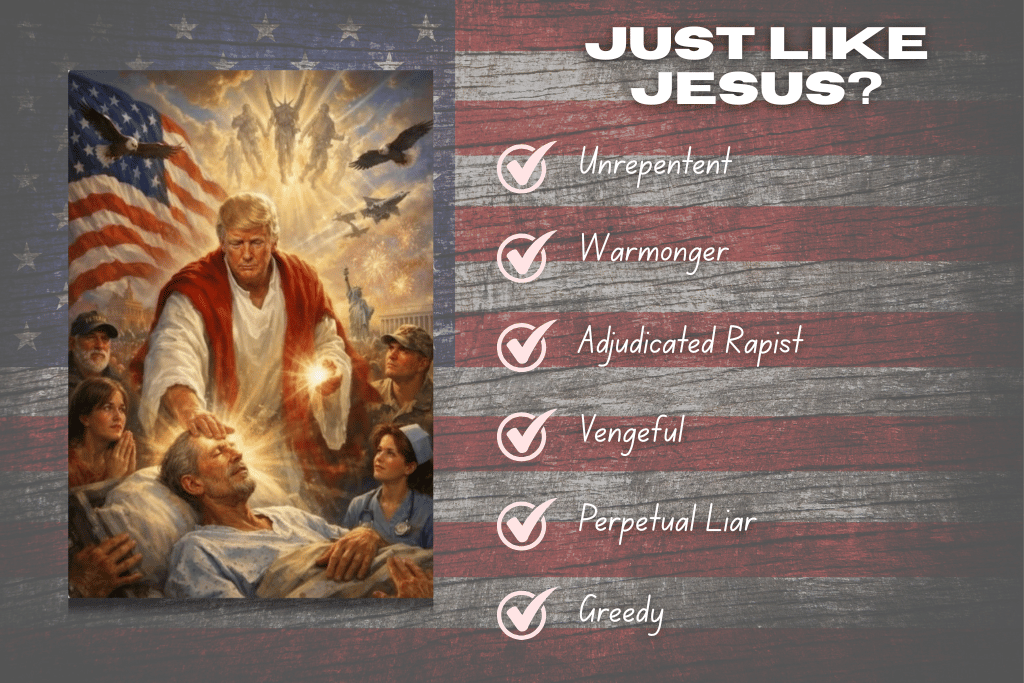
We’ve all seen the picture of Trump depicting himself as Jesus Christ. And after everything, apparently now it’s blasphemy. I genuinely don’t understand why this is the line.
Because if you’ve been paying even casual attention, this latest controversy falls right in line with who this man is and has always been. Trump has said “I am the chosen one.” He has wrapped himself in messianic language so often that it stopped even sounding strange to the people who were supposed to know better. He sold Bibles for a thousand dollars and signed them like memorabilia, even adding song lyrics into the text as if Scripture were just another branding opportunity. That didn’t trigger a mass exodus from white Evangelicals.
He was found liable for sexual abuse. He paid off a porn star. He attempted to overturn an election. He has been tied, at minimum, to deeply disturbing associations in the Jeffrey Epstein orbit. None of that caused this sudden wave of moral clarity.
Even more recently, he ordered bombings in Iran that reportedly killed hundreds of schoolgirls, and there was no visible remorse. No collective Christian uprising saying, “This is incompatible with the teachings of Jesus.” No decisive break from the man they claimed was God’s instrument.
But now, an AI-generated image of him as Christ?
Now Christians clutch our pearls.
It would almost be funny if it weren’t so revealing.
Because the outrage feels selective in a way that exposes something deeper than theological concern. It exposes self-preservation. The same influencers and commentators who spent years defending him, platforming him, and building entire brands around proximity to his power are suddenly discovering boundaries. Suddenly, they are “theologians” again.
People like Megyn Kelly, Riley Gaines, Allie Beth Stuckey, and Sean Feucht are beginning to signal that something has gone too far. And maybe, on some level, they believe that. But the timing is hard to ignore.
Where was this energy when professional grifter Paula White-Cain stood in front of cameras and essentially likened Trump to Jesus just last week? Paula White-Cain didn’t hide it. She amplified it. And she has been one of the most visible spiritual voices in his orbit for years.
That wasn’t disqualifying. So what changed?
The simplest answer is also the most uncomfortable one. The Trump train is slowing down, maybe even derailing, and the people who built their platforms on his momentum can feel it. They can see the cultural shift, read the room, and they need a clean exit.
You can’t spend a decade defending the indefensible without eventually needing a moment where you say, “This is where I draw the line.” Not because the line actually matters, but because your credibility, audience, and bottom line does.
So you wait.
You wait through the scandals. You wait through the cruelty. You wait through the violence, the lies, the corruption, the exploitation. You absorb it all, justify it all, spin it all. And then, when something comes along that is visually jarring enough, symbolically obvious enough, you take your stand.
“An image of Trump as Jesus? That’s too far.”
It sounds principled until you remember everything that came before it. For years, many of these same voices have been functionally silent or openly supportive as Trump wrapped himself in religious symbolism and political power. They baptized his rhetoric, defended his policies, and turned his opponents into enemies of God. They built audiences, sold books, launched podcasts, and grew followings by aligning themselves with him. And now, suddenly, they want to be seen as the ones who resisted.
That’s the part that doesn’t sit right. Because if this really is about blasphemy, then the timeline makes no sense. If this really is about protecting the name of Jesus, then the silence up to this point is deafening. If this really is about faithfulness, then it raises the question of what exactly they have been faithful to all along.
It’s hard to escape the conclusion that this isn’t about Jesus at all. It’s all about optics. It’s about getting off the ride before it crashes completely and being able to say, “I wasn’t part of that. Why would you even say that?” It’s about rewriting the story in real time, positioning themselves as people who eventually saw the light, rather than people who helped build the machine.
But history has a way of remembering and so do the people who were paying attention.
The tragedy in all of this is not just that Trump posted a blasphemous image. It’s that so many who claim to follow Jesus spent years normalizing behavior that contradicts LITERALLY everything he taught, only to wake up when it became socially or politically advantageous to do so.
If this is where the line is, it’s a strange place to draw it. And it tells us far more about the people drawing the line than it does about the man they’re finally, reluctantly, trying to leave behind.
If you’re navigating faith after certainty, loving Jesus but not the empire, or trying to hold on to hope in a burning world, you’re not alone. I explore these themes weekly on the Heretic Happy Hour podcast.
You can also explore my books—including Heretic!, The Wisdom of Hobbits, and others—right here: https://quoir.com/authors/matthew-j-distefano/
Thanks for reading. Thanks for thinking. And thanks for refusing to settle for easy answers.














 Ad-Free & Subscriber Log-In