

Palm Sunday follows on the heels of No Kings protests this year. Jesus’s procession was a type of protest and counters the violence of today’s Christian Nationalism.
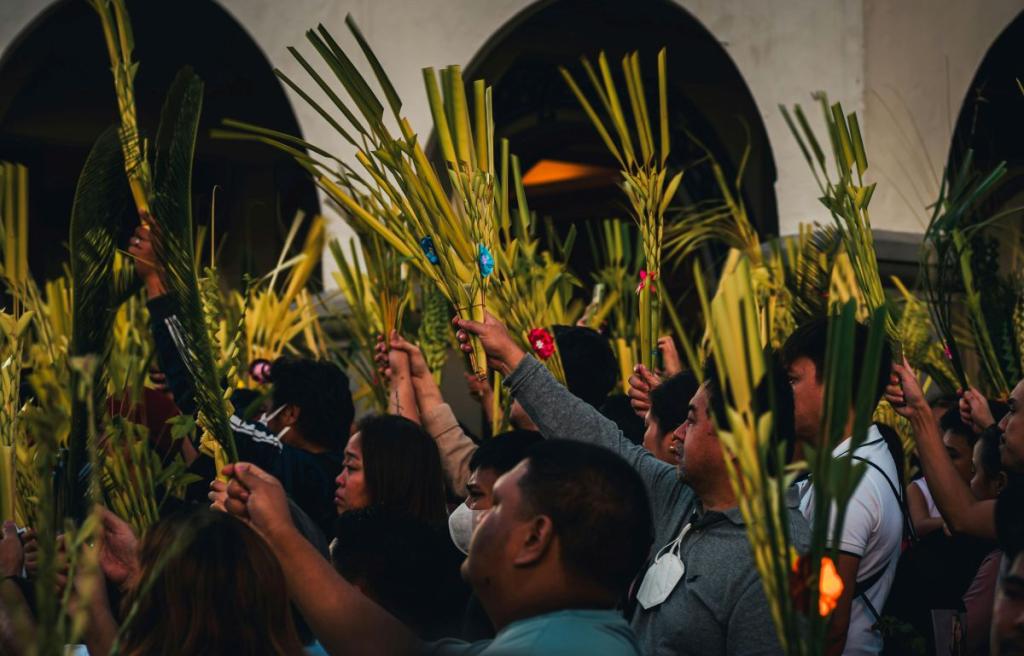
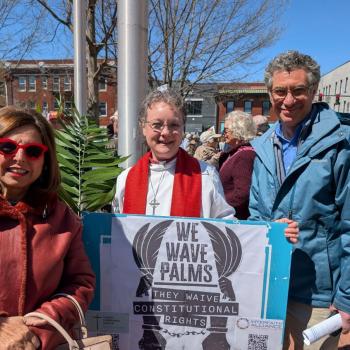
Palm Sunday was a type of protest march
Palm Sunday marks the beginning of Holy Week when Jesus entered Jerusalem riding a donkey amid crowds of people waving palm branches. This procession would eventually lead to his crucifixion and resurrection on Easter Sunday.
But if churches today wave green fronds and shout “hosanna” without understanding what Jesus was doing, we miss the political significance of this event.
Jesus didn’t ride into Jerusalem on a chariot or a fabulously decorated horse. Because those were symbols of war. Instead, Jesus sat on a donkey — a simple beast of burden used by the common people.
Riding a donkey was a form of cheeky, self-deprecating humor that disrupted the narrative of political and military power. In a sense, the processional into Jerusalem was a kind of protest march. Jesus rejected military pageantry to be in solidarity with the oppressed. In this way, Palm Sunday unveils the futility of foolish spectacle used to fluff the image of brutal, corrupt, and violent regimes.
[To learn more about Jesus’s use of humor to upend empire, check out Preaching Fools: The Gospel as a Rhetoric of Folly by Charles Campbell and Johann Cilliers.]
Courage to preach the gospel in the face of violence
On March 28, 2026, a massive day of protest called the No Kings March will precede Palm Sunday. Preachers and congregations can link Jesus’s protest against the Roman Empire and Americans’ protest against its current regime. In both cases, the power of nonviolence reveals the foolish futility of imperial domination. At the same time, it demonstrates power exercised through diverse human communities centered on justice and human flourishing.
On Palm Sunday, Christians can invoke the Spirit of Jesus to denounce the political and military systems of our time that are driven to commit crimes against humanity by the demonic ideology of Christian nationalism.
What is Christian Nationalism?
Christian nationalism distorts and weaponizes Christian teachings for its violent, patriarchal, racist, and ethnocentric agenda.
Christian nationalism was at the base of the January 6, 2021, insurrection on the grounds of the Capitol. On that day, there were public displays of two means of execution: a gallows for hanging and a cross for crucifixion. The violent mob planned to use the former to kill the Vice President and other elected officials. They used the latter as a source of prayer for the success of their endeavors. This was a confounding exercise in ignorant heresy.
Five years later, Christian nationalists are using a confounding, twisted interpretation of the Bible known as “dispensationalism” to justify a wholly manufactured and illegal war against Iran. They selectively manipulate apocalyptic and prophetic scriptures asserting that they are hastening the arrival of Armageddon. But these dangerous myths promote political agendas and obscure the real human and environmental costs of war. Christian nationalism and its close cousin, Christian Zionism, perpetuate cycles of violence under the guise of divine mandate.
American Christian nationalism has supported violence for generations.
Says Carter Heyward: “No one paying attention in America or in American churches could fail to notice that our national culture centers around a pride strengthened over time by the fondness of many white Christian American men (and some women) for wars, guns, conquest, police and military readiness, and scapegoating…‘others’ deemed alien, unpatriotic, or dangerous to the white Christian ‘all-American way’” (The Seven Deadly Sins of White Christian Nationalism, 127).
Even in mainline denominations, there are many who lean towards the tenets of Christian Nationalism. As Pamela Cooper-White points out, “statistics show that nearly two-thirds of mainline Protestants – members of the supposedly ‘liberal’ Christian denominations . . . agree with many of the sentiments, if not the actions, of the thousands who marched on the Capitol on January 6” (The Psychology of Christian Nationalism, 3).
So what is the antidote to the ever-increasing spiral of violence in American Christianity?
We must be very clear: Christianity is about compassion, respect, integrity, and liberation.
Jesus wanted people to realize that having power does not give one the right to lord it over others by means of wealth, shaming, or violence. Power is not to be used to grab all you can and then do anything you can to protect what you’ve stolen.
Rather, power is to be exercised with humility and service. As Paul explained: “Let the same mind be in you that was in Christ Jesus, who though he was in the form of God, did not regard equality with God as something to be exploited, but emptied himself, taking the form of a slave, being born in human likeness. And being found in human form, he humbled himself, and became obedient to the point of death – even death on a cross” (Philippians 2:5-8).
Today, Christians can turn to grassroots organizations to join with others in movements of creative, strategic nonviolence, such as the Poor People’s Campaign led by William Barber and Liz Theoharis. Other organizations include SURJ (Standing Up for Racial Justice) and Faith in Public Life. Many of these organizations trace their roots back to the One who led his own grassroots movement of nonviolent disobedience – Jesus Christ.
Palm Sunday interrupts the violence of empire.
Holy Week and Palm Sunday show us what it looks like to refuse to escalate violence and use it as a means to achieve what one desires, whether interpersonally, politically, or spiritually.

Jesus built a diverse coalition of fisherman, farmers, homemakers, tax collectors, and teachers to cultivate peacemaking while countering a violent imperial system. Then he trusted the power of God to sustain the Beloved Community he started, even if it meant succumbing to death by the powers that relied on violence to retain their power.
The resurrection validated that trust. And it is the source of our prophetic courage for continuing the nonviolent, creative, justice-building Beloved Community today.
Central Question, Central Claim, Central Purpose
(The Central Question, Central Claim, and Central Purpose statements are a way to organize and provide direction for a sermon that I developed in the book Introduction to Preaching: Scripture, Theology, and Sermon Preparation (Rowman & Littlefield, 2013). Here are possible Central Statements for a sermon countering the violence of Christian Nationalism on Palm Sunday.)
Central Question. In what ways can the church use strategic, nonviolent civil disobedience to counter the brutality of Christian Nationalism? How can our faith strengthen us for this task?
Central Claim. Palm Sunday showed that Jesus built a diverse coalition to cultivate peacemaking while disrupting a violent imperial system. Today, the church can continue the work of the Beloved Community in the face of death-dealing powers of Christian Nationalism.
Central Purpose. This sermon calls for trust in God and urges prophetic courage for continuing Jesus’s nonviolent, creative, justice-building Beloved Community today.
Read also:
An Ecological Stations of the Cross, 2026
More than Eco-Palms: Ecojustice and Palm Sunday
Ezekiel 37 Counters White Christian Nationalism
Michael Sheen’s The Passion of Port Talbot is a Revelation
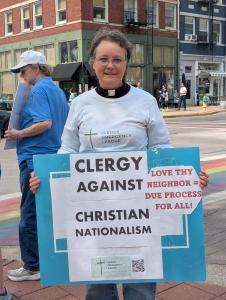
The Rev. Dr. Leah D. Schade is a seminary professor, ordained minister, and co-founder of the Clergy Emergency League. Her opinions are her own.
Leah is the author of Preaching and Social Issues: Tools and Tactics for Empowering Your Prophetic Voice (Rowman & Littlefield, 2024), Preaching in the Purple Zone: Ministry in the Red-Blue Divide (Rowman & Littlefield, 2019) and Creation-Crisis Preaching: Ecology, Theology, and the Pulpit (Chalice Press, 2015). She is the co-editor of Rooted and Rising: Voices of Courage in a Time of Climate Crisis (Rowman & Littlefield, 2019). Her book, Introduction to Preaching: Scripture, Theology, and Sermon Preparation, was co-authored with Jerry L. Sumney and Emily Askew (Rowman & Littlefield, 2023).












 Ad-Free & Subscriber Log-In