

The Interfaith Alliance of the Bluegrass in Lexington, Kentucky, invited three representatives of the Abrahamic faiths to speak at the March 28 #NoKings rally. I was honored to speak as a Christian minister ordained in the Lutheran Church (ELCA), and as co-founder of the Clergy Emergency League.
#NoKings protests offer opportunities for public theology
3,000 #NoKings demonstrations across the U.S. drew millions of attendees in March 2026. Estimates suggest that around 9 million people participated in these protests, making it one of the largest in U.S. history. #NoKings rallies offer faith leaders a chance to add their perspectives as public theologians to the diverse gatherings focused on standing up for democracy and community while defending the vulnerable.
In his book, From Pulpit to Public Square, Richard Voelz provides a framework for faith leaders to transition their proclamation from traditional church settings into the public sphere. Voelz encourages preachers to integrate their theological convictions with strategic goals to address systemic issues and communal crises effectively. He offers substantive and practical advice for transforming homiletical skills into tools for civic engagement and moral advocacy.
Voelz defines public proclamation as “communication that is intended for the public sphere, grounded in hope and employing faith-rooted language, with the purpose of working toward strategic goals of offering witness amid trouble, uniting in solidarity, and/or working toward justice and healing” (9). The #NoKings rallies offered opportunities for faith leaders to “unite those gathered in solidarity across differences for the common strategic goals of the gathering, organization, group of people, or community” (14).
Video of #NoKings speech
In my message, I pointed out that this is the weekend when Christians celebrate Palm Sunday. I shared that this day is not just a church ritual but was a powerful protest led by Jesus who rejected military spectacle to stand with the oppressed. I denounced the dangerous rise of Christian nationalism which twists faith into a tool for violence and exclusion. And I called for solidarity across faiths and communities to resist authoritarianism and uphold democracy, dignity, and compassion for all.
Here is a video of the speech followed by the transcript below. After the transcript, I provide some analysis about the speech as an act of public theology and proclamation.
Transcript of #NoKings speech
Tomorrow Christian churches will be celebrating Palm Sunday, the beginning of what we call Holy Week when we remember Jesus’s crucifixion and resurrection.
Palm Sunday may seem like an fun little church ritual with green fronds and shouting hosanna.
But I’m gonna let you in on a little secret. Palm Sunday was a protest march!
Palm Sunday was a protest march!
Jesus didn’t come riding in on a chariot or a horse. Those were symbols of war. No, Jesus sat on a donkey — a simple beast of burden used by the common people.
Jesus rejected military pageantry to be in solidarity with the oppressed. Palm Sunday reveals the foolishness of military spectacle used to prop up corrupt and brutal regimes.
Denouncing Christian nationalism
As a Christian leader, I invoke the Spirit of Jesus on this Palm Sunday weekend to denounce the political and military leaders of our time who are driven to commit crimes against humanity by the demonic ideology of Christian nationalism.
Christian nationalism distorts and weaponizes Christian teachings for its violent, patriarchal, racist, and ethnocentric agenda.
Let me be clear: Christianity is about compassion, respect, integrity, and liberation.
Interfaith solidarity
I stand here with my Jewish and Muslim colleagues because we are united in our desire for peace through nonviolent resistance to this regime. We worship no human king! We worship a God who calls on us to come together in a movement of faith, freedom, and flourishing for all.
Community solidarity
And we stand with all of our neighbors, whether you practice any faith or no faith. Because we join you in rejecting authoritarianism, fascism, and tyranny of any kind in any place. Our faith compels us to support our communities and to stand for democracy, equity, and the dignity of each and every person.
Let our unity here today be a model and a witness to the goodness, love, and courage that we envision for Lexington, for the state of Kentucky, for our nation, and for the world!
Analysis of #NoKings speech as an act of public theology and proclamation
Rev. Amanda Groves and I co-wrote an article with advice and tips for Christian clergy speaking at protests. Using our tips, I’ll offer a brief analysis of this #NoKings speech.
1 – Know your audience and topic.
This was a public event with thousands of people from all walks of life. I was careful to avoid theological aphorisms and religious insider language. At the same time, my goal was to add moral clarity to the realities of Christian nationalism and its nefarious influence on American politics.
2 – Balance interfaith sensitivities with role as Christian clergyperson.
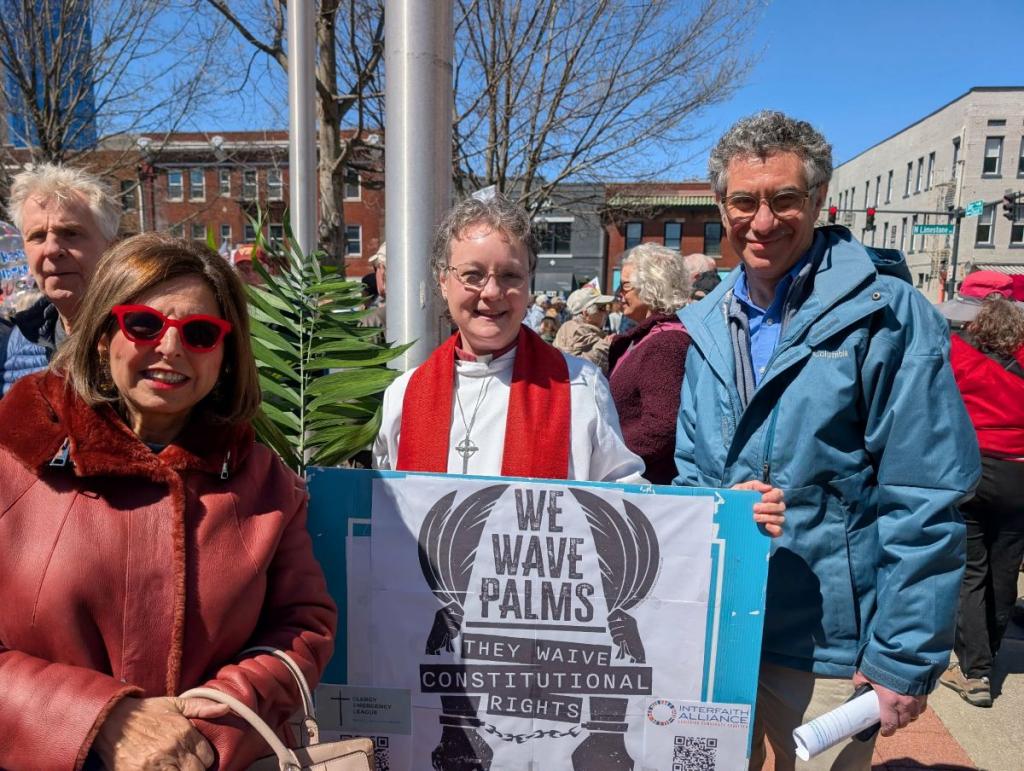
While I wore my alb and stole to denote my role as a Christian minister, I also emphasized solidarity with my interfaith colleagues. Wearing the stole allowed people to find me afterwards and share their words of appreciation or to ask questions for further engagement.
3 – Deliver a succinct address, not a sermon; 4 – Know your place in the line-up; and 11 – Consider your tone of “vibe.”
This speech clocked in at 4 minutes. My colleagues and I were the first to speak at the event, so we set the tone for the gathering. I opted for a “fire-them-up” approach to raise the energy of the crowd and inspire them with our collective witness.
5 – Utilize straightforward rhetoric and speech forms.
This speech was designed to be easy to follow with short sentences and uncomplicated syntax. I used the image of Jesus riding a donkey on Palm Sunday as the primary metaphor for a protest march. The form for the speech was: 1) Biblical premise; 2) Violation by the administration; 3) Call to action.
6 – Use repetition and call-and-response.
I repeated the phrase “We worship no human kings,” and the crowd immediately joined in. However, for this speech, I did not use call-and-response due to the time limit.
7 – Use a prop or dramatic action if appropriate; and 9 – Choose well-known biblical themes.
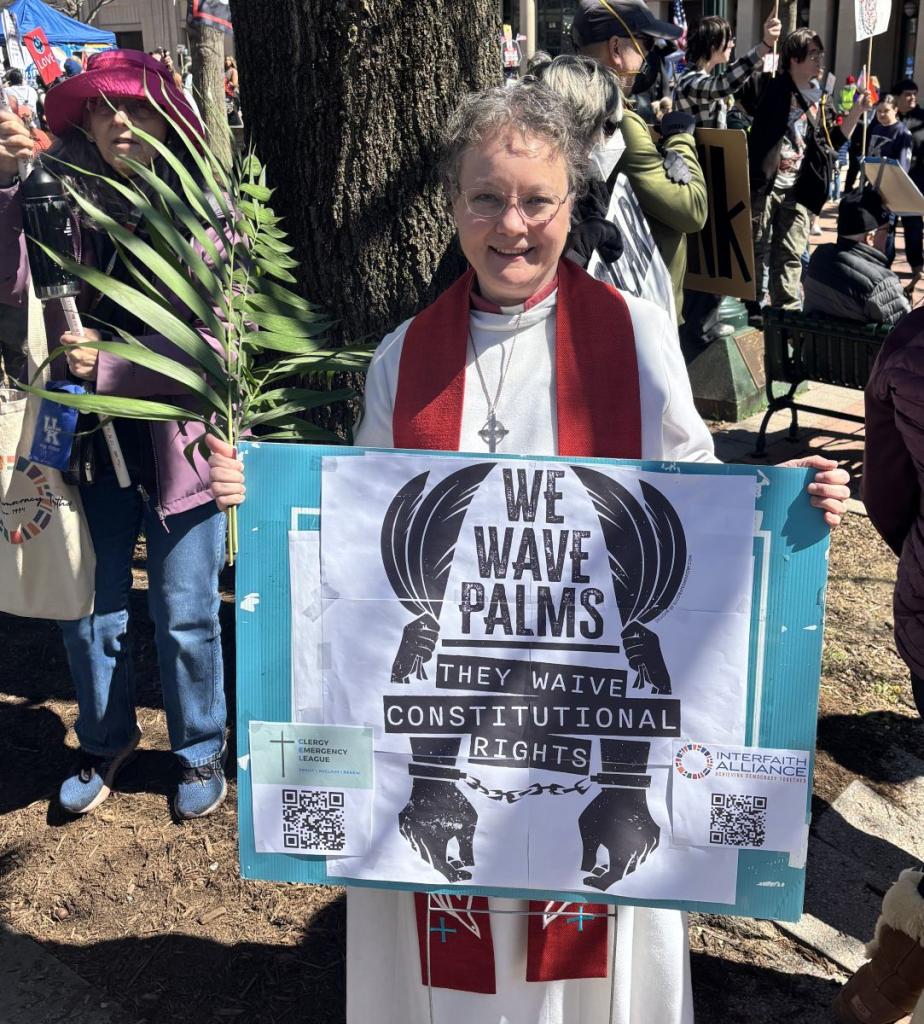
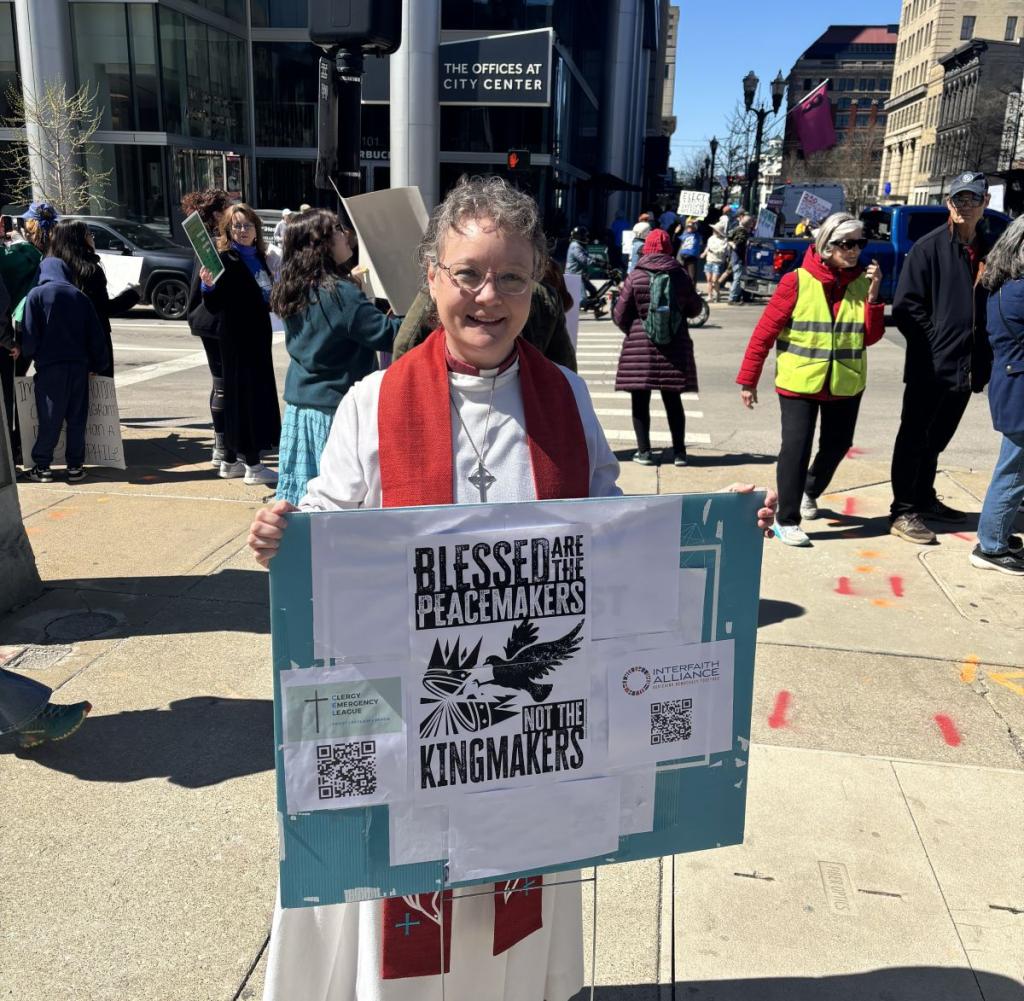
I held palms for the beginning of the speech when I talked about the next day being Palm Sunday. I also held a sign before and after the speech with an image by illustratedministry.com displaying the words “We wave palms. They waive constitutional rights.” On the other side, it read: “Blessed are the peacemakers, not the kingmakers.”
The framing of Jesus’s humility on Palm Sunday opened the way for a prophetic critique of today’s Christian nationalism while emphasizing Christianity’s values of “compassion, respect, integrity, and liberation.”
8 – Appeal to cherished ethics and values.
This speech provided moral and ethical framing for the #NoKings protest by stressing that those of us representing the three Abrahamic faiths were called by God to a movement for “faith, flourishing, and freedom for all.” Later, I highlighted shared values of defending our community and standing up for “democracy, equity, and the dignity of each and every person.”
10 – Use your “outside voice” and deliver with impact.
While we had a microphone and there were amplifiers set up throughout the area, the loud noise of cars honking, along with the cheering crowd, required me to project my voice as much as possible. I was careful to enunciate my words while speaking at a pace that people could follow.
While I expected a rousing response from the crowd, I was surprised by how much I felt their energy in my solar plexus and in my voice. So, I paused at certain times when the crowd cheered so I could catch my breath. This allowed me to sustain my own energy through the end of the speech.
12 – Practice, practice, practice.
I opted to deliver this speech without notes. This required extra time for memorization. In the week leading up to the speech, I practiced in the car on a long drive; at home in the basement while the family was sleeping; and on walks in my neighborhood. I even found myself practicing the speech in my head when I woke up in the morning.
Others delivered their speeches with notes, which is fine. I noted that some used spiral-bound notebooks so as not to lose pages to the wind. But I knew I wanted to have my hands free to hold the palms and to use gestures, so I was glad I had committed the speech to memory.
13 – “Count the cost” (recognize the risk).
I have been to many rallies and marches in Lexington over the past ten years and knew that there would always be a watchful but not hostile police presence. That was certainly the case at the #NoKings event on March 28. In addition to bike and foot patrols, the rally organizers had trained protest guides in fluorescent vests. Following the speeches, two police cars led the march as we followed behind with a banner, our signs, and lots and lots of call-and-response chants.
Interestingly, while I have sometimes seen a few counter-protesters at Lexington events in years past, I have not seen any since the second presidential term began. However, with the photos and video of this speech now on the internet, it would not surprise me to see negative comments or trolling on my social media feeds.
Hopefully, this will be the worst of it. However, if you find yourself in riskier or more dangerous situations when speaking publicly, follow the advice in this article and this article for how to prepare yourself for – and minimize – these risks.
Use your voice and prophetic authority to speak truth to power
The public needs to witness Christian clergy standing against the actions of the current administration and its use of Christian nationalism. When clergy uphold the values that keep our communities safe and advocate for protecting the vulnerable, they are embracing the prophetic call of their vocation.
Of course, not every minister may feel comfortable participating in high-profile protests or demonstrations. But for those who do, I encourage you to use your prophetic voice to inspire your community to resist corruption, oppression, and violence.
Like the biblical prophets—and Jesus himself—you can leverage your role as a faith leader to defend the vulnerable, challenge harmful policies, and oppose state violence. You can help mobilize your community toward creative, nonviolent resistance against authoritarian forces. Together, we can envision and work toward a Beloved Community where all can flourish.
Read also:
Palm Sunday Counters the Violence of Christian Nationalism
An Ecological Stations of the Cross, 2026
Christian Clergy Speaking at Protests: Advice and Tips
The Rev. Dr. Leah D. Schade is a seminary professor, ordained minister, and co-founder of the Clergy Emergency League. Her opinions are her own.
Leah is the author of Preaching and Social Issues: Tools and Tactics for Empowering Your Prophetic Voice (Rowman & Littlefield, 2024), Preaching in the Purple Zone: Ministry in the Red-Blue Divide (Rowman & Littlefield, 2019) and Creation-Crisis Preaching: Ecology, Theology, and the Pulpit (Chalice Press, 2015). She is the co-editor of Rooted and Rising: Voices of Courage in a Time of Climate Crisis (Rowman & Littlefield, 2019). Her book, Introduction to Preaching: Scripture, Theology, and Sermon Preparation, was co-authored with Jerry L. Sumney and Emily Askew (Rowman & Littlefield, 2023).













 Ad-Free & Subscriber Log-In