

Eco-anxiety and eco-grief are on the rise. As war, species extinction, habitat loss, deforestation, and catastrophic weather events increase every year, feelings of loss and grief become more acute. Rituals during Holy Week can help us process these profound feelings of environmental loss. Here is a liturgical resource for an Ecological Stations of the Cross.
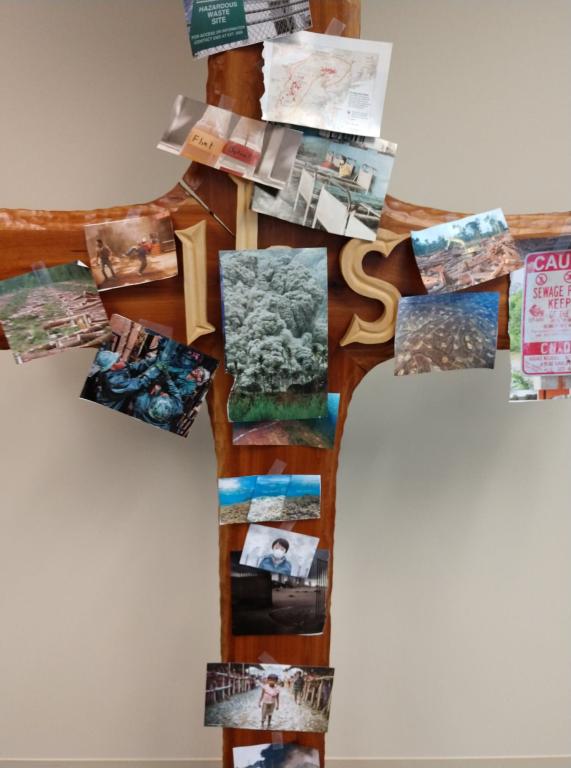
As Christians remember the crucifixion of Jesus on Good Friday, many will engage in a practice called The Stations of the Cross. Also known as the Way of the Cross, or the Way of Sorrows, the Stations of the Cross is a series of images depicting scenes from the crucifixion of Jesus Christ. Often found in Roman Catholic churches or outdoor spaces, these images are designed as a kind of spiritual pilgrimage to help the faithful contemplate the Passion of Christ. [Read: “The Stations of the Cross, a City Park, and Justice.”]
In light of the eco-crucifixion of our planet, I am suggesting that Christians practice an Ecological Stations of the Cross.
[This resource is part of the EcoPreacher 1-2-3 series that helps preachers and congregations address environmental issues in their sermons and ministry. The Ecological Stations of the Cross is made possible through support from the Interfaith Center of Sustainable Development with editing assistance from Rabbi Yonatan Neril.]
[En espanol, clique aqui.]
What is Eco-Crucifixion?
I coined the term eco-crucifixion in my book, Creation-Crisis Preaching: Ecology, Theology, and the Pulpit. Eco-crucifixion describes the torture, suffering, and death of the natural world and human communities due to environmental violence.
In his book, Finding God in the Singing River: Christianity, Spirit, Nature, Mark Wallace makes the case that the “cruciform Spirit” embodied in and through Earth suffers just as Jesus did on the cross. Today, the continual siege of ecological sin is leading to eco-crucifixion.
Wallace warns of a “permanent trauma to the divine life itself.” This happens through the crucifixion-like ecocide that humans inflict upon Earth and its inhabitants (129). He equates God’s suffering through Jesus on the cross with God’s suffering through the embodied Spirit in Earth.
Wallace hopes for “a conversion of the heart to a vision of a green earth, where all persons live in harmony with their natural environments.” Further, he urges us to “work toward a seamless social-environmental ethic of justice and love toward all of God’s creatures” (136).
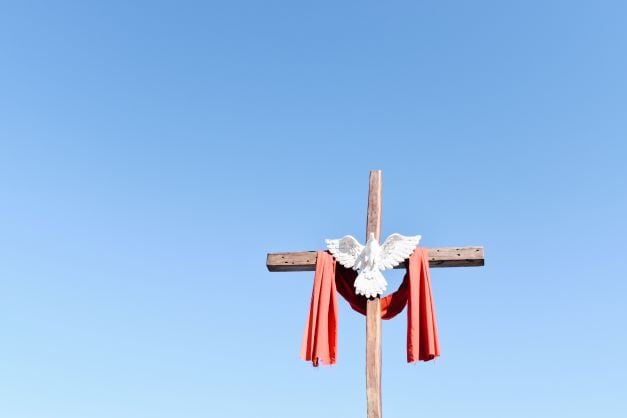
An Ecological Stations of the Cross can help process eco-anxiety and eco-grief
I’ve been working with the BTS Center and Creation Justice Ministries to host the EcoPreacher Cohort. This is a monthly online gathering of preachers for education, encouragement, and to address environmental issues in sermons. Nine in ten participants say that exploring their own eco-anxiety and eco-grief is either a “high” or “medium” priority. As species extinction, habitat loss, deforestation, and catastrophic weather events increase every year, feelings of loss and grief become more acute.
One way that the church can help process these feelings is by creating rituals for eco-lament, such as funerals for trees and remembering extinct species on All Saints Day. We can also offer blessings for those who protest environmental devastation. The Ecological Stations of the Cross is one of these rituals.
Uses for Ecological Stations of the Cross
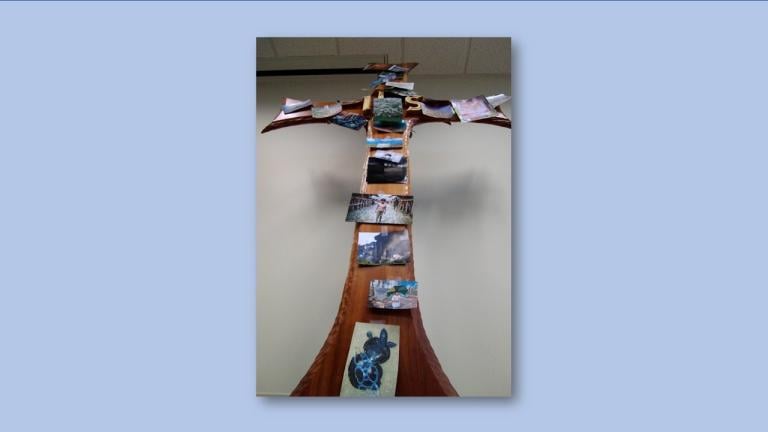
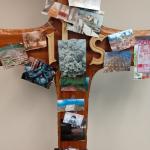
This Ecological Stations of the Cross can be done in a church sanctuary or outside on the church grounds. It can also be used in a local park or in a labyrinth. Place a cross affixed with images that symbolize the form of eco-crucifixion commemorated at each station. Alternatively, in an outdoor space, the images could be temporarily fastened to trees (without damaging the trunks, of course). Or as in the photo below, invite participants to choose from images of environmental devastation to affix to one large cross.
This ritual could be done as a group with different individuals invited to read the meditation for each station. Also, local musicians could offer appropriate hymns or songs to help sing the lament of the people.
Or the ritual could be done individually with a booklet handed out during the time that the stations are open. The booklet could contain the meditations from the Ecological Stations of the Cross (which are free for use with proper attribution) to enable participants to contemplate and reflect on Earth’s Via Dolorosa (Way of Suffering). [Click here for the PDF version in English. Access the Spanish-language version here.]
Use the Ecological Stations of the Cross for personal devotions as well. There are seven entries to read as part of your meditations for the seven days of Holy Week. Begin on Palm Sunday and conclude on Holy Saturday.
Action Emerges from Lament
Offer materials with ideas to take action as participants in the Ecological Stations of the Cross conclude their time with this ritual. Here are just a few ideas:
- Begin a Creation-centered Bible study using Eco Bible to learn about the deep Earth-wisdom woven throughout the Hebrew Scriptures.
- Provide a list of local environmental organizations with whom people can join to maximize their impact for change.
- Start (or recommit) an eco ministry in the congregation to educate and advocate for Creation care.
- Educate clergy and parishioners about the climate crisis to take effective action on a personal, professional, and political level. Faith-based organizations with excellent resources include: Blessed Tomorrow, Creation Justice Ministries, The BTS Center, Interfaith Center for Sustainable Development, and GreenFaith.
Download the Ecological Stations of the Cross here.
Access the Spanish-language version here.
Read also:
The Last Rhino, Good Friday, and the Preachers’ Silence
The Pietà of a Mother Orca: Carrying the Grief of an Eco-Crucifixion
Preaching about Racism, Economics, and Environment
EcoPreacher 1-2-3
EcoPreacher 1-2-3 is a partnership between the Rev. Dr. Leah Schade and the Interfaith Center for Sustainable Development, publishers of Eco Bible, a Jewish ecological commentary on the Hebrew Scriptures. We provide Creation-centered sermon preparation that is short, accessible, and based on a solid biblical foundation. To see other EcoPreacher ideas and to sign up to receive future EcoPreacher 1-2-3 installments, click here.
The Rev. Dr. Leah D. Schade is a seminary professor and ordained minister. Her opinions are her own. Leah is the author of Preaching and Social Issues: Tools and Tactics for Empowering Your Prophetic Voice (Rowman & Littlefield, 2024), Preaching in the Purple Zone: Ministry in the Red-Blue Divide (Rowman & Littlefield, 2019) and Creation-Crisis Preaching: Ecology, Theology, and the Pulpit (Chalice Press, 2015). She is the co-editor of Rooted and Rising: Voices of Courage in a Time of Climate Crisis (Rowman & Littlefield, 2019). Her book, Introduction to Preaching: Scripture, Theology, and Sermon Preparation, was co-authored with Jerry L. Sumney and Emily Askew (Rowman & Littlefield, 2023).












 Ad-Free & Subscriber Log-In