

One of the most poignant moments of the Good Friday service for me is when the acolyte stands before the candelabrum during the Tenebrae and extinguishes the next-to-last flame.

The Good Friday service begins in silence.
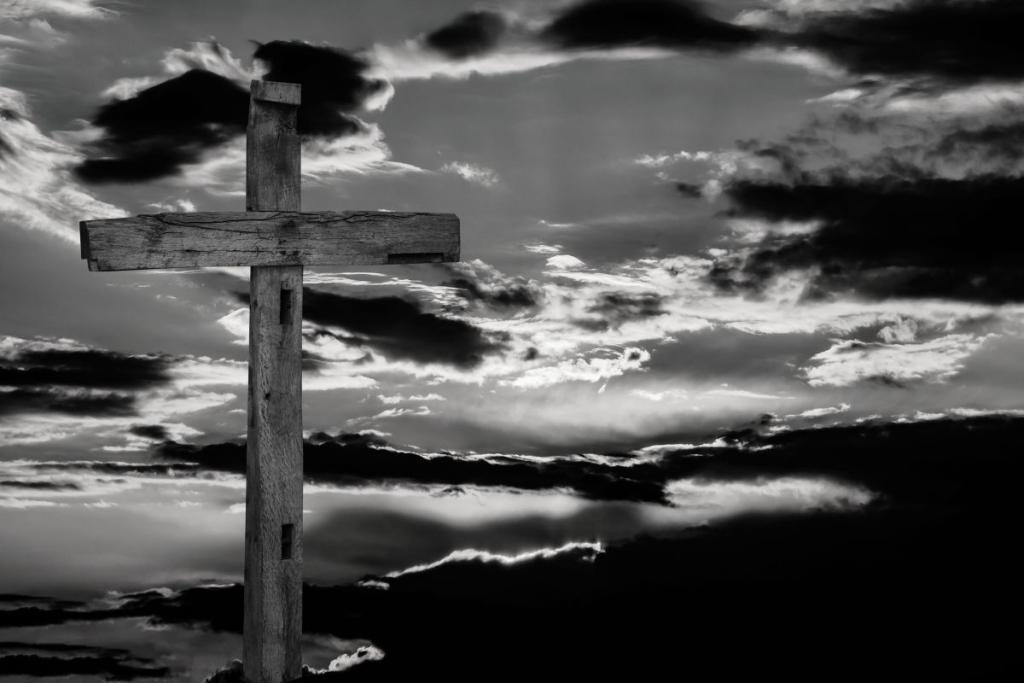
There’s no organ prelude, no chit-chat about going to brunch afterward. Black cloth drapes the cross. All the paraments and decorations are gone. They were removed from the chancel at the conclusion of the Maundy Thursday service.
All that remains is a seven-branched candelabrum, a lampstand resembling the Jewish Menorah. It stands before the congregation gathered on Good Friday for the service of gradual darkness. For Christians, the candelabrum symbolizes the sevenfold Spirit of God. The candle at the top represents the light of Christ.
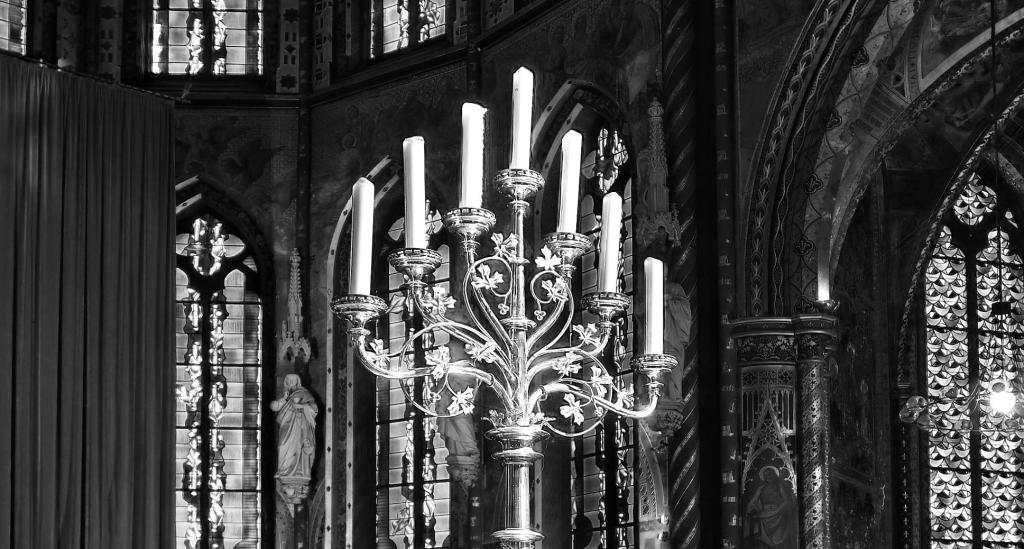
During this service of solemnity and grief, we read passages from the Bible telling the story of Jesus’s arrest, trial, torture, and execution. It’s the story of an innocent man cruelly and unjustly murdered by the Roman government in collusion with religious leaders. After each reading, the acolyte places the small, bell-shaped end of the snuffer over a candle to extinguish its flame.
Good Friday holding space for eco-grief
As a Christian who deeply loves the natural world God created, including the birds and flowers Jesus spoke about in his teachings (Matt. 6:25-34), Good Friday creates a liturgical holding space for my grief for all we have lost.
Or, rather, all that has been cruelly and unjustly taken from us by a government in collusion with religious leaders. The forests clear cut for fracking and mining. Clean waters poisoned by industrial waste and consumer plastics. Pure air choked by fossil fuel emissions. And endangered species extinguished like a flame at the end of the acolyte’s snuffer.
“God Squad” votes to send more species to extinction
On March 31, 2026, a Congressionally authorized committee known as the “God Squad” voted unanimously to exempt oil and gas drilling activities in the Gulf of Mexico from complying with the Endangered Species Act. The committee, made up of Trump-appointees, permitted the oil and gas industry to bypass protections for endangered species such as sea turtles, manatees, and Rice’s whales. This committee has extensive ties to the fossil fuel industry, and the conflict of interest at their core threatens the integrity of our nation’s most successful conservation law.
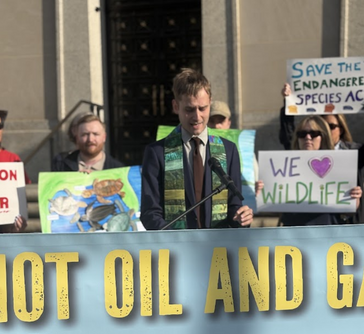
When my friend and colleague, Avery Davis Lamb, director of Creation Justice Ministries, told me about this exemption, I felt gutted. How tragically ironic that this vote took place during Holy Week. And how brave and faithful he and others were to stand before the Department of the Interior to protest this action.
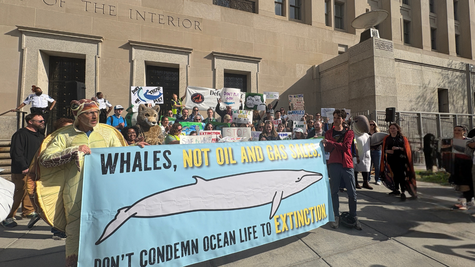
The hypocrisy, irony, and tragedy of this political act during Holy Week
“It’s not lost on me that during Holy Week the so-called God-squad convenes to determine which of God’s creatures are expendable,” said Avery, in his speech. “Once again, just like that week over 2000 years ago: A council of political leaders gathers to decide what lives and dies.”
Authorized by Congress in 1978 but convened only three times in nearly 50 years, the “God Squad” has the exclusive authority to grant broad exemptions to the Endangered Species Act. By permitting economic priorities to take precedence over the survival of species, this committee essentially decides which of God’s creatures will be saved and which will face extinction. In other words, they get to play “God” in deciding between life and death for the most vulnerable species.
Christian Nationalism’s anti-environmental agenda
This cruel and unjust action by our government was indeed committed in collusion with religious leaders. Project 2025, the blueprint for the Trump administration rooted in Christian nationalist ideology, has shaped regulatory decisions that align with its broader agenda of prioritizing economic and political goals over environmental protections. Christian nationalism distorts and twists Christian teachings and interpretations of the Bible to justify its agenda for dominance over the Earth.
As Carter Heyward explains in The Seven Deadly Sins of White Christian Nationalism, a theology of domination treats the Earth and nonhuman creatures as objects to be controlled rather than neighbors to be loved. She argues that our faith must include the well-being of both humans and Creation. But white Christian nationalism rejects this holy mandate by shaping faith around power, supremacy, and a politics of control instead of God’s justice.
“In America, and wherever on earth the Christian Church plays a major role in shaping cultural norms and politics, the root of planetary destruction is a bad Christian theology of domination,” Heyward writes. This heretical theology is specifically about “rulership of the earth and earth creatures rather than of building mutual partnership with earth and animals as our way of being human” (117).
Countering the sin of domination over Earth and Earth’s creatures
Heyward challenges Christians to “creatively and constructively combat white Christian nationalism’s deadly sin of domination over the earth and all earth creatures” (126). My friend, Avery, echoed this challenge in his address at the Department of the Interior. He called on the members of Administration to follow their duty to preserve the public trust and the sanctity of life. His charge exhorted them to adhere to their ethical obligation to prevent extinction.
Avery also noted the hypocrisy of a supposedly “Christian” Administration celebrating Easter “while continuing to crucify creation.” He pointed out that “by weaponizing this committee for short term profit, the administration is turning its back on our call to care for creation. We cannot remain silent while the political interests of the oil and gas industry are placed above the inherent value of God’s handiwork.”
And yet on this day, Good Friday, silence is the only appropriate response.
As Avery wrote in a profound reflection following the “God Squad’s” vote:
In the Good Friday readings, we are reminded that on the cross, Jesus cries out, ‘My God, my God, why have you forsaken me?’ And then: silence. Silence.
As I hear these readings, I can’t help but think of the call of the Rice’s whale ‘long-moan call,’ a bass vibrato echoing through the Gulf waters. I heard it for the first time this week through a NOAA recording (which you can hear here) and imagined it speaking back to us: ‘My friends, my fellow creatures: why have you forsaken me?’
The cry of the Rice’s Whale
The Rice’s Whale is one of the rarest whale species on earth. There are less than 100 remaining of America’s only endemic whale species.
On Good Friday, Christ’s cry is echoed by the Rice’s Whale, the Kemp’s Ridley sea turtle, the Mexican Four-Eyed Octopus, and countless other endemic species threatened with loss of habit, suffering from pollution, and extinction.
I read Avery’s words, imagining the members of the God Squad gleefully exercising idolatrous power in that well-appointed room at the Department of the Interior. It was like sitting in church on Good Friday, watching the next-to-last candle snuffed out.
A single candle
At the end of the service, the acolyte takes the final candle from the stand and processes down the aisle to the back of the church. All the lights in the sanctuary go out. We sit in complete darkness for what seems like an interminable stretch of time.
The cavernous room is tomb-like. It evokes the utter darkness of the grave. Sometimes I hear muffled sobs in the darkness. Often, tears run down my own cheeks as I contemplate the finality of crucifixion. Eco-crucifixion. Extinction.
Then a soft shuffling of feet disturbs the silence. The acolyte returns with the candle. The flame, small though it is, remains. The acolyte reaches up and places the lit candle into the top of the candelabrum. No words are spoken as the congregation leaves the sanctuary in silence.
Slowing down to grieve
This tiny flame is the light that will begin our Saturday Vigil. It is a service of readings, prayers, and hymns eventually leading to a remembrance of baptism and an announcement of resurrection followed by communion.
I know many want to rush to Easter and the grand flood of sunlight drenching the sprays of flowers trumpeting the Resurrection.
But I’m not moving that fast today.
I’m going to sit quietly holding my candle, listening for the sound of the Rice’s whale in the depths of the sea.
Read also:
The Pietà of a Mother Orca: Carrying the Grief of an Eco-Crucifixion
The Last Rhino, Good Friday, and the Preachers’ Silence
An Ecological Stations of the Cross, 2026
Ecological Stations of the Cross: #1 – Condemned to death

The Rev. Dr. Leah D. Schade is a seminary professor, ordained minister, and grant director of Compelling Preaching in a Climate-Changed World, a partnership of Lexington Theological Seminary, Creation Justice Ministries, and The BTS Center. Her opinions are her own.
Leah is the author of Preaching and Social Issues: Tools and Tactics for Empowering Your Prophetic Voice (Rowman & Littlefield, 2024), Preaching in the Purple Zone: Ministry in the Red-Blue Divide (Rowman & Littlefield, 2019) and Creation-Crisis Preaching: Ecology, Theology, and the Pulpit (Chalice Press, 2015). She is the co-editor of Rooted and Rising: Voices of Courage in a Time of Climate Crisis (Rowman & Littlefield, 2019). Her book, Introduction to Preaching: Scripture, Theology, and Sermon Preparation, was co-authored with Jerry L. Sumney and Emily Askew (Rowman & Littlefield, 2023).









 Ad-Free & Subscriber Log-In