

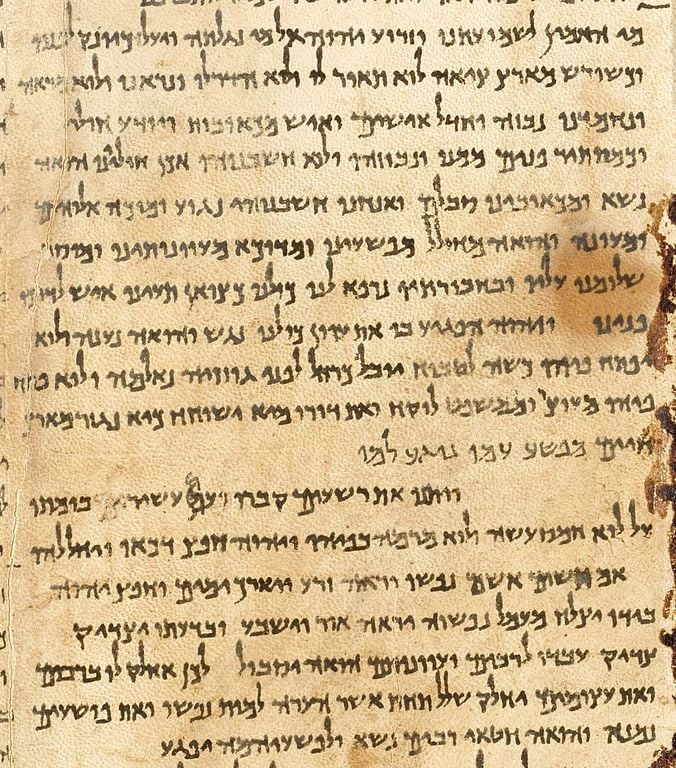
Posted today on the static, never-changing website of the Interpreter Foundation: “Seek Ye Words of Wisdom: Paragraphs and Verses in the Scriptures,” written by Kent P. Jackson:
Part of our book chapter reprint series, this article originally appeared in Seek Ye Words of Wisdom: Studies of the Book of Mormon, Bible, and Temple in Honor of Stephen D. Ricks, edited by Donald W. Parry, Gaye Strathearn, and Shon D. Hopkin. For more information, go to https://interpreterfoundation.org/books/seek-ye-words-of-wisdom/.
“English-speaking Latter-day Saints are used to seeing each verse of the scriptures start a new paragraph. But this isn’t how the scriptures were written, and it isn’t how they’ve always been. Books in the Old and New Testaments were written with some internal divisions but not with the chapters as we have them today. The numbered chapters in modern Bibles are, by biblical standards, a rather recent development, having been inserted into the Bible only in the thirteenth century AD.”
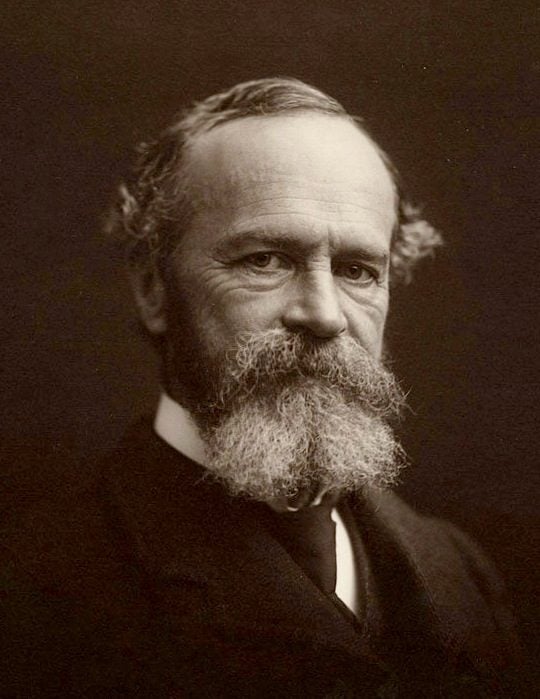
James and his companions in this scientific ghost hunt were famed for their intellectual brilliance—their intellectual courage gained them less admiration. Yet they possessed both qualities in abundance. James’s fellow ghost hunters included the codiscoverer of the theory of evolution, a physiologist from France who would win the Nobel Prize in Medicine, an Australian who became a founding member of the American Anthropological Society, a female mathematician who became principal of Cambridge University’s first college for women, a pioneer in British utilitarian philosophy, and a trio of respected physicists. All of them had reputations that would suffer as a consequence, and all of them, like William James, would refuse to abandon the search. (15)
James wrote to Science magazine, a journal devoted to upholding the research ethic, that he loathed the reverential use of the word “scientist . . . it suggests to me the priggish, sectarian view of science, as something against religion, against sentiment,” even against real-life experience. (17)
“The ideal of every science is that of a closed and completed system of truth,” James acknowledged. If supernatural events did not match the categories of the scientific system they “must be held untrue.” James admired the efficiency of the “scientific” approach to the spiritual murkiness. “It is far better tactics, if you wish to get rid of mystery, to brand the narratives themselves as unworthy of trust,” James wrote. But while he agreed that most so-called supernatural events were suspect, he worried that scientists stayed deliberately blind to the rare credible ones, that researchers might be ignoring “a natural kind of fact of which we do not yet know the full extent.” And he worried too about the larger effect of such prejudice on the way people viewed science itself. “Thousands of sensitive organizations in the United States today live as steadily in the light of these experiences, and are as indifferent to modern science, as if they lived in Bohemia in the twelfth century. They are indifferent to science, because science is so callously indifferent to their experiences.” . . .
If scientists did not afford some respect to the beliefs of the lay public, James warned, there was little reason for the public to respect the pronouncements of science. (42)
He complained that a scientist seeking to explore the supernatural found himself instantly demoted, “set down as credulous and superstitious, if not openly accused of falsehood and imposture, and his careful and oft-repeated experiments ignored as not worth a moment’s consideration.” (65)
The message seemed clear enough. Investigating supernatural events was off limits to scientists, unless the findings proved fraud. Those who chose to ignore that rule—unspoken but strictly enforced—would find themselves off limits as well. (71)
James had that year also published in a popular magazine an essay favorably comparing psychical research to other fields of science. To the readers of Scribner’s, James had extravagantly praised his colleagues, naming Henry Sidgwick “the most incorrigibly and exasperatingly critical and skeptical mind in England.” He also praised the SPR publications: “Were I asked to point to a scientific journal where hard-headedness and never-sleeping suspicion of sources of error might be seen in their full bloom, I should have to fall back on the Proceedings of the Society for Psychical Research.” (236)
In perhaps his strongest criticism of those scientists to date, James wrote in Scribner’s that in its determined orthodoxy, scientists had come to seem a mirror image of those clergymen who insisted on only one way of seeing the world: “Science means, first of all, a certain dispassionate method. To suppose that it means a certain set of results that one should pin one’s faith upon and hug forever is sadly to mistake its genius, and degrades the scientific body to the status of a cult.” (237)

My wife and I went out to dinner last night with two of the students who were with us when I led an intensive Arabic program over in Jerusalem back in the first half of 1993. One of them was visiting, with his wife — who also came last night — from Fairbanks, Alaska, where he is a physician. It was a very pleasant evening. We spoke of politics and family and joys and sorrows, of friends and memories. I’m thrilled to see how members of that small group of students are doing. Since, to our own surprise, we ended up living in the BYU Jerusalem Center itself rather than, as we had expected, out in faculty housing in the French Hill part of the city, we came to know them exceptionally well. It was a great experience for us and, I hope, for them also.

Theists and theism continue to hurt people worldwide. Here are three more examples of their crimes, drawn from the sadly inexhaustible Christopher Hitchens Memorial “How Religion Poisons Everything” File™:
- “Church Education Initiative Is Helping Youth Succeed in School: After-school program promotes academic, spiritual and life skills”
- “Succeed in School”
- “Refugee Children Find Hope in Jordan: Latter-day Saints and Baptists collaborate to uplift refugee families through education and medical care”
Someday, perhaps, governments worldwide will come to their senses and join together to prohibit and punish such exploitation of innocent young people. In the meantime, though, the blind, pitiless, indifferent, deterministic, unaware cosmos rolls pointlessly on, compelling us to suffer such wrongs.













 Ad-Free & Subscriber Log-In