

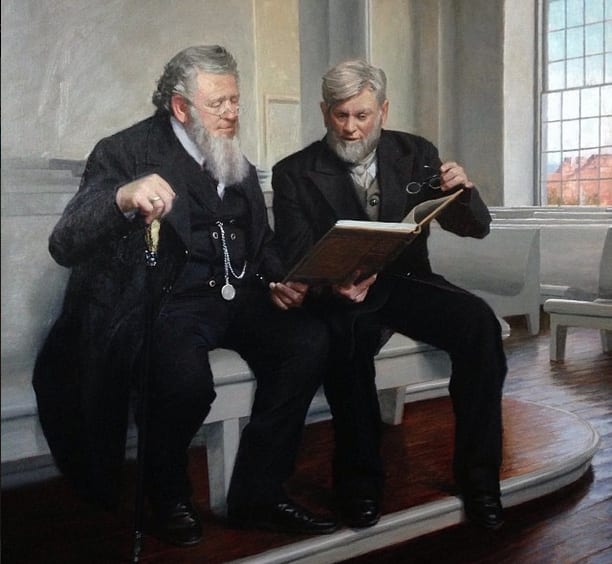
A new article of mine has gone up in Meridian Magazine: “Brigham Young, Race, and Slavery: Reexamining Utah’s 1852 Service Act.” If you can bear to do so, please feel free to take a look at it.
Also on the subject of Brigham Young, we were back again today in the Pioneer Memorial Museum in Salt Lake City — the headquarters of the Daughters of the Utah Pioneers — for more filming. The footage that we obtain there will eventually become part of Becoming Brigham, a forthcoming series of short documentaries from the Interpreter Foundation and Red Brick Filmworks.
While waiting for the filming to begin — our film team are setting up cameras, positioning lights, and so forth, and strictly (and prudently) forbid ignoramuses such as I to mess with the equipment — I read an interesting article from a British magazine called The Catholic Herald: “Pope Leo’s desire for ‘flatmates’ offers a valuable lesson to all Catholics: It is encouraging to discover the Pope’s determination to live in community and bring Augustinian spirituality to the heart and apex of the Catholic Church, beginning with the papal apartments.” The article is interesting overall, but a particular point stood out to me for separate mention:
The article cites the English historian Peter Ackroyd as having noted that something like 90 per cent of the world’s ghost stories are found in English literature. Ackroyd apparently also suggests that one of the reasons for this seeming obsession with tales of the macabre lies in Henry VIII’s spectacular dissolution and pillaging of the the nation’s monasteries at the commencement of the English Reformation. Why? Because it abruptly ended the long-established English Catholic practice of prayer for the dead.
I don’t know whether this is actually true. But it’s an intriguing thought.
I’ll try to flesh the argument out as I understand it, a bit beyond what the article itself actually says: With his destruction of the monasteries, Henry put an end to the perceived reality of “the Communion of the Saints,” which was conceived as the spiritual union of all who are united in Christ — that is to say, the union of all Christians — including the faithful on Earth (“the Church Militant”), the souls still working through Purgatory (“the Church Penitent,” or “the Church Suffering”), and the saints in Heaven (“the Church Triumphant”), who form, altogether, one “mystical body” head by Christ. (The damned, the souls in Hell, are excluded; they are literally excommunicant.) Members of the Communion of the Saints participate in each other’s spiritual welfare and well-being, praying for one another out of the recognition that death ends neither their mutual love nor their fellowship with one another
The author of the article, a British Catholic convert named Gavin Ashenden, argues that the abolition of the monasteries by Henry VIII (whom he terms “psychopathic”) was a catastrophe,
leaving a scar on the national psyche that has never yet been healed. . . . The suppression of our monasteries interrupted a profound sense of communal belonging across space and time, between the generations. Consequently a profound neurosis entered the collective English soul which erupted in the sterile preoccupation with ghosts and ghost stories.
As I say, I don’t know whether the claim advanced by Peter Ackroyd and, now, by Gavin Ashenden holds up, but I find it an interesting opportunity for reflection, as follows:
Latter-day Saints don’t use the term “Communion of Saints” or “Communion of the Saints.” But, in its essence, I don’t think that the concept is entirely foreign to us. We don’t officially pray for the dead or seek intercession from the Saints, but we do perform ordinances on behalf of the dead in our temples and, through genealogical research or family history work, we seek out the names of the dead in order to serve them. The fourth element of the “four-fold mission of the Church” is “uniting families for eternity.”
Moreover, we expect that those who have gone on before us remain interested in our lives and our choices. I could elaborate further on this — and may, at some point, do so — but these seem to me clear indicators of a conception rather like that of a “Communion of the Saints.” Which may, I think, help to explain what I judge to be a pretty healthy view of death and of the dead among believing Latter-day Saints. We are, I think, exceptionally receptive to accounts of near-death experiences. And when we hear reports of encounters with the dead occurring during family history research or attendant upon temple service, we welcome them — and there is, in them, no trace of darkness or the macabre. On the contrary, there is light.
Henry VIII may perhaps have left a scar on the English psyche that survived him for centuries. His action may well have disrupted the profound sense of communal belonging across space and time, between the generations, that once prevailed, creating a profound neurosis about death and the dead. The ordinances of the temple, however, and the profoundly important work of the redemption of the dead, offer a path to healing.
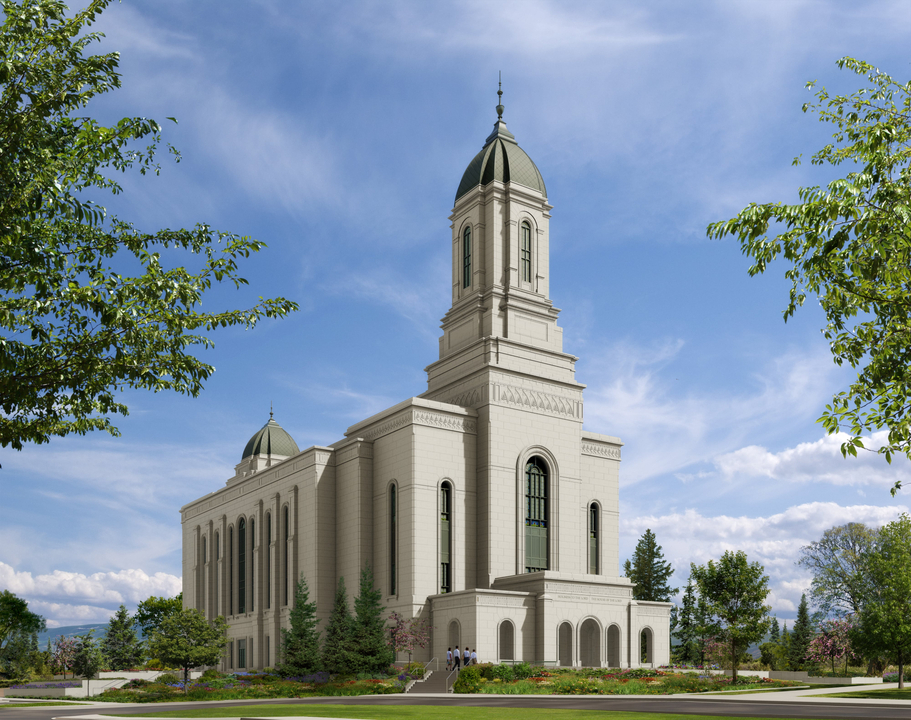
This is great news: “Construction for Heber Valley Utah Temple underway: 3 years after its groundbreaking, construction work on the previously postponed Heber Valley Utah Temple has begun”
Brethren, shall we not go on in so great a cause? Go forward and not backward. Courage, brethren; and on, on to the victory! Let your hearts rejoice, and be exceedingly glad. Let the earth break forth into singing. Let the dead speak forth anthems of eternal praise to the King Immanuel, who hath ordained, before the world was, that which would enable us to redeem them out of their prison; for the prisoners shall go free. -Joseph Smith, 6 September 1842; Nauvoo, Illinois (Doctrine and Covenants 128:22)












 Ad-Free & Subscriber Log-In