


The information that I’ve reproduced immediately below — drawn from an official release from the Church of Jesus Christ of Latter-day Saints — is easily accessible online at “Preventing and Responding to Abuse.” (“This document summarizes current Church policies and guidelines on abuse. All priesthood and Church organization leaders should be familiar with and follow them to help protect God’s children.”). It’s well worth a look, for those who hold opinions on the subject or hope to do so:
The Abuse Help Line
For some years, the Church has operated a free and confidential abuse help line (1-800-453-3860, ext. 2-1911), established for bishops and stake presidents in the United States and Canada. In other areas, bishops who learn of possible abuse should contact their stake presidents, who will seek guidance from the Area Presidency. (See General Handbook: Serving in The Church of Jesus Christ of Latter-day Saints, 38.6.2.1, ChurchofJesusChrist.org.)
The following information will help bishops and stake presidents use this help line:
This help line is available for bishops and stake presidents to call 24 hours a day, 7 days a week, when addressing situations involving any type of abuse.
The bishop or stake president should promptly call the help line about every situation in which he believes a person may have been abused or neglected or is at risk of being abused or neglected.
When bishops or stake presidents call the help line, legal and clinical professionals will answer their questions and provide instructions about how to assist victims, comply with local laws and requirements for reporting abuse, and protect against further abuse. For more information, see General Handbook, 38.6.2.1.
I have a specific reason for reproducing the information above in this blog entry: I’ve posted items over the past two days, here and here, regarding the Church’s “help line,” assuming that people reading those items knew what it is. Apparently, though, I was wrong. In at least one case.
I’ve often referred here to an anonymous detractor of mine whom I’ve designated (with clinical accuracy) my “Malevolent Stalker.” He’s been closely monitoring me for something on the order of fifteen or twenty years now, commenting day in and day out, week in and week out, month in and month out, year after year after year, on my depraved buffoonery, my mean-spirited cruelty, my incompetence, my venality, my dishonesty, and my general wickedness. So, of course, he’s been very critical of my posts here about the “help line.”
Something that he posted yesterday, though, strongly suggests that he doesn’t even actually know what the “help line” is. In his post, he says that, were I to find out that a loved one of mine was being abused, I would surely call the relevant legal authorities rather than dialing up the Church’s “help line” and depending upon its “bureaucrats” for remedy.
And, of course, he’s right. (Not about my being a hypocrite on this subject, but that I wouldn’t call the Church’s “help line.”)
The “help line” isn’t intended for everybody and anybody out there who knows of abuse or who suspects that abuse is occurring. It certainly isn’t intended as a universal substitute for relevant legal procedures. It is, as the passage cited above clearly and repeatedly says, “for bishops and stake presidents.” Specifically, as should be obvious, it’s “for bishops and stake presidents” who learn of abuse or form suspicions of abuse in the course of carrying out their ecclesiastical duties. If, for example, while interviewing a member of his ward, a bishop hears a confession of abuse or of experiencing abuse, or begins to worry that abuse might be happening, what is he to do? (Such interviews are typically conducted with the expectation of privacy or confidentiality, so the question arises — for example — when something comes up in the course of the conversation that could potentially entail intervention by law enforcement or by child protective services.)
As someone who is currently serving neither as a bishop nor as a stake president, I’m under no expectation of “clergy-penitent confidentiality” and, thus, in that regard at least, my path to calling in the proper government authorities in a case of real or suspected abuse is clear and unproblematic. The Church is absolutely not telling concerned parents or grandparents to contact their bishop or call the “hot line” in lieu of contacting law enforcement or child welfare agencies.
My Malevolent Stalker is usually more cunning and clever than this. Candidly, I’m a bit disappointed; I expect more from him. His mysteriously implacable, comprehensively distorting, and obsessive personal hatred for me is, of course, a given. It’s invariable. But not fundamental incompetence.

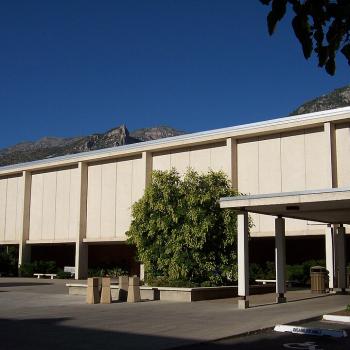
(Image from the BYU website)
On a somewhat related topic: Browsing through the Christopher Hitchens Memorial “How Religion Poisons Everything” File™ this morning, I came across an interesting article, written by Jacob Hess, Stephen Cranney, and Shima Baradaran Baughman, that originally appeared in this morning’s issue of Salt Lake City’s Deseret News: “Seeking a more comprehensive understanding of sexual violence in Utah: To reducing sexual violence, it’s crucial to consider all available data to understand this tragic problem with greater clarity.” I share a passage from it here, and I encourage you, if the subject interests you, to look at the entire piece, as well as at its predecessor in what will eventually be a four-part series:
While generalized, statewide numbers for Utah get frequent attention, more specific analyses can raise new insights. For instance, if membership in The Church of Jesus Christ of Latter-day Saints made someone more vulnerable to sexual assault, we would expect to see elevated rates of sexual violence in more Latter-day Saint heavy areas, all other things being equal.
That’s opposite of what available comparative data across Utah’s population centers suggests. . . .
In Utah, for instance, the rate of reported rape per 100,000 inhabitants in the more Latter-day Saint-heavy Provo/Utah/Orem metropolitan area is 40.8 per 100,000 people, lower than the Utah average. The Salt Lake City/Murray area is 65.3, the Ogden area is 48.7, and the St. George Metropolitan area is 44.3.
This data suggests that more Latter-day Saint-heavy metropolitan areas have lower rates of sexual violence in Utah.
In a similar way, if there is something about membership in The Church of Jesus Christ of Latter-day Saints that prevents sexual assault, we would expect to see lower rates of sexual assaults at the Church’s universities, compared with other campuses.
That’s precisely what we find when we look at the latest 2023 data gathered by the U.S. Department of Education on sexual assault on American campuses. Brigham Young University-Provo reports .03 rapes per thousand students, while the University of Utah reports 4.96 per thousand students, and Utah Valley University and Utah State report .07 and .11, respectively. Looking outside of Utah, UCLA reports 1.54, while the University of Nevada in Las Vegas is .19.
I find such statistics interesting. If you wish, you can file them under something like “Utard: How Morgbot Religious Dominance Has Made the State a Hell on Earth.”














 Ad-Free & Subscriber Log-In