


This column in the Deseret News is worth a look: “Perspective: Online influencers aren’t accurately representing Latter-day Saint reality: Disaffected influencers might be leaving a religious movement, but they’re not leading one”
So is this piece, from the Deseret News Editorial Board: “Opinion: Regaining trust in vaccinations”
And this, too: “Ready to join the new counterculture? Braver Angels’ leader says it will take courage: In a culture of widening contempt, we have the power to choose something better, says Maury Giles” (Scarcely relevant footnote: Years ago, I participated — at his invitation — in three small meetings organized by David Blankenhorn: one Malaga, in southern Spain; one at the Carter Center in Atlanta; and one on the Mediterranean island of Malta. They were attempts to foster dialogue between the West and the Islamic Middle East. I haven’t been involved in Braver Angels, but I applaud its intent. David Blankenhorn is always trying to improve conversation across yawning divides.)

Responding to a comment following my blog entry “Calling All Experts!” I remarked that, on medical subjects, “as I do in many areas of my life, I tend to accept the consensus of experts.”
Unsurprisingly, that remark draw mockery from my groupies at the Peterson Obsession Board. After all, they follow me with absolutely rapt attention pretty much twenty-four hours a day, seven days a week, and many of them are either incapable of accurately understanding what I say or too intoxicated with hatred to care about attempting such an understanding.
“Folks,” says one of them, “you can’t make this stuff up” — a formulaic comment that is commonly used on the Obsession Board, as in this case, to signal that something made-up has just been presented or is about to be presented. After all, he says, Peterson is a guy “who employs [sic] LDS academics for the express purpose of going against the consensus of experts.” Which, I guess, is supposed to be a contradiction. Which, comments another groupie, proves me a “hypocrite.”
Except, of course, that it doesn’t.
Why? I’ll try to explain this so clearly that any reasonably intelligent and minimally honest reader should be able to follow me. How my groupies at the Obsession Board will react, of course, is a different matter.
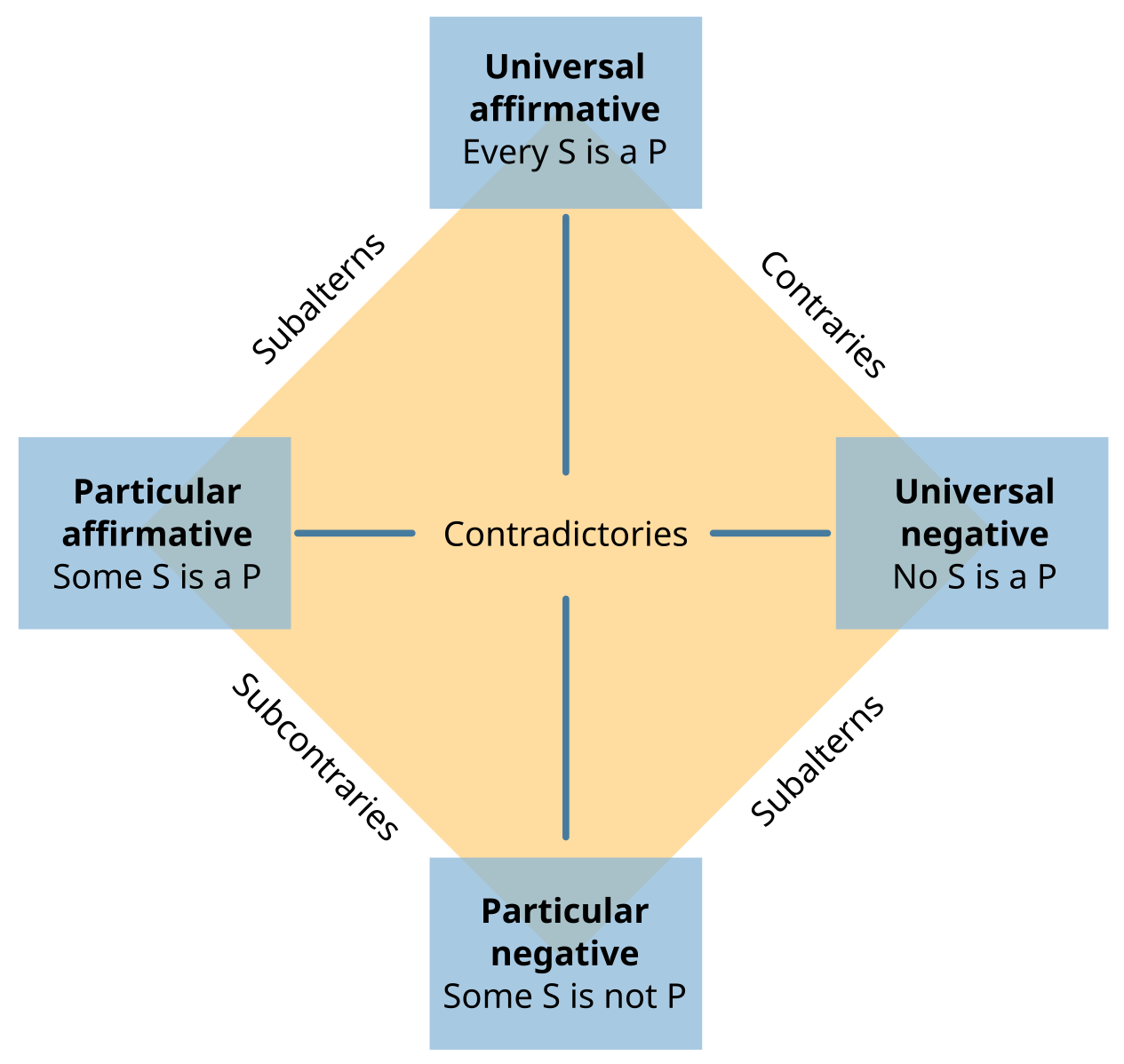
The four corners of the chart shown above represent the four basic forms of propositions recognized in classical (Aristotelian) logic:
A propositions, or universal affirmatives, take the form: All S are P or Every S is a P.
E propositions, or universal negations, take the form: No S are P or No S is a P.
I propositions, or particular affirmatives, take the form: Some S are P or Some S is a P.
O propositions, or particular negations, take the form: Some S are not P or Some S is not P.
On the assumption made within classical (Aristotelian) categorical logic, that every category contains at least one member, the following relationships hold within the square:
Firstly, A and O propositions are contradictory, as are E and I propositions. Propositions are contradictory when the truth of one implies the falsity of the other, and conversely. Thus, the truth of a proposition of the form All S are P implies the falsity of the corresponding proposition of the form Some S are not P. For example, if the proposition “All expert consensus opinions are trustworthy” (A) is true, then the proposition “Some expert consensus opinions are not trustworthy” (O) must be false. Similarly, if “No expert consensus views are trustworthy” (E) is false, then the proposition “Some expert consensus views are trustworthy” must be true.
Secondly, A and E propositions are contrary. Propositions are contrary when they cannot both be true. An A proposition — e.g., “All experts are right” — cannot be true at the same time as the corresponding E proposition: “No experts are right.” Please note, however, that A and E propositions, while they are contrary, are not contradictory. While they cannot both be true, they can both be false; “All experts are right” and “No experts are right” don’t exhaust the logical possibilities: “Some experts are right” (a proposition of form I), if it is the case, obviously falsifies the corresponding A and E propositions.
Next, I and O propositions are what classical Aristotelian logic terms subcontrary. Propositions are subcontrary when it is impossible for both to be false. Because “Some experts are infallible” is false, “Some experts are not infallible” must be true. Please notice, however, that it is possible for corresponding I and O propositions both to be true, as with “Some authorities are reliable,” and “Some authorities are not reliable.” Again, I and O propositions are subcontrary, but they are neither contrary nor contradictory.
Finally, two propositions are deemed to stand in the relation of subalternation when the truth of the first (the “superaltern”) implies the truth of the second (the “subaltern”), but not conversely. A propositions stand in the relation of subalternation with the corresponding I propositions. The truth of the A proposition “All experts are fallible” implies the truth of the proposition “Some experts are fallible.” However, the truth of the O proposition “Some experts are not correct” does not imply the truth of the E proposition “No experts are correct.” In traditional logic, the truth of an A or an E proposition implies the truth of the corresponding I or O proposition, respectively. Consequently, the falsity of an I or O proposition implies the falsity of the corresponding A or E proposition, respectively. However, the truth of a particular proposition does not imply the truth of the corresponding universal proposition, nor does the falsity of a universal proposition carry downwards to the respective particular propositions.
To return to my own specific case: I wrote that, in many areas of my life, I tend to accept the consensus of experts. I did not say that I always accept the consensus of experts in all areas of my life. What I actually did say can be translated into an I proposition, as follows: [Peterson believes that] Some consensus views of experts are worthy of trust, i.e., that Some S are P. Is it possible, though, for an I proposition to be true at the same time that an O proposition — Some S are not P — is true? Yes, it is. See above. They are subcontraries. They are not contrary statements, nor are they contradictory statements. It is possible — and it doesn’t make one a “hypocrite” — to believe, at the same time, that Some consensus views of experts are worthy of trust and that Some consensus views of experts are not worthy of trust.
Thus, I can be inclined to accept consensus medical and pharmacological views while, at the same time — and with neither hypocrisy nor self-contradiction — I dissent from consensus views about some aspects of pre-Classical Mesoamerica and related matters.
I doubt, of course, that this little excursus into the first week of Logic 101 — drawn quite unoriginally from https://iep.utm.edu/sqr-opp/ — will help my groupies over at the Obsession Board. I doubt that they want help. Still, although I’m retired from the university, I remain by disposition a teacher. As the late Geoffrey Chaucer put it:
A Clerk ther was of Oxenford also,
That unto logyk hadde longe ygo. . . .
Sownynge in moral vertu was his speche,
And gladly wolde he lerne and gladly teche.A Clerk there was also, from Oxford,
That had gone into the study of logic long ago. . . .
His speech was always consistent with moral virtue,
And gladly would he learn, and gladly teach.

(LDS.org)
Religions typically teach and encourage service, so, in the spirit of the Christopher Hitchens Memorial “How Religion Poisons Everything” File™ where this was found, we are obligated to conclude that service, emotional health benefits, well-being, and decreased depression must be terribly, toxically, bad things: “The startling emotional health benefits of serving others: In study after study, service towards others — both strangers and family — shows a measurable impact in boosting well-being and decreasing depression”















 Ad-Free & Subscriber Log-In