

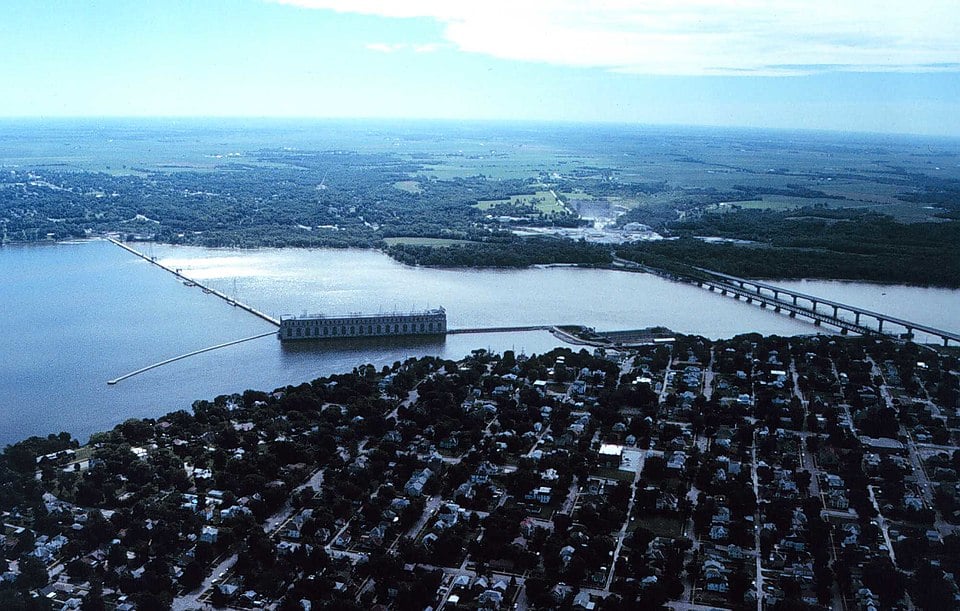
At one point, the city of Nauvoo, Illinois, was well on its way to someday having its own international airport. But the events of late June 1844 and those of the two years that followed blocked that pathway, and Nauvoo is now a small and very remote town, and quite hard to reach. I flew into St. Louis, where it was raining fairly heavily, and then drove three solo hours through Hannibal, Missouri, up to exotic Keokuk, Iowa, “the town that time forgot.”
Our core film crew arrived here yesterday, along with John Donovan Wilson (“Brigham Young” in Six Days in August) and Camrey Bagley Fox (our “Emma Smith” in both Witnesses and Six Days). They filmed today in both Nauvoo and Quincy. I needed to stay in Utah for an important meeting. But I’m here now. Filming begins for me mañana.
My wife isn’t here. She intended to be, but there was a change in calendar. So she headed down to Moab today, with friends, on a long-scheduled trip. To the real Moab, by the way. The one in southern Utah — not the wannabe pretender in the southern portion of the Hashemite Kingdom of Jordan.
And — get this! — her friends don’t have to be paid to be there. In stark contrast, those who are with me here are here for a job. They’re working here. And that probably tells you all that you need to know about my repellent personality and my legendarily repulsive lack of character.
Finally, I have a confession to make: I ate again last night. My wife and I met a fair number of our neighbors at a Greek fast food place, and I ate. (Clearly, I’ve fallen in with a bad crowd. They shamelessly encourage me in my addiction to daily eating.) Afterwards, we all attended a performance of Flowers for Mrs. Harris nearby at The Ruth and Nathan Hale Theater (aka “The Ruth,” at doTERRA) in Pleasant Grove, where the play is having its North American premiere. I confess to having not liked the first half overly much, but the second half of the play redeemed it (in, admittedly, a very sentimental and moralizing way).
Yesterday, having had a very long day in which I could not write, I reposted an old item about whether there can be any valid evidence against the claims of the Restoration. I had another long day today, during which I was unable to write. So I’m reposting the blog entry with which I followed up that original post. I’ve made a few minor mechanical changes to it and insert a brief bracketed notes:
A short while ago, I posted a blog entry titled “Can there be any valid criticisms of the Church?”
It’s generated quite a storm of indignant criticism in certain quarters over the past hour or two, none of which seems to me to have much merit, since it’s based on a fundamental misunderstanding of my point.
Why? Because my point was and is a simple, modest, and, properly understood, uncontroversial one.
Perhaps, of course, I’m just incompetent, a poor communicator. (More than a few of my many anti-fans will readily grant that, and even enthusiastically insist on it.) Or perhaps some, out of adversarial hostility or over-hastiness or pre-existing judgments or because of some other factor or factors, misread what I wrote. Or some combination of the two. (I used the term ex hypothesi in my previous post, for instance, and I think that many of the critics of the post either failed to notice it or, perhaps, didn’t know what it means.)
Whatever. It hardly matters.
Let me try again, this time syllogistically:
- Premise 1: True propositions cannot be genuinely falsified.
- Premise 2: X is a true proposition.
- Conclusion: Therefore, X is not genuinely falsifiable.
This seems manifestly, obviously, sound to me. You can easily apply it to a multitude of different situations. For example,
- Premise 1: True propositions cannot be genuinely falsified.
- Premise 2: Modus ponens (“If p, then q. p. Therefore q.”) is a true proposition.
- Conclusion: Therefore, modus ponens is not genuinely falsifiable.
Or
- Premise 1: True propositions cannot be genuinely falsified.
- Premise 2: Socrates was a man is a true proposition.
- Conclusion: Therefore, that Socrates was a man is not genuinely falsifiable.
But, of course, Premise 2 in the syllogism might actually be false. Perhaps Socrates was an alien, a shape-shifting reptilian intruder from the planet Zarkon. And, if Premise 2 is false, the Conclusion will not have been soundly derived and will, in fact, be false.
Now permit me to apply that reasoning to the specific case of my view of the Restoration:
I’m sometimes asked whether, from my point of view as a convinced believer in the Restoration, there can ever be genuine evidence against it.
My answer to this is that No, there cannot be genuine evidence against the Restoration from my point of view as a convinced believer in it.
Why?
Ex hypothesi — remember, I’m responding to a question that’s asked of me as as a convinced believer in the Restoration — the claims of the Restoration are true. Let’s reformulate that (rather crudely, I admit) as “The claims of the Restoration are, collectively, true.”
On that assumption, I offer a rephrasing of the syllogism above:
- Premise 1: True propositions cannot be genuinely falsified.
- Premise 2: The claims of the Restoration constitute a true “proposition.”
- Conclusion: Therefore, the claims of the Restoration are not genuinely falsifiable.
This seems such an obvious logical entailment that I genuinely cannot see any problem with it, nor any controversy that should attend it.
[I add here a clarification that I’m definitely not claiming infallibility for every notion, every bit of folklore, every speculative thought, every interpretation, even every commonly-shared assumption that has ever been entertained within the Church of Jesus Christ of Latter-day Saints. I can certainly discuss this further, if it proves necessary, but, for now, I’ll content myself with a quotation from Brigham Young: “I do not even believe that there is a single revelation, among the many God has given to the Church, that is perfect in its fulness. The revelations of God contain correct doctrine and principle, so far as they go; but it is impossible for the poor, weak, low, grovelling, sinful inhabitants of the earth to receive a revelation from the Almighty in all its perfections. He has to speak to us in a manner to meet the extent of our capacities.” (Brigham Young, “The Kingdom Of God,” [8 July 1855] Journal of Discourses 2:314.) But back to my oration:]
Does it mean that no evidence can ever seem to count against the claims of the Restoration? No. Not at all.
Does it mean that no decisive argument or cluster of arguments could ever conceivably be mounted against Premise 2, above (“The claims of the Restoration constitute a true ‘proposition.'”)? No, it doesn’t. I don’t anticipate seeing such an argument or cluster of arguments — certainly, in my judgment, no such decisive or conclusive arguments have yet been offered — but they’re easily conceivable. (It’s conceivable, though improbable, that a letter might be found and authenticated beyond any reasonable doubt in which Joseph Smith says “Stupid suckers! I made it all up!”)
Does it mean that I am, or that others ought to be, uninterested in evidence? Not even remotely.
What it means is that, to borrow the useful terminology of Thomas Kuhn, from within the paradigm of a convinced Latter-day Saint no evidence will ultimately prove paradigm-defeating. The same would be true, and logically should be true, of a convinced evolutionist, a convinced a believer in the Big Bang, a convinced adherent of the Stratfordian position on Shakespearean authorship, or any number of other positions.
If a paradigm-defeating piece of evidence is admitted to be such, the person recognizing it as a defeater of his or her paradigm will have no rational alternative but to abandon that paradigm — to cease, in other words, to be a Latter-day Saint, or an evolutionist, or a believer in the Big Bang, or a Stratfordian.
So, in answering the question put to me whether, as a convinced believer in the Restoration, I recognize the existence or even the real-world possibility of an ultimately valid disproof of the Restoration’s essential claim, my response must necessarily be No. Should I encounter such a decisive disproof, in recognizing it as such I would instantly and by that very act cease to be a believer in the claims of the Restoration.
In other words, what I was saying was tautological, and thus should be uncontroversial. But I don’t think it quite trivial — as, obviously, those who’ve repeatedly put the question to me over the years have also not regarded it as trivial.
Once again, though, I don’t deny, even as a firmly convinced Latter-day Saint, that there are serious-appearing arguments and evidences that a reasonable observer could regard as defeaters of the Restoration paradigm. I don’t even deny that there are arguments and evidences regarding which a reasonable observer (possibly I myself) might judge that believers don’t yet have a fully satisfactory reply. I simply say that, as a firmly convinced Latter-day Saint, I don’t believe that such arguments and evidences are actual defeaters.
Moreover, evidence — even seemingly negative evidence — can be very helpful in polishing and refining a paradigm. And, in that respect, arguments against the Restoration or against elements of its claims, even if they aren’t granted the status of paradigm-defeaters, can and sometimes do have real value.
A young child’s view of prophets and apostles probably won’t fully survive encounters with evidence of human frailty among the leadership of the Church. I don’t think that it should. But evidence of human frailty, while it can be (and has been) a defeater for some, need not be viewed as a definitive defeater of the Latter-day Saint paradigm. It can humanize and deepen our story, but needn’t upend it completely.
Maybe this will help. My resigned guess, though, is that — for some, at least — it won’t.
(I briefly discussed a related theme in a 2012 newspaper column titled “The Restoration stands up to history.”)
Posted from Keokuk, Iowa











 Ad-Free & Subscriber Log-In