

This is a really good article in Public Square Magazine, and it’s very timely: “When Law Meets Love: Dallin H. Oaks’ ministry to sexual and gender minorities: Dallin H. Oaks pairs law with love, showing humility, outreach, and a call to hold truth with tenderness.”
And this one, an article in The Conversation by , a sociocultural anthropologist and ethnographer at the University of Arkansas, is also worth reading: “The new president of The Church of Jesus Christ of Latter-day Saints will inherit a global faith far more diverse than many realize”
And I enthusiastically recommend this fine article, written for The Dispatch by Hal Boyd, a fellow of the Wheatley Institute at Brigham Young University and the executive editor of Deseret Magazine who holds degrees from both BYU and Yale Law School: “When the Latter-Day Saints Came Marching: How the quest for religious freedom transformed a people and the nation.”
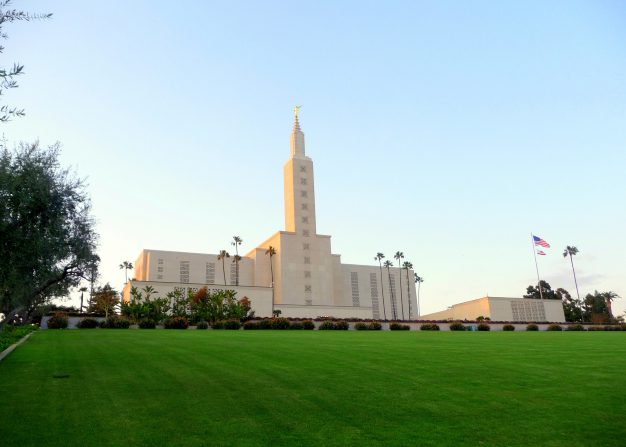
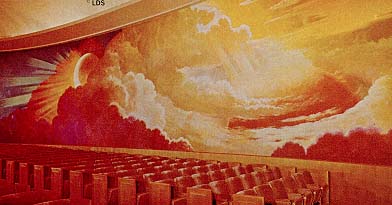
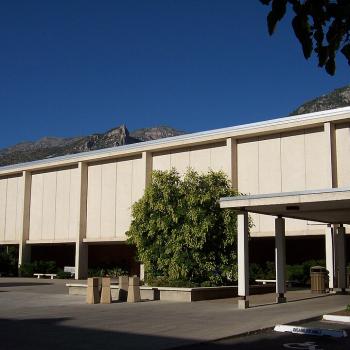
With the friend who came down with us from Utah, my wife and I attended a session today in the Los Angeles California Temple. It’s been a while since I’ve done that, and I really enjoyed it. This temple has a special family significance to me; my parents were sealed in it and my brother and I were sealed to them in it. My wife and I visited the room in which that sealing took place. (It was a year or two after our own wedding.) I was able, when I was a teenager, to participate in baptisms for the dead in the Los Angeles California Temple — something that made a mighty impression on me.
I have long thought that the temple and the Gulag are appropriate opposing symbols.
The Gulag — which, for me, represents the entire class of concentration camps, labor camps, extermination camps, death camps, or whatever you wish to call them — embodies the denial that human individuals have any intrinsic value. For Marxists, particular people are mere instantiations of classes, some of which need to be eliminated. For the National Socialists, specific individuals were nothing but representatives of approved or disapproved ethnic groups. Hitler, a social Darwinist, regarded humanity as a whole as no more than “a ridiculous cosmic bacterium” (ein lächerliches kosmisches Bakterium). For the totalitarians of the twentieth century, entire populations were to be “liquidated.” And, in the Gulag and at Auschwitz and in the Ukrainian terror-famine and in the Cambodian killing fields and, for that matter, under the blade of Madame Guillotine, they were. Brutally and remorselessly. Whole villages and towns were demolished, their records destroyed, their populations murdered, all human traces obliterated.
In stark but wonderful contrast, the temple represents a conviction that human individuals are eternal and of irreplaceable worth. They aren’t fungible. Ordinances are performed for particular people, by name. Not in batches. Families aren’t destroyed; they’re sacralized. We labor to preserve records of individuals and families, not to destroy them. We do research, sometimes at considerable cost and effort, sifting through the records that remain in order to identify our ancestors and others who have passed away. We do this so that we can act on their behalf, for their benefit. As I’ve said before, in many cases these people are being remembered, and their names are being spoken, for the first time in generations and perhaps for the first time in centuries. (Today, I was privileged to act in the temple on behalf of an ancestor of mine, Niels Rasmussen. He was born around 1778, in Odense, Denmark.) This is in dramatic and holy opposition to the work of the death camps. It is, in centrally important ways, a profoundly humanistic enterprise.

But here are a few chilling recent atrocities that I retrieved just today from the Christopher Hitchens Memorial “How Religion Poisons Everything” File™:
“Church Partners with Congolese Government to Provide Support to the Victims of Flood Disaster: The Church of Jesus Christ of Latter-day Saints Provides Humanitarian Support to the Victims of the June 14 Flood Disaster: A Partnership Welcomed by the Congolese Government.”
“Grace Ninsiima: From Poverty to BYU-Pathway Leader | Her Journey of Faith, Education & Miracles”
“Church Coordinates Relief Efforts After Earthquake in Cebu”
Referring to Latter-day Saints and the leaders of their church, one careful and objective observer recently explained on the Peterson Obsession Board that “They feel fine ignoring the poor and downtrodden.” Indeed.
Posted from Newport Beach, California









 Ad-Free & Subscriber Log-In