An aerial view of the Thomas Jefferson Building of the Library of Congress, in Washington DC. (Wikimedia Commons public domain image)
I was pleased to be able to participate on Saturday evening in an Interpreter Foundation event, a program followed by a light dinner that was jointly organized by the Foundation and by his children, in celebration of my former teacher and longtime friend and colleague Noel Reynolds. The occasion was the presentation to Noel of a festschrift — a volume of essays by friends and associates, in his honor. It was a very pleasant evening, attended by a good number of people (in some cases of people that I haven’t seen for too long a time). The only blemish on the evening was the absence of an actual final copy of the festschrift: The recent government shutdown made it impossible for us to secure a Library of Congress Control Number of LCCN in time to have the festschrift ready for presentation today’s event, which we had already scheduled so that friends and family could attend. The finished festschrift will be ready shortly. For now, we presented Noel with a spiral-bound copy of the final copyedited and typeset version.
I append below the remarks that I gave at the beginning of the evening:
Noel Reynolds has led a consequential life. He has made a difference. In many areas.
It’s an honor to pay some small measure of tribute to him. I’m pleased to represent the Interpreter Foundation today, to welcome you to this event, and much more pleased that the Foundation was able to support the production of a festschrift in his honor.
I begin with Noel’s most fundamentally important area of consequence, as a Patriarch:
Noel and Sydney are the parents of a remarkable family of eleven children. In itself, that is a major contribution that will, obviously, resound for generations to come. By definition.
He has provided important leadership in the Church:
After serving his youthful mission in Uruguay, Argentina, and Paraguay, Noel married Sydney and, thereafter, they have been equally yoked. For five years, she was a member of the Primary General Board of the Church of Jesus Christ of Latter-day Saints. And then she served as a member of the Church’s Primary General Presidency from 1999 to 2005.
Noel has served as a bishop and stake president. With Sydney at his side, he presided over the Florida Fort Lauderdale Mission, and then, with her as temple matron, as president of the Mount Timpanogos Utah Temple.
He has been of consequence as an Academic Administrator:
After finishing graduate studies at Harvard University, Noel taught on the faculty of Brigham Young University from 1971 to 2011, taking breaks to serve as a visiting professor at Harvard Law School, the University of Edinburgh, and the Hebrew University of Jerusalem. (I remember well his unique office in the bomb shelter of BYU’s Jerusalem Center for Near Eastern Studies, which is located on Mount Scopus, directly adjacent to the Hebrew University’s main campus. I thought that, if we were hit in a surprise attack, he might be the only survivor.)
Noel chaired the Department of Philosophy at BYU before joining the Department of Political Science. Eventually, he served as an associate academic vice president at BYU.
And, while he has spent a considerable amount of time as both a Church leader and a University officer, he has nonetheless managed to make significant contributions as an Academic and a Scholar:
His scholarly interests and publications cover an exceptionally wide range, from political and legal philosophy (his professional focus), and ancient Greek philosophy, through the American Founding, authorship studies, the Dead Sea Scrolls, and ancient studies more generally, to what we once innocently called “Mormon studies.” (I’m still searching for a manageable replacement name for that area of academic work.)
I’ll cite just four examples of his broad range of interests:
1988: He published Interpreting Plato’s Meno and Euthyphro.
1989: He led the research for the award-winning film A More Perfect Union: America Becomes a Nation.
1992: He served as one of the editors of the landmark multi-volume Macmillan Encyclopedia of Mormonism.
2006: With Emanuel Tov of the Hebrew University of Jerusalem, he directed the creation of The Dead Sea Scrolls Electronic Library.
However, for our purposes today and in my role as president of the Interpreter Foundation, I want to conclude by focusing on his pivotal role in Book of Mormon and related studies:
His contributions to specifically Latter-day Saint scholarship include such edited volumes as
Book of Mormon Authorship: New Light on Ancient Origins (1982)
Book of Mormon Authorship Revisited: The Evidence for Ancient Origins (1997)
Latter-day Christianity: Ten Basic Issues (1998)
Early Christians in Disarray: Contemporary LDS Perspectives on the Christian Apostasy(2006)
In 2005, an important, pathbreaking film appeared under the title of Journey of Faith: From Jerusalem to the Promised Land. Noel was its co-executive producer.
He has published twenty articles in Interpreter: A Journal of Latter-day Saint Faith and Scholarship, for which I—along with many other readers—am very grateful. But he has also earnestly sought to have the Book of Mormon taken seriously outside of what sometimes seems the Latter-day Saint “ghetto” to which Mormon’s record is often relegated.
One example of this was his convening a seminar in which prominent non-Latter-day Saint scholars came together for several days to discuss selected texts from the Book of Mormon. They were both surprised and impressed at the depth of what they saw in it. Another is his publication, in 2015, of an article entitled “The Gospel according to Mormon” in the Scottish Journal of Theology. We’ve rarely managed to reach such audiences.
It’s not surprising, given his skills as an academic administrator, that Noel has also contributed very significantly, to the management and direction of Latter-day Saint scholarly and apologetic organizations.
At various times, he served as president and director and as a member of the board for the Foundation for Ancient Research and Mormon Studies (FARMS) and its successor organization, the Neal A. Maxwell Institute for Religious Scholarship. And then, when what happened to that organization happened, he joined the board of directors for the Interpreter Foundation, on which he served very helpfully for several years.
I knew, when we founded the Interpreter Foundation, that I really wanted Noel Reynolds to be a part of it, if we could get him. His involvement would signal continuity with the previous efforts of FARMS and the Maxwell Institute. But that was far and away not my only reason.
Noel’s dedicated and productive attention to the Book of Mormon has made him a pivotal figure in the rebirth of interest in the book—a rebirth (after rather surprising neglect) to which he himself called attention in a seminal 1999 BYU Studies article entitled “The Coming Forth of the Book of Mormon in the Twentieth Century.” We needed to have him with us.
And we needed his savvy, wise, cool, and calm counsel. I’m not sure that I’ve ever actually used the word sagacity before, but it’s kept occurring to my mind as I’ve thought about what I would say here.
I’m absolutely delighted to be able to participate in honoring Noel Reynolds, who has made contributions of historic importance to the Church of Jesus Christ of Latter-day Saints, to Brigham Young University, and to the commending and defending of the Book of Mormon and the Restored Gospel of Jesus Christ.
Some months ago, I was privileged to be in a small meeting with President Jeffrey R. Holland. In that meeting, referring to another figure, an academic and writer who has played a role in contemporary Latter-day Saint scholarship and apologetics, President Holland twice said to those present “He has changed the face of the Church.” “He has changed the face of the Church.” The same can certainly be said of Noel B. Reynolds.
After the program, Noel expressed some mild surprise that I hadn’t mentioned that I myself had been a student of his. Truth be told, I’ve always harbored the slight hope that he might have completely forgotten about that. I had never mentioned it to him. I was, umm, not always the most disciplined or focused of students during my undergraduate career. The university was a vast and infinitely distracting smörgåsbord to me during my early years; the classes in which I enrolled immediately forfeited my attention while I was enticed by other shiny objects — lectures, films, plays, concerts, reading lists of courses other than those in which I myself was enrolled. “I don’t think that I gave you an A,” he said. I agreed that he had not, and said that I hadn’t deserved one.
I earned much better grades after marriage, in graduate school. I buckled down. I think that I received only one A-. And that was when I skipped third-year Persian in order to take a Persian literature class from an Iranian professor in which I was the only participant who wasn’t a native speaker. It was terrifying, and I considered myself very fortunate indeed to have earned that A-.
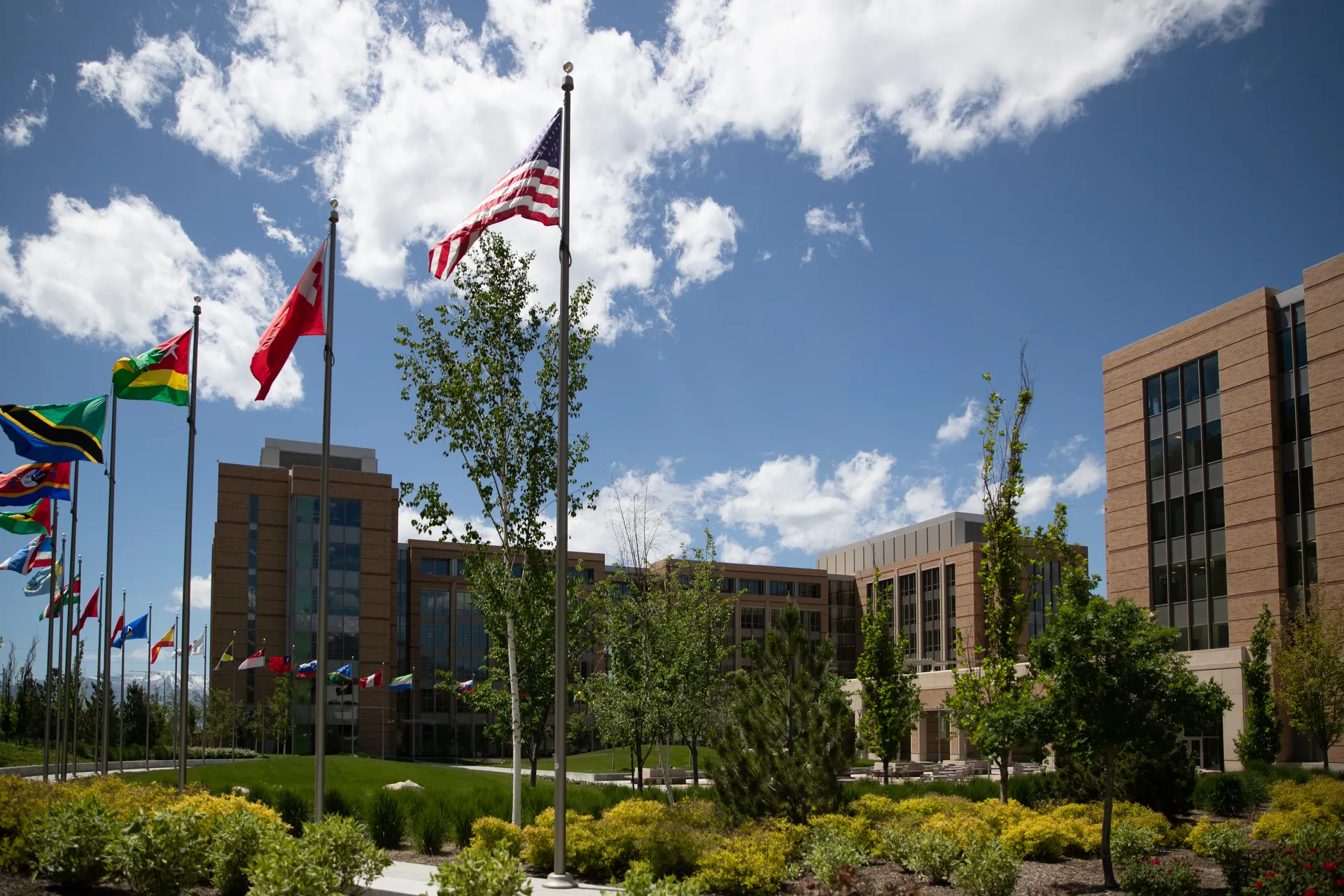
A view of the Provo Missionary Training Center (or MTC), adjacent to the Provo campus of Brigham Young University
I close this blog entry, as I often do, with some gleanings from the Christopher Hitchens Memorial “How Religion Poisons Everything” File™:













 Ad-Free & Subscriber Log-In