

First of all, I wish a Happy Thanksgiving to everybody. Even to those who live in places where today isn’t actually Thanksgiving Day. May you have an absolutely wonderful day!
For various reasons, I haven’t written a “Thanksgiving column” every single year. But I’ve done several of them. In at least one year (2019), I wrote two. I shared a few of them yesterday. Here are a few more. I hope that somebody out there might find something worthwhile in one of them:
-2016-
It’s not insignficant that the verbs “to think” and “to thank” (compare German “denken” and “danken”) share the same linguistic root. The scriptures are replete with exhortations to “remember,” to reflect, to thank:
“O give thanks unto the Lord,” says the psalmist (105:1-5), “call upon his name: make known his deeds among the people. Sing unto him, sing psalms unto him: talk ye of all his wondrous works. Glory ye in his holy name: let the heart of them rejoice that seek the Lord. . . . Remember his marvellous works that he hath done; his wonders, and the judgments of his mouth.”
Even secular-minded people should pause occasionally to consider the blessings that we enjoy. We live in a universe, for example, that’s seemingly fine-tuned for our arrival, on a privileged planet where the conditions are primed for life.
But those conditions have existed throughout history. Today, though, most Americans live in unprecedented luxury of which even kings couldn’t have dreamed a few generations ago. Royal castles were drafty and cold then, and lacked plumbing. For us, by contrast, if the weather is too hot, we turn the air conditioning on. If it’s too cold, we have central heating.
We can, if we choose, enjoy an unimaginably rich cuisine—American one day, Chinese the next. Mexican, Thai, Indian, Japanese, French, Italian. We eat a variety of fruits and vegetables, without regard to season. The diet of a Renaissance prince was poor and monotonous compared to the offerings of a typical American supermarket.
For most of us, hunger and starvation aren’t the issue; our problem is actually having too much. (Of course, that’s not true of everybody, and now our challenge is to share with those most in need and, ideally, to bring them and others up to a better standard of living.) If anything, the traditional Thanksgiving feast has lost a bit of its “specialness” because many of us eat pretty well all the time. (One of my students tells me, though, that she’s looking eagerly forward to what she calls “non-ramen Thursday.”)
Our technology, our labor-saving devices, would astonish our ancestors. We travel at unimaginable speeds in unthinkable comfort; we’re upset if our flight is delayed for thirty minutes, and irritated when we’re handed pretzels rather than peanuts or obliged to sit in a middle seat.
We listen to the Berlin Philharmonic or to the latest rock or country tunes wherever and whenever we want. We communicate cheaply and instantaneously at great distances. The world’s knowledge is available to us with a few clicks. We watch movies on demand, whenever we choose. In our own homes. Whereas earlier generations were obliged to work from sunrise to sunset in order to survive, we worry about whether we’re getting enough exercise.
Many of the diseases that once carried us off can be cured with simple medicines; other ailments can be fixed with routine procedures. Death still takes us eventually but, on the whole, we live pretty well until it does. When our hearing falters, we have hearing aids. We keep our teeth, or else we replace them—along with our hips and our knees. Have you ever thought to be grateful for your glasses or contact lenses? Perhaps you should. What would your life be like without them?
Latter-day Saints, though, have specific reasons to be thankful, reasons that go far beyond material comforts and technological marvels.
The restoration of the gospel in the early nineteenth century provides modern corroboration of the biblical stories. It testifies of Christ’s atoning sacrifice and of his resurrection from the dead, gracious gifts from a loving Father and his selfless Son. Because Christ rose, we too will rise, and the ordinances of the gospel link generations together for all eternity. Life wins. Love wins. The restored gospel tells us of the plan of salvation, a plan of happiness that suffuses our lives with rich and deep meaning. It teaches us of a Heavenly Father who wants us to inherit everything that he has.
“O give thanks unto the Lord,” sings the Psalmist, “for he is good: for his mercy endureth for ever” (Psalm 107:1)
Moreover, the restored gospel teaches us that—like God, who seeks to share everything he has with his children—we should share our abundance with our brothers and sisters. At this season, as at all others. “Be ye therefore perfect, even as your Father which is in heaven is perfect” (Matthew 5:48).
-2017-
“If you wish to make an apple pie from scratch,” the late American astronomer and science popularizer Carl Sagan once quipped, “you must first invent the universe.”
As Americans enjoy their Thanksgiving dinners today, many of those dinners will include apple pie. But any other food would serve to make Sagan’s important point.
Unless we ourselves grew the apples and grains and other ingredients vital to our apple pie, we can’t really claim to have made it from scratch. After all, those components came to us via complex and varied trade networks, from widely scattered farms.
Moreover, the hardworking farmers who grew our apples and the grains for our piecrusts didn’t create them out of nothing. They came from pre-existing seeds.
Lest this column rapidly grow far too complicated, though, we’ll concentrate only on the apples:
Rev. William Blaxton planted the first apple orchard in North America in Boston, in 1625. But apples had already been grown in Asia and Europe for millennia. In fact, the apple tree, which originated in Central Asia, may have been the earliest tree ever cultivated.
Where do apple trees come from, ultimately? The origin of life on Earth as a whole remains a mystery; science doesn’t know how or whence it arose. But apples are very far from simple or primitive organisms. The apple genome, its genetic material, may contain more genes than any other plant genome yet analyzed, and perhaps even more than the human genome does. But even a single gene is a remarkable thing. Unlike the machines that humans create, DNA—the hereditary material in cells—has the capacity to reproduce itself. Planting a Porsche or a hammer doesn’t yield new craftsman’s tools or sports cars. Apple trees, though, produce seeds that, in their turn, yield new apple trees.
This would all be irrelevant, of course, had chemical and biological processes not created soil in which to plant apple seeds. Moreover, according to some current science, that soil wouldn’t have contained key ingredients for the chemistry of life—elements such as hydrogen, oxygen, nitrogen, phosphorus and sulfur—if they weren’t regularly replenished by the constant movements of the tectonic plates that cover Earth’s surface. (In other words, you may owe your apple pie to the same forces that cause earthquakes.)
There would be no soil, though, no tectonic plates and neither apples nor apple pie if there were no Earth. Where did it come from? Our solar system formed roughly 4.6 billion years ago and, shortly thereafter, the Earth began to coalesce.
Ultimately, of course, the genesis of apples is to be found in the Big Bang, which occurred (for reasons that may lie forever beyond the reach of science) about 13.7 billion years ago.
But the path from the Big Bang to the appearance of life (and apple pies) on Earth is paved with remarkable facts. Somehow, only a fraction of a second after that unimaginable explosion, nature’s fundamental forces were established—in ways that make life possible. If, for example, gravity differed even slightly—making you weigh a billionth of a gram more or less than you do—or if the universe’s expansion rate were even slightly slower or faster, or if the overall density of the cosmos varied by as little as 0.0000000000001%—roughly the same precision required for a blindfolded man to choose a single predesignated coin from a pile of pennies sufficient to pay off the national debt of the United States—either a “Big Crunch” would shortly have followed the Big Bang or, alternatively, atoms would have scattered so widely that neither galaxies, stars, planets nor apples could have formed.
Sir Fred Hoyle (d. 2001), an illustrious astronomer and a vocal atheist, conducted path-breaking research into the indispensable role that stars played in the synthesis of all the chemical elements heavier than helium—including carbon—without which life (and apple pie) would be impossible. What he found shocked him deeply:
“A commonsense interpretation of the facts,” he commented, “suggests that a super-intellect has monkeyed with physics, as well as with chemistry and biology, and that there are no blind forces worth speaking about in nature. The numbers one calculates from the facts seem to me so overwhelming as to put this conclusion almost beyond question.”
Making apple pie absolutely from scratch is plainly more difficult than most of us have imagined. Downright mysterious, in fact. Praise God, from whom all blessings flow.
-2019 A-
As we in the United States approach the national Thanksgiving holiday for 2019, it’s appropriate to consider things for which we should express our gratitude. Obviously, of course, there’s the good food that many of us will be eating. There are the family members with whom many of us will be gathering to share it. However, there is much, much more. Indeed, our reasons for gratitude are virtually infinite. Here, let me suggest one vital factor in our lives that we almost always take for granted:
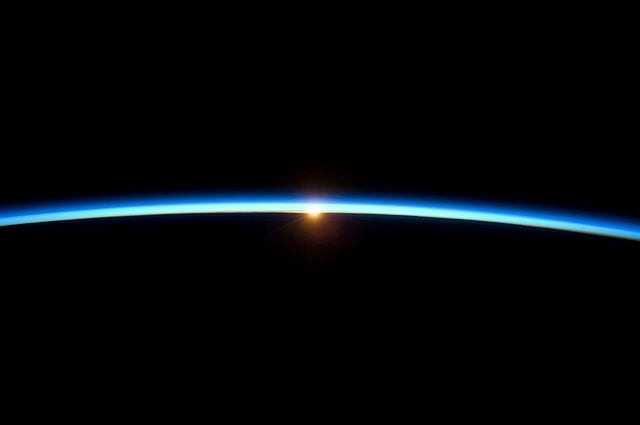
The phrase “thin blue line” is sometimes used to refer to the role of the police in society, who hold chaos at bay and thus permit order and civilization to flourish. The term could perhaps be used even more appropriately to describe the function of our terrestrial atmosphere, which allows not only civilization and order but sheer physical survival.
Our atmosphere as it exists today derives (as our oceans also do) from the “degassing” of the primitive semi-molten earth, supplemented by later additions belched up from volcanoes and emitted by hot springs. The atmosphere of early geologic times was composed of such gases as hydrogen, nitrogen, carbon monoxide, carbon dioxide, water vapor, and various forms of hydrogen chloride. We couldn’t have survived those conditions. However, the lighter gases (e.g., hydrogen and helium) escaped toward space. Five hundred miles above the earth, our “atmosphere,” if it can still be called that, is composed of 50% helium and 50% hydrogen.
Somewhat later in our planet’s history, living organisms developed that were capable of photosynthesis. They provided the oxygen that then permitted animal respiration and eventually the colonization of land, as well as providing the famous ozone layer that shields Earth (and us) from the sun’s ultraviolet radiation.
Evidence for this sequence of atmospheric development can be found, to some degree at least, in Precambrian rocks and a few fossils, which show a transition from a largely oxygen-free environment to what we might term a free-oxygen environment.
Our terrestrial atmosphere is an exceedingly thin envelope surrounding Earth. Perhaps somewhat more than 99% of our planet’s air exists within a region no higher than thirty kilometers (or approximately eighteen miles) above sea level. Earth’s radius — the distance from its center to its surface or circumference — is 6400 kilometers (somewhat less than 4000 miles), which means that the thickness of that oxygenated region of our atmosphere is a bit less than 0.5% of Earth’s radius.
But oxygen isn’t evenly distributed even within that thin envelope. Denser and, thus, heavier gases such as oxygen, carbon dioxide, nitrogen, and water vapor hang low in the current atmosphere, mostly within about three miles of the planet’s surface. That thin band is equivalent to approximately 0.00075 of Earth’s radius, well under one ten-thousandth. Its outer edge is not far above our heads.
These heavier gases, especially oxygen, are essential to life. More than roughly three miles above sea level, we humans cannot usually function very well without supplemental oxygen.
Any resident of lower altitudes who has climbed in the Colorado Rockies or the Sierra Nevada of California, or visited the old Inca capital city of Cusco in Peru, knows the risks of nausea and lightheadedness that are encountered there. And death awaits those who travel, unaided, very much higher.
Federal regulations require the use of supplemental oxygen by pilots who fly more than 30 minutes at cabin pressure altitudes of 12,500 feet (roughly 3.8 kilometers, slightly more than two miles) or higher. And at cabin altitudes above 14,000 feet (somewhat more than 4.25 kilometers, about 2.5 miles), pilots must use oxygen at all times.
Altogether, the gases in the atmosphere serve to insulate the earth by filtering out most cosmic radiation and, as mentioned, blocking most of the sun’s ultraviolet radiation. Furthermore, they prevent large swings in temperature. They also burn up untold millions of meteors before those objects are able to collide with our planet. Again, in these ways, too, they are essential to life.
It’s also fortunate that our atmosphere deflects or reflects much interstellar “noise” back into space. Without that, radio and television broadcasts would be effectively impossible, lost in an impenetrable wall of static. On its “underside,” though, our atmosphere partially reflects (rather than merely transmitting) radio waves, which makes television and communication by radio possible.
As the Thanksgiving holiday draws near, there is much for us to be thankful for—including the very air that we breathe.
-2019 B-
Two weeks ago (https://www.deseret.com/2019/11/14/20959872/daniel-peterson-the-miracle-of-earths-atmosphere-design-and-the-air-we-breathe), I argued that we should be grateful for Earth’s atmosphere and the air we breathe. Today, still in the Thanksgiving spirit, I suggest gratitude for the dirt beneath our feet.
The internal structure of our planet is a series of concentric spheres. A solid metallic “inner core” is surrounded by a liquid “outer core.” The “outer core” is, in turn, contained within Earth’s viscous “mantle.” And then, finally, we reach the solid “outer crust,” pretty much the planet of our daily experience.
Like the skin of an apple, Earth’s crust is very, very thin in comparison to the overall radius of our planet. Whereas Earth’s average radius is 6,378 kilometers (3,958.8 miles), the thickness of Earth’s crust ranges from about 70 kilometers beneath continental mountains (43 miles) to less than 8 kilometers (5 miles) beneath the oceans, which means that the crust represents just 0.005 to 0.00125 of that radius.
Rather like the film that forms on a cooling cup of hot chocolate, Earth’s crust “floats,” as it were, on the solid but soft and viscous or “plastic” mantle—much hotter and much more dense—located underneath. (This gives new meaning to the expression “solid earth” or “terra firma.”)
Obviously, we live atop the terrestrial crust. But even that crust is mostly inhospitable to life. On its surface, of course, things are (by definition) at air temperature. However, at the bottom of the world’s deepest mine, 2.4 miles down in South Africa’s TauTona, the ambient air temperature is 55 degrees Celsius (131 degrees Fahrenheit) and the temperature of rock surfaces is 60 °C (140 °F). Without artificial air conditioning, that air temperature alone would soon kill the miners. So the lowest humanly habitable depth on our planet is generously reckoned as about two miles down into the crust.
Deeper crustal temperatures reach approximately 870 °C, or about 1600 °F. To put this in perspective, 350 °F will bake bread. At 1600 °F, rocks begin to melt. Immediately beneath the crust is the solid but plastic mantle, where temperatures reach as high as 4000 °C (or nearly 7,250 °F).
Moreover, as my previous column noted, humans cannot usually function very well without supplemental oxygen beyond roughly three miles above sea level. Which means that we can only live in a thin region, roughly five miles thick, within the combined area of Earth’s nearly 3960-mile radius and its surrounding 500 miles of atmosphere.
That’s a stunningly narrow range. Humans can survive in only 5/4460 (or 0.00112108)—slightly more than a tenth of one percent—of the vertical portion of Earth’s combined mass and ambient atmosphere.
The loose, upper, “weathered” layer of Earth’s crust is called “soil.” It’s tempting to dismiss soil as mere “dirt.” If something or someplace is “dirty,” we want to clean it, to get rid of the dirt. But life on Earth would be impossible without soil. For example, it helps to filter and clean our water, plays a vital role in cycling nutrients (e.g., the carbon and nitrogen cycles), and releases important gases such as carbon dioxide into our atmosphere. Very obviously, most plants require soil in which to grow. They anchor themselves into the ground with their roots and thereby extract nutrients from it—and animal life (including human life) clearly depends upon such plants.
Soil is not only vital to life. It teems with life, itself. A teaspoon of good soil, for example, will commonly contain several hundred million bacteria. Moreover, a typical acre of good cropland will serve as the home to more than a million earthworms. And, of course, many animals, fungi, and bacteria rely on soil as a place in which to live.
However, the primary layer where plants and other organisms live is the topsoil, which is usually only 5-10 inches thick where it exists at all. The formation of just an inch of topsoil can require up to 1000 years. Below the topsoil is the subsoil, which is made up primarily of clay, iron, and organic matter. Below the subsoil is the so-called “parent material,” mostly large rocks that have not yet been completely broken down—so called because the topsoil and subsoil develop from it. And beneath the “parent material” is bedrock, a large mass of solid rock located several feet below the surface.
So human life depends upon 5-10 inches of dirt on the surface of a planet that’s nearly 8000 miles in diameter.
Now, though, I shift the tone a bit:
I have to acknowledge that Heather Gay is not only a moral hero but, in her own quiet and unassertive way, a courageous intellectual pathfinder. In fact, she’s an inspiration to us all. And — miraculously — she’s evidently making very good money at it. Here’s an article about her from Newsweek, which, back when I was young, was a prominent and relatively respectable magazine: “Heather Gay Defined Mormonism for Pop Culture—Now She’s Exposing It”
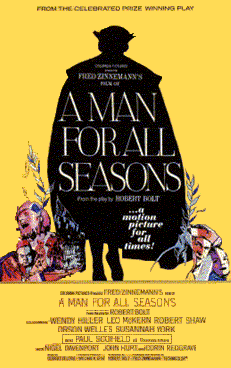
In Robert Bolt’s play A Man for All Seasons and in the film based on it and bearing the same title, the crown prosecutor tries to force Sir Thomas More (1478-1535), the Lord Chancellor of England, to take an oath, against his conscience, to support the marital and ecclesiastical measures taken by King Henry VIII. When Sir Thomas refuses, the prosecutor finds a witness, Richard Rich, who is willing to lie and thereby to provide the false testimony needed to convict More of treason. After the trial, Sir Thomas sees Rich wearing a new chain of office, signifying the latter’s new position as Attorney-General for Wales:
“For Wales? Why, Richard, it profits a man nothing to give his soul for the whole world. . . . but for Wales?”
Posted from Park City, Utah










 Ad-Free & Subscriber Log-In