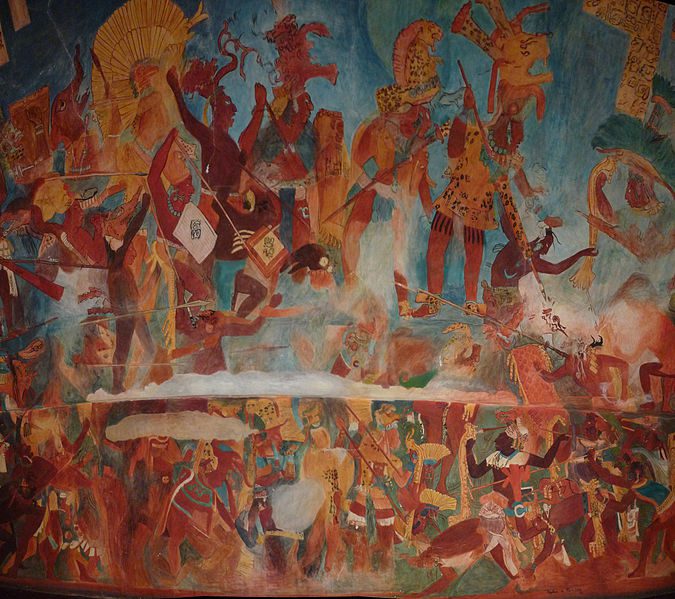
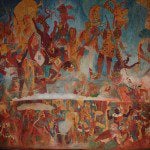
A scene of ancient Mesoamerican warfare in a detail from a reproduction of one of the murals at Bonampak, Chiapas, Mexico. (Wikimedia Commons public domain image)
Abstract:The name Helam, attested as a place name in the Bible is also attested as a personal and place name in the Book of Mormon. Evidence suggests that this name is derived from the Hebrew noun ḥayil/ḥêl, which has a wide range of meaning, including “wealth,” “abundance,” “power,” and even “army” (including Pharaoh’s “army” or “host”). The form of Helam suggests the meaning, “[God is] their wealth,” “[God is] their abundance,” “[God is] their power,” and even “[God is] their army.” Although the promise latent in the name Helam is celebrated in their exceeding prosperity and abundance, Alma1’s people also meet with a dramatic and ironic (apparent) reversal of this abundance and prosperity, when an army of the Lamanites occupies Helam and brings them into bondage. Mormon draws multiple lessons from this event, and he draws substantively from the language of Alma2’s conversion accounts to narrate this event and its meaning.
A video introduction to this Interpreter article is now available on all of our social media channels, including on YouTube at https://youtube.com/shorts/XXPUNguI2PI.
The Takeaway: Bowen suggests that the Book of Mormon uses the Hebrew word “Helam” (ḥayil/hêl meaning “wealth” or “abundance”) as an appropriate label for a land where people experience both spiritual and temporal abundance. He also explores the term’s secondary meaning of “army” in the context of descriptions of Lamanite armies in connection with that land.
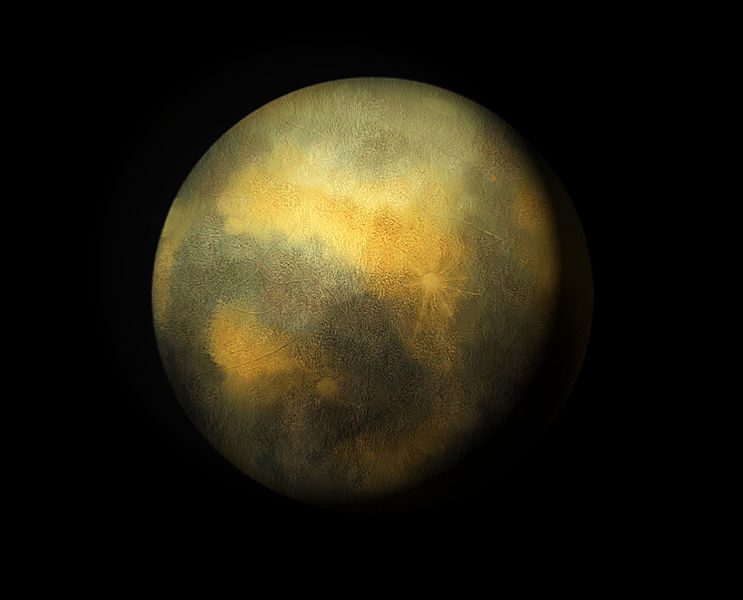
A Wikimedia Commons public domain image of the Pluto formerly known as “planet,” created on the basis of photographs from the Hubble Space Telescope. Drawing upon serious inspection of this image extending over several seconds, I propose my own account of the object: Plainly, it’s an exceptionally large but quite moldy cantaloupe. Pluto was discovered at the Lowell Observatory by Clyde Tombaugh in 1930.
You will remember the lamentations of those who opposed the building of a Latter-day Saint temple in Cody, Wyoming, on the grounds that it would loom oppressively over the city, block views of the night sky, and hide the surrounding mountains. Construction photos from the scene of the crime have abundantly justified those concerns, demonstrating that the massive 9,950-square-foot bulk of the nearly-completed Cody Wyoming Temple does indeed conceal the mountains, blot out the expanse of the Wyoming sky, and make it impossible for residents of Cody to see so much as a trace of the mountains around them.
But, now, another urgent crusade has been launched: Agitation against the construction of a Latter-day Saint temple in Flagstaff, Arizona, began almost immediately upon President Russell M. Nelson’s announcement, on 6 April 2025, of the Church’s intent to build one — well before its location was announced. By, it seems, no later than 7 April: “Prevent the Construction of Mormon Temple Protecting Flagstaff’s Dark Sky Designation”
The proposed site for the temple (along with its size as a single-story building of about 18,500 square feet) was announced on 20 January 2026 — three days ago — and the opposition seems to have instantly ratcheted up a notch or two (or three): “Sign the Petition, protect our beautiful dark sky from the Mormon temple” (which went up three days ago).
The comments on these petitions are instructive. Many are (ostensibly, at least) about protecting the darkness and clarity of the night skies over Flagstaff, which is (ostensibly, anyhow) a legitimate concern, and one that, I hope and trust, the Church will seek to accommodate. (It doesn’t appear, though, that Flagstaff is completely dark at night.) Nor, for that matter, is Flagstaff’s famous Lowell Observatory complex itself.) Many comments, though, seem to represent flat-out and quite unashamed religious bigotry, and I, at least, am not at all unhappy to see such bigotry on brazenly prominent display. Let them rave; such expressions can only damage their cause. Some opponents clearly object to a Latter-day Saint temple being built in Flagstaff at all, whatever its lighting or design (about which nothing official has yet been said) might be. Some devote their comments to maligning my faith as such, manifesting no apparent concern whatever for the visibility of the Big Dipper or the Milky Way.
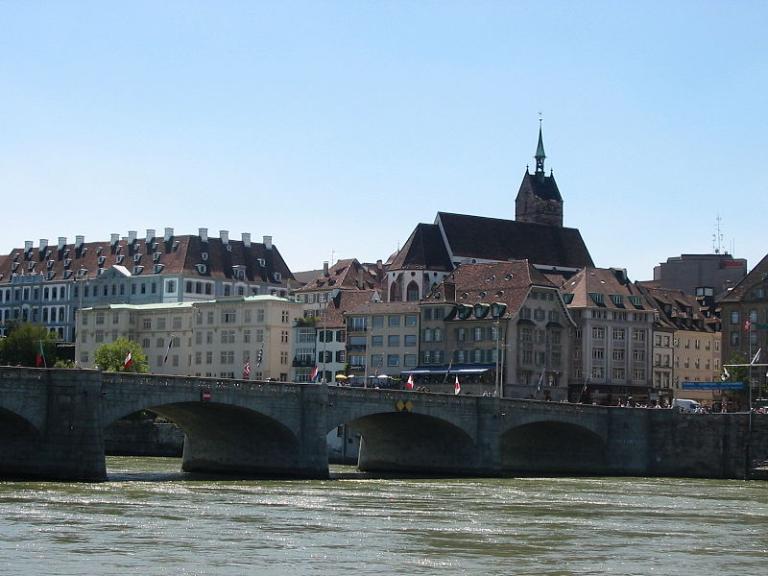
A view of Basel, Switzerland, from the Rhine River (Wikimedia Commons public domain photo by Rokus Cornelis)
I suppose that this composition, Lamb of God, like other oratorios (such as Johann Sebastian Bach’s St. John Passion and St. Matthew Passion and George Frideric Handel’s Messiah) as well as Franz Schubert’s Mass in G and Wolfgang Amadeus Mozart’s Requiem), is simply yet another redundant specimen from the Christopher Hitchens Memorial “How Religion Poisons Everything: File™. In moments of moral weakness, though, I actually really like some of that toxic music.
Incidentally, there was a brief discussion in some of the comments to a prior blog entry here about Swiss German or Schweizerdeutsch (or Schwyzertütsch, or Schwizerdütsch, or Schwiizerdütsch) as contrasted with Standard German (Hochdeutsch, “High German,” or, as the Swiss tend to call it, Schriftdeutsch, “Written German”). It might interest some who noticed that exchange to know that, in the first video that’s included — rather mysteriously and without explanation — in the news article to which I link above — all but one of the German-speaking people being interviewed are actually speaking in their Swiss German dialect rather than in Standard German. The concert evidently took place in Basel, Switzerland, and that’s where the interviews were conducted. People who know German will readily hear the difference, but I think that even non-German speakers might be able to detect it, as well.








 Ad-Free & Subscriber Log-In