


Becoming Brigham, the new series of mini-documentaries produced by the Interpreter Foundation and Red Brick Film Works, will launch tomorrow, Monday, 26 January. Its first episode will be posted to YouTube at, I think, 12 noon Utah time. I hope that you’ll give it a look at your earliest convenience — the episodes will typically run about fifteen minutes in length — and that, if you feel at all so inclined, you will bring it to the attention of others (e.g., family, ward members, neighbors, colleagues, and friends) who might be interested.
We’ve been working on Becoming Brigham for well over a year now. At this point, we simply hope that it will (a) attract an audience and (b) prove informative and enjoyable. I’m pretty confident about (b) and cautiously optimistic about (a). But we shall see!
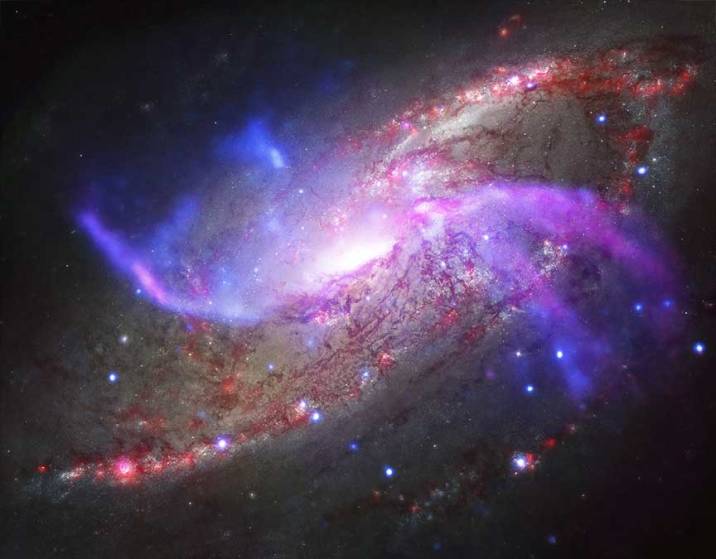
(Chandra X-Ray Observatory/Caltech/NASA public domain)
I sometimes encounter the complaint from some atheists that they don’t even desire immortality because, they say, eternal life would be unendurably boring.
I don’t take the complaint very seriously. Maybe they’re tired of life, but I’m not. On any given day, if I were to be told that I could choose between my life ending (even painlessly) at midnight, on the one hand, and, on the other, having at least one more day, I would always choose the latter. I would prefer to think of the next day, of the next minute, rather than of “forever” as some sort of concrete and monolithic reality, and I’m always up for the next minute and the next day. I’ll always elect for yet another dip in the pool, yet another Alpine panorama or tropical seascape, tomorrow’s chocolate milkshake or chicken coconut kurma, one more repetition of Pachelbel’s Canon, one more viewing of Groundhog Day, that really interesting book that sits still unread on my bookshelf, that great novel that I’ve been meaning to read forever but still haven’t managed to open. I’ve always found it difficult to call it quits and turn the lights off at night. Am I bored by tours to the Middle East? I can see why one might imagine touring the same places again and again to grow boring. But I always enjoy introducing people for their first time to the pyramids and Caesarea Philippi and the Hagia Sophia.
There’s much more that could be said, of course, in response to the claim that immortality would be or will be unbearably dull. And I suppose that the claim does raise a serious issue. But I ran across this passage from G. K. Chesterton’s classic book Orthodoxy (1908) a few months ago, and it seems cheekily relevant to the topic:
Because children have abounding vitality, because they are in spirit fierce and free, therefore they want things repeated and unchanged. They always say, “Do it again”; and the grown-up person does it again until he is nearly dead. For grown-up people are not strong enough to exult in monotony. But perhaps God is strong enough to exult in monotony. It is possible that God says every morning, “Do it again” to the sun; and every evening, “Do it again” to the moon. It may not be automatic necessity that makes all daisies alike; it may be that God makes every daisy separately, but has never got tired of making them. It may be that He has the eternal appetite of infancy; for we have sinned and grown old, and our Father is younger than we.
One of the great passages in Latter-day Saint scripture is this, in which the Lord himself is speaking:
And the Lord God spake unto Moses, saying: The heavens, they are many, and they cannot be numbered unto man; but they are numbered unto me, for they are mine. And as one earth shall pass away, and the heavens thereof even so shall another come; and there is no endto my works, neither to my words.For behold, this is my work and my glory—to bring to pass the immortality and eternal life of man. (Moses 1:37-39)
I can imagine that bringing about the immortality and eternal life of intelligent persons would be at least as absorbing and fulfilling for a perfectly caring Person as introducing tourists to the Old City of Jerusalem or to the ancient walls of Constantinople is to a reasonably decent retired professor. Moreover, I have no conception at all of the enjoyments, satisfactions, and joys open to an exalted being. The gap between fallen mortals and deity is surely vastly greater than that between beginning piano students, barely coping with Twinkle, Twinkle, Little Star, and accomplished virtuosi. The former cannot really imagine what it’s like to play, say, Beethoven’s Emperor Concerto.

Given all of the tumult and distractions in the current headlines, here’s an important news story that you might easily have missed: “First Astronauts On Mars Greeted By Mormon Missionaries”

Wikimedia Commons public domain image
Perhaps you’ve already seen this announcement: “First Presidency announces 1-hour sacrament meeting to commemorate Palm Sunday in 2026: Easter Sunday this year is the same day as the final day of the Church’s April 2026 general conference” What is striking to me about the announcement is not only the idea of a one-hour sacrament meeting on the Sunday prior to Easter and General Conference but the fact that we’re now referring to that day as Palm Sunday. I’ve long advocated more emphasis not merely on Easter, standing alone in splendid isolation, but on Holy Week, which culminates in Easter — or, as Claudia Bushman prefers, in “Resurrection Day.” See, for example, “The days leading up to Easter Sunday” (a Deseret News column from 2011) and “Holy Week aids Easter reflections” (a Deseret News column from 2014).
If you thought that Sunday would be a day when you would be spared the horrors of the Christopher Hitchens Memorial “How Religion Poisons Everything” File™, you thought wrong. Here’s something that I just retrieved from its seemingly infinite (and yet ever increasing) collection of outrages: “How the Church Is Celebrating the 250th Anniversary of the United States”
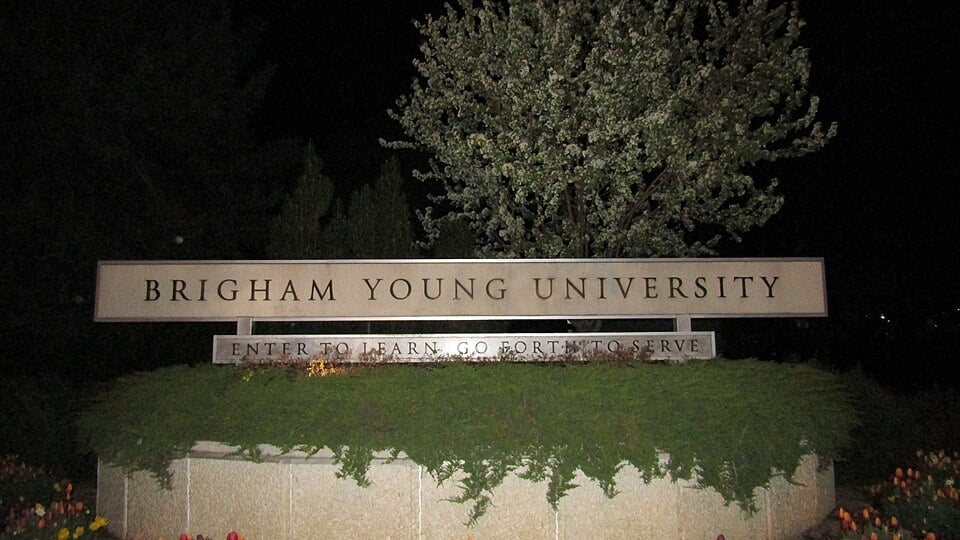
And this is something that comes from at least the vicinity of the Hitchens File: “BYU ranks ahead of Princeton, Yale with one of the top admission yield rates in the country: High yield rates suggest a college is a ‘first choice’ school for many students”













 Ad-Free & Subscriber Log-In