

A new article has just gone up, yet again, on the website of the moribund Interpreter Foundation: C. Robb Smith, “Alma or Mormon? The Voice of Alma 29,” Interpreter: A Journal of Latter-day Saint Faith and Scholarship 68 (2026) : 53-118:
Abstract: For more than a century, Alma 29 has been read as a direct quotation from the prophet Alma. Yet, unlike every other extended quotation in Mormon’s record, this passage lacks attribution, framing, or transition. This anomaly has gone largely unnoticed because of a chapter break, added in 1879, that masks the continuity of Mormon’s voice from Alma 28 into chapter 29. This paper challenges the traditional attribution and argues that Alma 29 is more likely Mormon’s editorial reflection than Alma’s psalm. While the study focuses on Alma 1–29, the editorial patterns it identifies—Mormon’s consistent use of speaker attribution, narrative framing, and formal introductions to quoted speech—hold true across his entire abridgment. Alma 29, if understood as Alma’s psalm, would stand out as the sole exception, with no introduction to mark a change in speaker. Close attention to verb tense usage, narrative posture, and thematic continuity with Alma 28, together with the prophetic vocabulary Mormon uses elsewhere, suggests that these words reflect Mormon’s own meditation. Attributing Alma 29 to Mormon reframes the chapter as the theological culmination of his editorial design. Mormon situates his record within a prophetic chain stretching from Joseph in Egypt, through Nephi, to his own day. His repeated use of “my brethren” reflects covenant kinship rather than contemporaneity, and his testimony of a “holy calling” reveals a prophet who, even in an age of societal collapse, experienced his own quiet triumph in saving souls.
The appearance of C. Robb Smith’s article is paired with the publication online of “Interpreting Interpreter: Who Wrote Alma 29?” written by the inimitable Kyler Rasmussen:
This post is a summary of the article “Alma or Mormon? The Voice of Alma 29” by C. Robb Smith in Volume 68 of Interpreter: A Journal of Latter-day Saint Faith and Scholarship. All of the Interpreting Interpreter articles may be seen at https://interpreterfoundation.org/category/summaries/. An introduction to the Interpreting Interpreter series is available at https:/interpreterfoundation.org/interpreting-interpreter-on-abstracting-thought/.
A video introduction to this Interpreter article is now available on all of our social media channels, including on YouTube at https://youtube.com/shorts/gZQvKy7xdm4.
The Takeaway: Smith proposes that Alma 29, traditionally attributed to Alma, may instead have been written by Mormon. He argues that the words and themes are as much a fit for Mormon as they are Alma, that the use of “my brethren” could reflect covenantal kinship, and that it would be uncharacteristic for Mormon to fail to properly attribute the passage to Alma.
And don’t miss this, which is newly up on the Interpreter Foundation’s website: The Interpreter Insights Podcast — February 19, 2026 — “The Early History of God: Yahweh and Other Deities in Ancient Israel, by Mark Smith”:
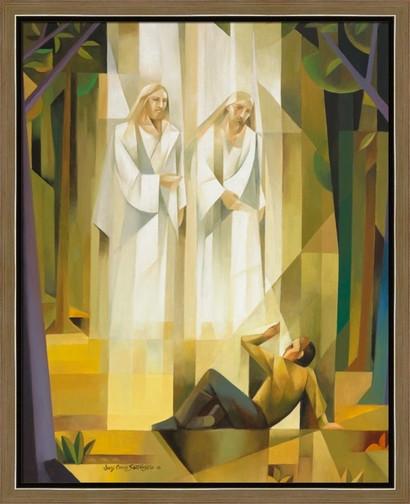
In the February 19, 2026 episode of The Interpreter Insights Podcast, our host Martin Tanner describes how Mark Smith, PhD, Harvard researcher, now a professor at NYU, in his book The Early History of God: Yahweh and Other Deities in Ancient Israel, demonstrates ancient Israel, and early books of the Bible describe God (YHWH) as a divine human. This looks like Joseph Smith’s descriptions of God in his accounts of the First Vision. The audio track is also included in our podcast feed (https://cms.interpreterfoundation.org/feed/podcast).
In the meanwhile, have you visited becomingbrigham.com yet? Four episodes of our new series of mini-documentaries have already gone up onlline; a fifth will drop on Monday. Don’t fall too far behind.
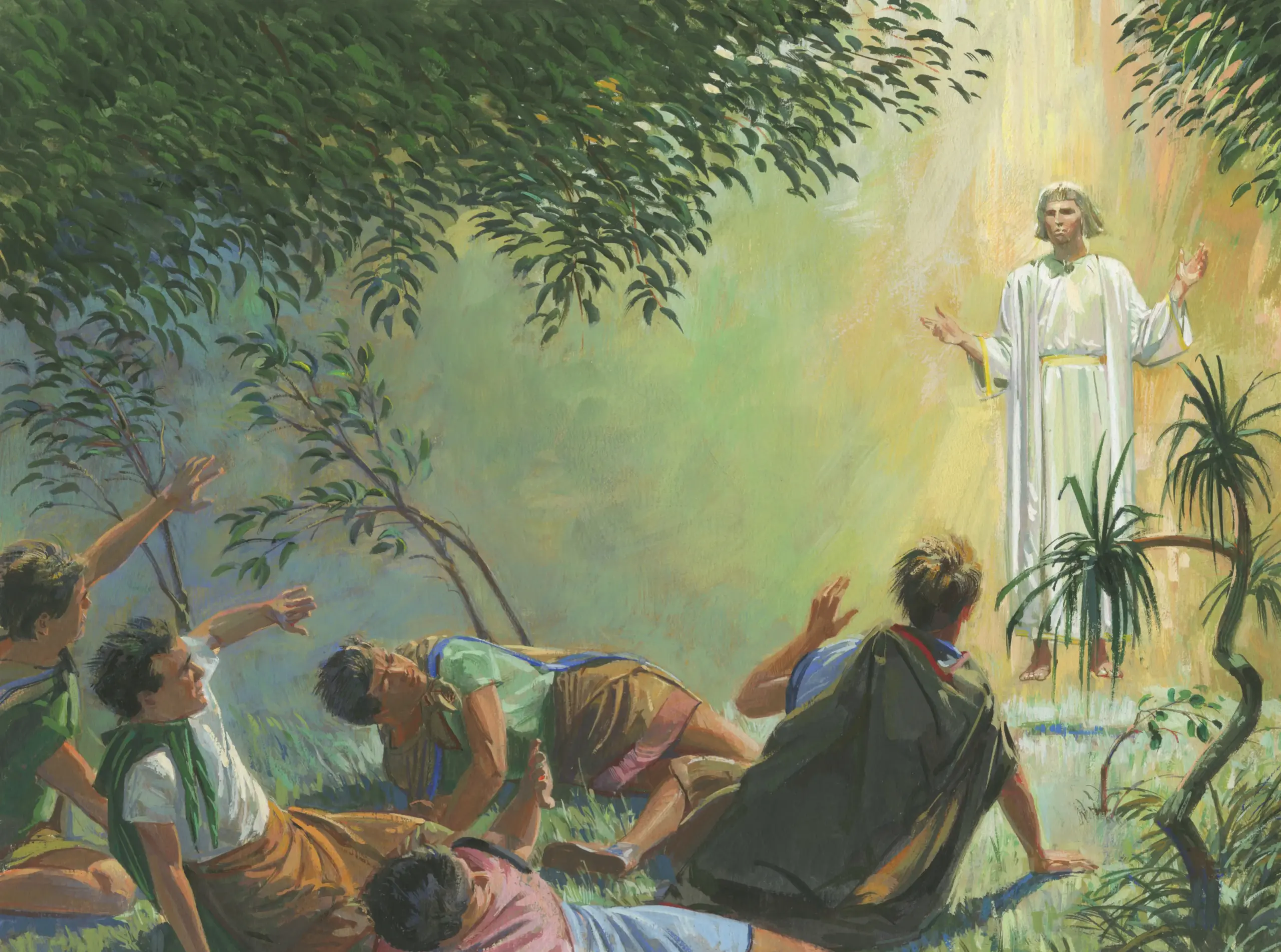
“O that I were an angel, and could have the wish of mine heart, that I might go forth and speak with the trump of God, with a voice to shake the earth.”
If it were only so, I would be able to get the word out quite a bit better regarding Becoming Brigham. As it is, I rely largely upon word-of-mouth, hoping that people out there will watch our series, subscribe to it, and recommend it to friends, neighbors, and relatives.
You may have noticed, by the way, that I have some interest in the cinema, and specifically in Latter-day Saint cinema. So I’m pleased to remind you that the annual Zions Indie Film Fest commences this coming Monday, in Orem, Utah.
My wife and I went out last night to watch the Angel Studios release Solo Mio. (No Interpreter Foundation donor funding was diverted to buy our tickets.) I enjoyed the movie. For one thing, Nicole Grimaudo is adorable as Gia, and, for another, the Roman and Tuscan scenery is gorgeous. It’s a sweet film, and I didn’t have to compromise my moral worldview to like it. (Has anybody else out there seen it? If so, what did you think of it?) I’m very pleased with what the folks at Angel Studios are doing, and I wish them every success.

Since his call to the apostleship, Elder Clark G. Gilbert has been thoroughly demonized in some quarters. Among other things, he has been compared to Martin Bormann and Heinrich Himmler of Hitler’s Third Reich and labeled “The Enforcer.” I reject such comparisons and labels as not only hyperbolic (of course) but thoroughly inappropriate and misguided. For those who are interested in actually understanding Elder Gilbert, I recommend this recent Deseret News interview with Jane Clayson Johnson: “‘Deseret Voices’ Episode 16: Elder Clark G. Gilbert on conviction, controversy and compassion: Church’s newest apostle shares his message for those inside and outside of the faith”











 Ad-Free & Subscriber Log-In