A view of the Grand Canyon (Wikimedia Commons public domain photograph)
It’s spiritually beneficial to see the Grand Canyon from time to time. I just saw it again two or three hour ago, albeit from at least 30,000 feet. Even at that altitude, though, it’s still pretty impressive.
You’re probably familiar with this story, but I love it. I would give credit for it to somebody, but I have no idea who that somebody might be:
A professional therapist moves to a mostly Latter-day Saint community and opens his practice there. Eventually, a woman goes to see the therapist and he asks her what’s wrong. The woman replies, “It’s the sunbeams. They’re driving me crazy.”
“Oh?” replies the therapist, a bit puzzled.
“Yeah, they keep running everywhere, they won’t stay still, they’re too loud, and they won’t listen to me when I tell them to stop.”
The therapist is getting confused, thinking that he has a real case on his hands.
“Have you tried talking to somebody about this?”
“Yes, I talked to the president about it but she couldn’t help.”
Now the therapist is very concerned and is eyeing the door, wondering if he should call for assistance.
“Can anyone else see and hear these sunbeams?” the therapist asks.
The woman looks at him and says, “I’m guessing that you’re not LDS. Right?”
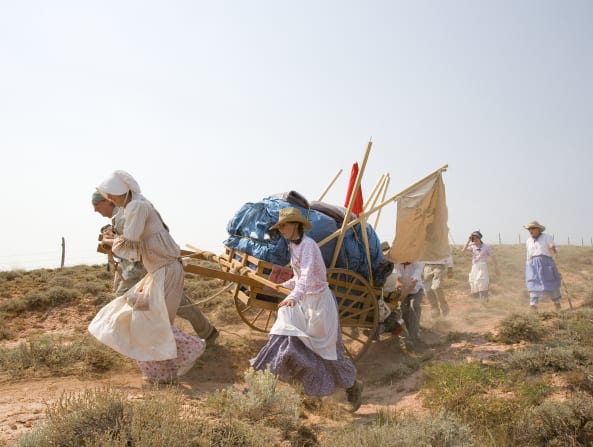
Young women dressed in pioneer clothing participate in a reenactment of the Latter-day Saint handcart experience of the 1850s. (LDS Media Library)
While serving on a stake high council, I also served at least once as a stake Sunday School president. And I’ve served in at least one other Sunday School presidency, as well. For the life of me, I honestly couldn’t see much real point in the position of Sunday School president, whether at the stake level or at the ward level; I didn’t feel that I was contributing anything of value to the Kingdom. (But then, perhaps that merely reveals my own lack of vision. And it raises another topic: Have I ever contributed much of value to the Kingdom? Views on that question might disagree rather dramatically, I suspect.)
I think that Sunday School presidencies can add value if they are always there to substitute when a teacher is ill or must be absent for some other reason — although, when I’ve served as a teacher and needed a substitute, I’ve generally asked somebody to fill in for me, directly, without involving the presidency. Often, I haven’t even known who the Sunday School presidency were.
Once, a stranger came up to me at the end of a Gospel Doctrine class that I had taught. He identified himself as the stake Sunday School president and observed that I clearly hadn’t based my lesson on the official course manual. I conceded that that was so. “Are you unaware,” he said, “that the Church’s official Sunday School is given by revelation?” I responded, rather gently, that I was serving at that time on the Church’s Gospel Doctrine writing committee, and that I knew pretty well how the manuals were produced because our committee was responsible for producing their first drafts (before they went, among other things, through correlation).
At the time that I was called to serve on that Gospel Doctrine writing committee (on which I eventually served for about eight years or so), I told the General Authority who extended the call to me that I wasn’t sure that I was the person they wanted for the position. I thoroughly disliked the Sunday School manuals, I said to him, and found them impossible to teach from. My mind simply doesn’t work that way. He replied that I was exactly the kind of person they wanted. But I never really felt that my preferred approach had much of an impact on the final product, after it had gone through various curriculum committees and, in the end, through the Correlation Committee.
Despite all of my grousing here, I’m pleased to see a small policy change that has just been officially announced by the Church:
I’m happy to see women being given more leadership and service opportunities across the Church, and I’m very pleased to see their talents and abilities given more scope within the Kingdom — however limited, in my experience, the scope of Sunday School presidencies turns out to be. I could never see any reason why members of a Sunday School presidency needed to be male or to hold the priesthood. So this is a welcome change.
I recall very well the first time that I saw several women — and only women — “manning” the recommend desk in a temple; I was delighted. Women can now serve as witnesses for ordinances in and out of the temples, and young women regularly serve as “greeters” at the doors of my home ward (and, I presume, of other wards beyond mine). Small things, perhaps. But welcome changes.
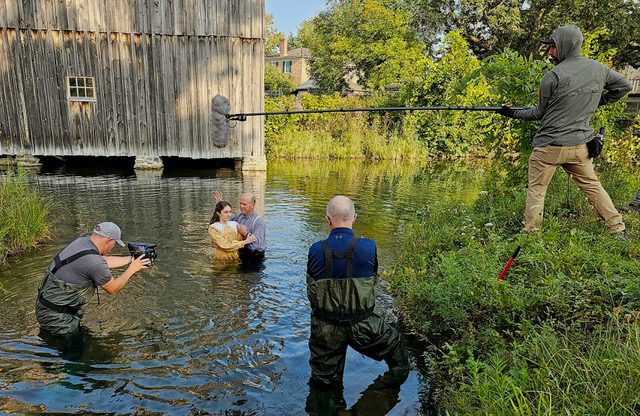
The baptism of Miriam Works Young in 1832, as depicted in a scene from the Interpreter Foundation’s 2024 theatrical film Six Days in August.
Eight episodes of Becoming Brigham — eight of what we project to end up at approximately seventy or seventy-five — are now available online for you to watch. The eighth of them was posted on Monday, and, with one or two planned exceptions, new installments will be posted every Monday until roughly the middle of next year.
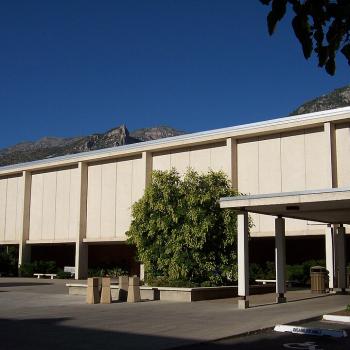
The Cody Wyoming Temple (aka Barad-dûr), more or less as represented by its fiercest opponents. (Provenance of image unknown. If there is an objection to its use here, please contact me at [email protected].)
Just as these heroic citizens said, the sheer daunting vastness of the massive 9,950-square-foot temple does completely block views of the Wyoming sky. It does conceal the mountains that surround Cody. It does tower threateningly over the humble buildings of the town that cluster closely around its base. If only people had listened! If only the government had intervened to stop this crime against both suffering humanity and the fragile Western ecosystem!

















 Ad-Free & Subscriber Log-In