

The lawsuit that has been filed against John Dehlin’s Mormon Stories podcast by the Church of Jesus Christ of Latter-day Saints has drawn considerable attention, some of it both confused and negative. Here is a helpful article on the subject by my friend Steve Densley, an attorney who also happens to be the Executive Vice President of the Interpreter Foundation: “Protecting the Symbols of Christ’s Church: How a Trademark Lawsuit Aligns with Prophetic Guidance”

There have been hundreds of responses to my recent conversation with Jasmin Rappleye, Neal Rappleye, and Steve Smoot on Informed Saints. Many of them have been positive. Some have been very negative, not only toward Brigham Young but also toward the hosts of the show and, specifically, toward me.
Some have faulted the conversation for having provided no evidence for what we said, as if our friendly 37-minute informal discussion had tried but failed to be an annotated academic treatise. A number have repeated the sorts of claims against Brigham Young that are common among his most negative critics, almost as if they hadn’t actually listened at all to what we said. In such cases, I simply encourage them to watch the episodes of Becoming Brigham as those appear over the next year and more. We’re making a serious effort to address all of the substantive issues and criticisms that are connected with Brigham Young and with the Church itself during the period of his leadership.
But you didn’t say enough about the Mountain Meadows Massacre! And what about Brigham Young and racism! What about Brigham Young and violence! What about Brigham Young and women!
I can promise that, by time the series draws to a close, all of those issues (and others) will have been addressed. Not perhaps, I readily grant, to the satisfaction of every critic. (I’m not naïve enough to believe that such a goal, even if it were our target, is achievable.) But we won’t be omitting any serious subjects. We’re making a very deliberate effort not to do so.
However, I want to respond to one issue that has been raised, yet again, against me personally. It comes up pretty frequently: It is the charge that, because I’m a bought-and-paid-for apologist for the Church of Jesus Christ of Latter-day Saints, nothing that I say can be trusted.
First of all, even if it were true, the claim would merely be an illustration of the common logical error known as the “ad hominem fallacy.” There must be literally hundreds of definitions, descriptions, and discussions of it that are easily available online, but the ad hominem fallacy (the name is Latin for “against the man”) –- is committed when a person attacks the character, motives, or personal traits of the individual making an argument rather than addressing the substance of the argument itself. This tactic, which can be viewed as an attempt to distract the audience’s attention or to deflect the discussion to something that is actually irrelevant, tries to discredit a claim by attacking the person, rather than by providing evidence to refute what the person has said.
It might also be considered a specimen of the informal logical fallacy of “poisoning the well” – also widely covered online – in which adverse (or, anyway, seemingly adverse) information is preemptively presented to discredit an opponent before she even utters or writes a word, simply by virtue of who or what she is. (“You can’t believe anything he says, because he’s a Republican/Democrat/Jew/Catholic/vegan.”) The name seems to be rooted in the ancient war tactic of contaminating an enemy‘s water supplies.
Strictly speaking, whether I’m paid for apologetics is irrelevant to the question of whether my position or my argument is valid or not. If I say that sunny skies are blue, my statement remains true whether or not I’m on the payroll of the militant League for Affirming the Blueness of the Skies (LABS) or not. They might be paying me with daily truckloads of gold bullion sprinkled with high quality diamonds, but the skies will remain blue.
In fact, though, the claim that I’m paid to do apologetics by the Church of Jesus Christ of Latter-day Saints is false. One of those making the claim even buttresses it by noting that I work for Brigham Young University, the Church’s flagship institution of higher education. But this is no longer true; I retired several years ago. And even when I worked for BYU, my principal duty was to teach courses on Arabic grammar, classical Arabic literature, the Qur’an, the religion and culture of the Islamic world, and medieval Islamic philosophy, along with the usual responsibilities of a university professor (including quite a bit of editing and a lengthy and intellectually debilitating stint of academic administration). I was never paid to write or speak on Latter-day Saint apologetics.
And the Church certainly doesn’t pay me to do apologetics now. Period.
Although, given my years of experience with them, I have no reason to expect that those who deliberately make and love this lie will ever voluntarily surrender it, I want normal people to understand the actual situation. So, periodically, I feel that I need to restate the truth.
Happily, the little essay above transitions very naturally into today’s report for my dedicated monitors at the Peterson Obsession Board. They, by the way, were roused from their dogmatic slumbers by yesterday’s report (“Another glimpse of my glamorous life as an apologist”), and they’re eagerly calling out questions like cub reporters in an old black-and-white Superman episode. (I’ll address some of their earnest inquiries in a moment.) Here, for the benefit of the researchers at the POB, is today’s installment in the chronicle of this week’s luxury dining tour of Utah:
Where appropriate, Redbrick Filmworks builds travel expenses into its project budgets. People traveling on Redbrick jobs have their travel expenses covered. Although, unlike the others who are involved in the Becoming Brigham series (Camrey Bagley Fox, John Donovan Wilson, Mark Goodman, James Jordan, and Russ Richins), I’m not paid for my time, my motel and travel and food expenses are covered, per Redbrick’s policy, just as those of the others are. Here are today’s details:
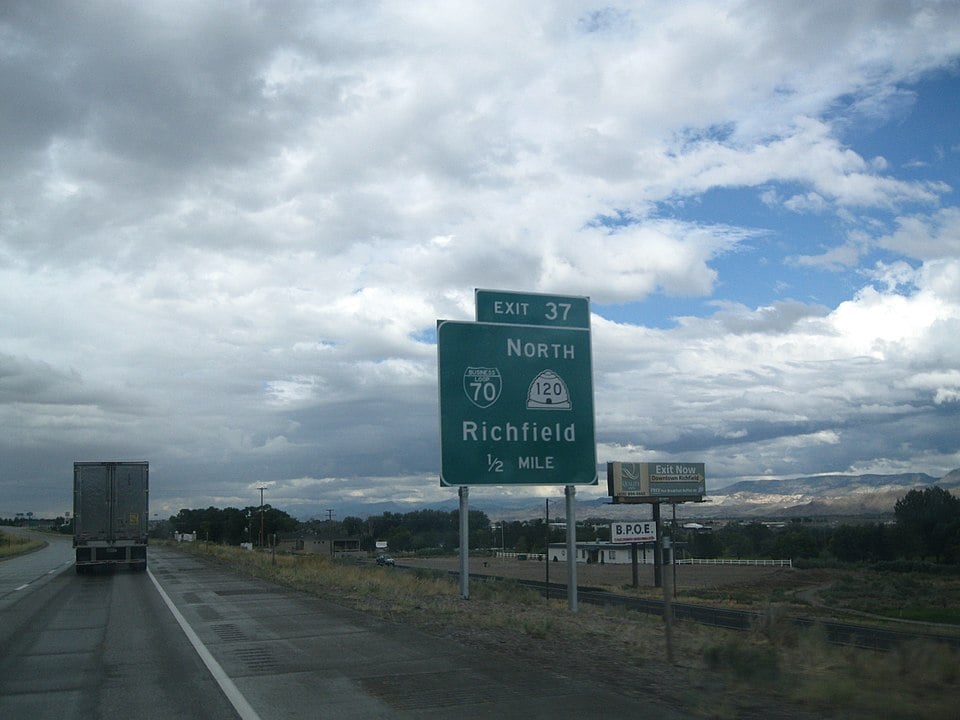
I savored a hearty gourmet breakfast of instant oatmeal and hot water at the motel restaurant this morning, washing it down with a small carton of orange juice, and then, after several hours of further filming for Becoming Brigham at the Utah Territorial Statehouse (on Brigham Young, race, and slavery), went again with the group to The Eatery in Fillmore for lunch. I had a chicken-fried breakfast steak, but I couldn’t actually finish the meal. Thereupon, we drove up to Scipio (2020 population 353) and over to Richfield (population roughly 8200) where I’ve just gotten into my room at the Ramada Inn.
This is the life I dreamed of living! This is the lavish, epicurean lifestyle that I went into apologetics to achieve!
Now, though, permit me to address some of the specific questions from those eager cub reporters, which I’ve paraphrased for the sake of conciseness and efficiency:
“Peterson’s diet on this trip thus far isn’t balanced. How can he justify such eating?”
It isn’t, and he can’t. Fast food places aren’t known for healthy nutrition, and Peterson didn’t really have the time to explore the various vegan, vegetarian, or pescatarian options in Fillmore (2020 population 2592). This isn’t his usual diet. Where the group goes, he goes.
“The Best Western Paradise Inn in Fillmore is quite upscale. Did Peterson book the best room for himself?”
Someone’s definition of “upscale” seems a tad eccentric. Anyway, Peterson didn’t book the rooms in Fillmore; Redbrick Filmworks did. And all of the rooms appear to be pretty much identical in terms of splendor, refinement, and elegance.
“Fillmore is only about 90 minutes from Peterson’s home. Why didn’t he just commute between his home and his filming location?”
Notwithstanding the vast sums that he earns from his apologetic enterprises, Peterson’s home currently has fewer cars than drivers, and those cars are needed throughout the day. So he and his five associates piled into two vehicles for their journey, thus leaving means of transportation available to the people living in his house. Anyway, as illustrated today, Peterson and his co-conspirators didn’t remain in Fillmore, and they won’t remain in Richfield, either. As Bilbo sings, “The Road goes ever on and on.”
“Had Peterson’s wife been able to come along, would her expenses have been paid?”
No. As in past trips, she would have paid for her own meals. In the past, when she has flown to a filming location, she has paid her own airfare. She and Peterson would have shared a room, though. And she probably would have driven in the same car with Peterson. (Notwithstanding his notoriously repulsive personality and his poor character, they’re still on friendly terms with each other.)
My little crowd of devoted groupies is actually both rather cute, in its way, and quite amusing. We’ll see what additional questions they’ll come up with for tomorrow’s report!
Posted from Richfield, Sevier County, Utah













 Ad-Free & Subscriber Log-In