

A pseudonymous online critic has launched an attack against my supposed view that irreligious people cannot be moral — a view that is obviously false and that I do not hold. He also suggests that, in my opinion, people only rein in their impulses and restrain their actions because they’re terrified of the wrath of God, and that I think that, if I were ever to cease to believe in God as a kind of crutch for morality, I would likely embark on a rampage of immorality and become another Jeffrey Dahmer.
I’ve explained myself on these matters and specifically refuted such caricatures on numerous prior occasions, and I’ll almost certainly do so again when and where I think it appropriate. But not now. I don’t believe that it would help this critic and his small but astoundingly gullible audience. I don’t see any evidence that they really care to understand what I’ve said on this topic. And, in the words of Murphy’s Second Corollary, which I recently quoted here in an analogous case, It is impossible to make anything foolproof because fools are so ingenious.
But I do want to correct a historical error: In support of his assertion that, contrary to my alleged view, irreligious people can be moral, my pseudonymous online critic cites a comment from one of the Pilgrims at Plymouth Plantation, Edward Winslow, about the indigenous Pokanoket (or Pakanokick, or Pauquunaukit) people of southern New England. In a letter dated 11 December 1621, Winslow wrote that
They are a people without any religion, or knowledge of any God, yet very trusty, quick of apprehension, ripe-witted, just, the men and women go naked, only a skin about their middles . . .
It must be pointed out, though, that Mr. Winslow was a zealous Christian Separatist who was born in 1595, and that, mutatis mutandis, his attitude toward other faiths was probably closer to that of Henry Fielding’s fictional Parson Thwackum than to that of a modern field anthropologist or a twenty-first-century scholar of comparative religions. Said Parson Thwackum:
When I mention religion I mean the Christian religion; and not only the Christian religion, but the Protestant religion; and not only the Protestant religion, but the Church of England. (from Henry Fielding, The History of Tom Jones, a Foundling)
It was unwise for my critic to rely so naïvely upon Edward Winslow’s account of Pokanoket spirituality (or the lack thereof). I would be surprised if Mr. Winslow had even a rudimentary knowledge of the language of the Pauquunaukit. How much did he understand about Pokanoket spirituality? Probably little or nothing.
So, out of curiosity, I did a very quick online search regarding the Pokanoket people, a powerful Wampanoag group who, during the critical period of their interaction with the Pilgrims, were led by a chief named Massasoit.
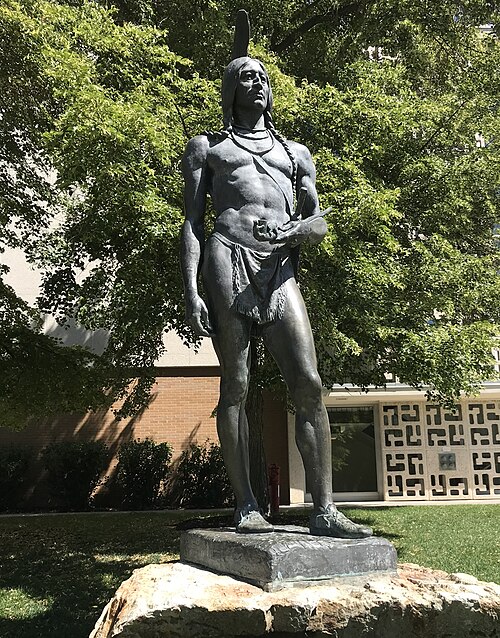
An aside: Those who are familiar with the campus of Brigham Young University will recall the statue of Massasoit that is prominently placed directly west of the University’s Harold B. Lee Library. The sculptor was Cyrus Dallin, who also created the statue of the Angel Moroni that stands atop the Salt Lake Temple. (President Dallin H. Oaks’s first name was given to him in honor of Cyrus Dallin by his mother, Stella, for whom she had once served as a model.)

(Brooklyn Museum, public domain)
So, is it true that the Pokanoket were wholly without a religion? Unsurprisingly, No, it is not.
Pokanoket spirituality, I found, was (and, to some extent, still is) rooted in a reverence for the Creator, Mother Earth, and the spirit world, in a cosmology that emphasizes interconnectedness, balance, and gratitude for all of creation.
For the Pokanoket, the Creator, the source of all life, is the Supreme Being. But everything — both plants and animals, as well as the land itself — is inhabited by spirits. ( To illustrate, a Pokanoket seeking to make a canoe would thank the spirit of a tree before cutting it down.) Among these, Mother Earth is regarded with special reverence. She is a divine entity who is particularly concerned with birth and rebirth. Living in peace and in harmony with her is central to their beliefs, and she should always be respected.
In some accounts of Pokanoket religion, a figure known as Hobbamock serves as an intermediary between the people and the Creator God. He is seen as a problem-solver for times when things are out of balance with Mother Earth.
Pokanoket spirituality values certain particular locations — e.g., three sacred mountains, including Potumtuk, which was known to the colonists as Mount Hope — as places of unique spiritual significance where rituals and ceremonies (including prayers, thanksgivings, and the veneration of ancestors) were carried out. (Potumtuk continues to be venerated among the Pokanoket even today.) The religion of the Pokanoket also appears in the ceremonial reinterment of ancestors, which is designed to honor them.
Gratitude is central to Pokanoket spirituality, expressed not only in annual ceremonies pegged to the lunar year but in ceremonies for the seasonal harvests (of, for example, strawberries and cranberries). Prayers, sometimes accompanied by a ceremonial offering of tobacco, begin and end with thanks to the Creator and to Mother Earth.
Spiritual leaders called powwas played a central role in the Pokanoket community, presiding over councils — rather theocratically, it must be said, and especially so for a people allegedly lacking any religion! — with the sachems (political leaders or chiefs) and the sagamores (subordinate chiefs) to make decisions. To this very day, the Pokanoket Nation has a spiritual leader who is known as the Powwas.
Edward Winslow probably wouldn’t have recognized any of this as a real religion. After all, it scarcely resembled his own Protestant Christianity. It bore little similarity to Calvin’s Institutes. But he very likely didn’t even know about it.
So my critic mocks me for views that I don’t hold, and he supports his mockery by deploying as his weapon a gross historical falsehood. Which is pretty much par for the course at the place where he holds forth. And then, by the way, another member of the choir there cites an evolutionary explanation of the origins of morality that, he apparently feels, is superior to my position — to which it isn’t even germane. Most impressive.
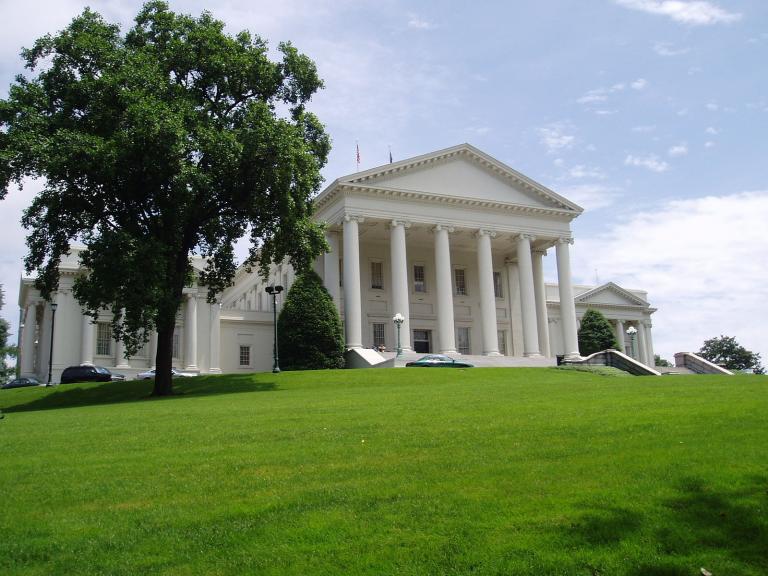
(Wikimedia Commons public domain image)
I don’t know whether any of you are aware of the remarkable recent controversy involving the Democratic nominee to be the next attorney general of the Commonwealth of Virginia. If not, and if you can access it, this article in National Review (where the precipitating story broke) should bring you up to speed: “Jay Jones’s Texts Are a Frightening Peek into a Bleak Moral Worldview”
I can’t help being reminded of a saying attributed to the late Mongolian statesman Mr. Genghis Khan, who might have made an excellent Democratic candidate for statewide office in Virginia had he met the residency requirements and lived in the right century.
“The greatest happiness is to vanquish your enemies, to chase them before you, to rob them of their wealth, to see those dear to them bathed in tears, to clasp to your bosom their wives and daughters.”
Posted from Newport Beach, California











 Ad-Free & Subscriber Log-In