

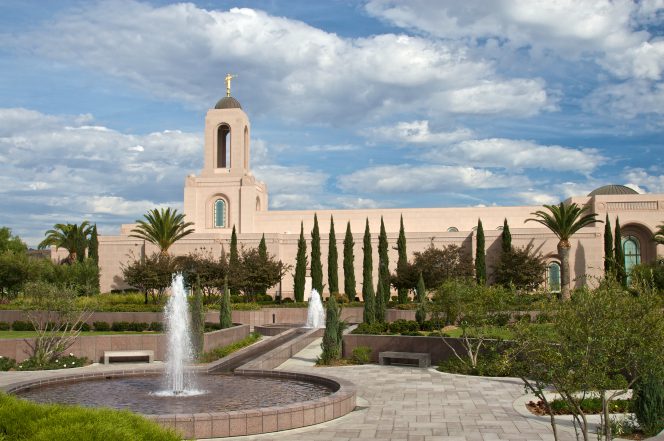
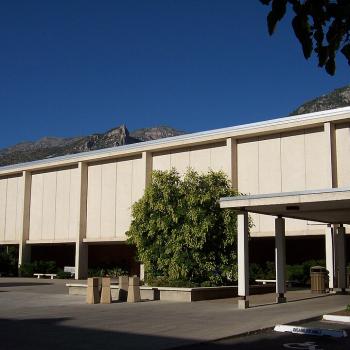
We attended sacrament meeting this morning in the meetinghouse that is situated directly next door to the Newport Beach California Temple. It was, I thought, a very good service. The first speaker, a brother, used two talks from the recently concluded semi-annual general conference of the Church to address the topic of families. The second, a sister, spoke with great panache about spiritual promptings, and related some personal stories of her own.
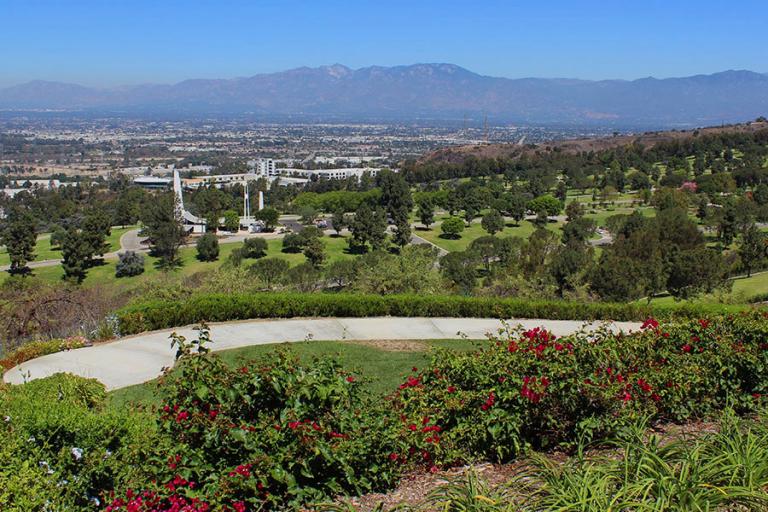
(Wikimedia Commons public domain image)
Before attending the Los Angeles California Temple yesterday, we drove to Rose Hills Cemetery, in Whittier, where we visited the graves of my parents. I try to do this whenever I’m in the area. And we also took note of the directly adjacent grave of Frenchy Morrell, of whom I’ve written here before:
I’ll mention one particular visit to my parents’ graves, which took place in July 2018. I made a note of it here, which is why I remember that specific day relatively well.
The view from their burial place is splendid, and this was a beautiful, clear day. We could see the skyscrapers of downtown Los Angeles off in the distance to the west, and, to the north, the San Gabriel Mountains — including Mt. Wilson, which I saw every day of my life growing up, with its television broadcasting towers and its observatories (from which Edwin Hubble first noticed the red shift of distant galaxies, thus discovering the expansion of the universe and leading to the theory of the Big Bang). It’s a very peaceful place, and I love it. The inscriptions on their tombstones sum them up, simply but eloquently: For my Mom: “Beloved wife and mother,” and then “Family first.” For my Dad: “Beloved husband and father,” followed by “A good man.” (I once dedicated a book to him with a citation from John 1:47 in the KJV New Testament: “an Israelite indeed, in whom there is no guile.”)
I was happy again that day to see the grave next to my mother’s, on the opposite side from my father’s. Why happy? Let me explain.
My father died on 30 June 2003. My mother died on 11 April 2005. I think it was on our first visit to the cemetery after my mother’s passing that my wife and I, driving up the rather steep hill toward my parents’ graves, noticed an elderly man who was toiling painfully up the road. We pulled over and asked him whether he could use a ride. Yes, he said, he could. He was walking to put flowers on the grave of his wife, whose loss, it soon became clear, he still felt with acute pain.
We invited him to ride with us and asked him to tell us where to turn. To our astonishment, his wife’s grave turned out to be about four or five feet from my parents’ burial place. It was separated from their graves by his own tombstone, with his name, “Frenchy M. Morrell,” and his birthdate inscribed on it but, obviously, no death date. We talked for a while, and he spoke movingly about how much he missed his wife, Wanda, who had died in 1985. He was horribly lonely, and he longed to be with her again. We offered him a ride back down the hill and to wherever he wanted to go, but he had planned on spending several hours there by his wife’s grave, and he declined our offer. We never saw him again.
We’ve returned, and I’ve come back alone, many times since then. Whenever I’m in southern California, if I can do it, I visit the cemetery. Every time for years, I looked to see whether Frenchy had finally gotten his wish.
Visiting in the spring of 2013, we immediately noticed that the grass next to my mother’s grave was fresh, and so, with some excitement, I hurriedly walked over to confirm what I suspected: Frenchy was gone. He had died on 30 August 2012.
I was deeply happy for him. After twenty-seven long years of sorrowful separation, he was with his wife again. And my faith tells me that he really is, not merely metaphorically.
We took some of the flowers that we’d brought for my parents that day and placed them on his grave.
“And God shall wipe away all tears from their eyes; and there shall be no more death, neither sorrow, nor crying, neither shall there be any more pain: for the former things are passed away” (Revelation 21;4).
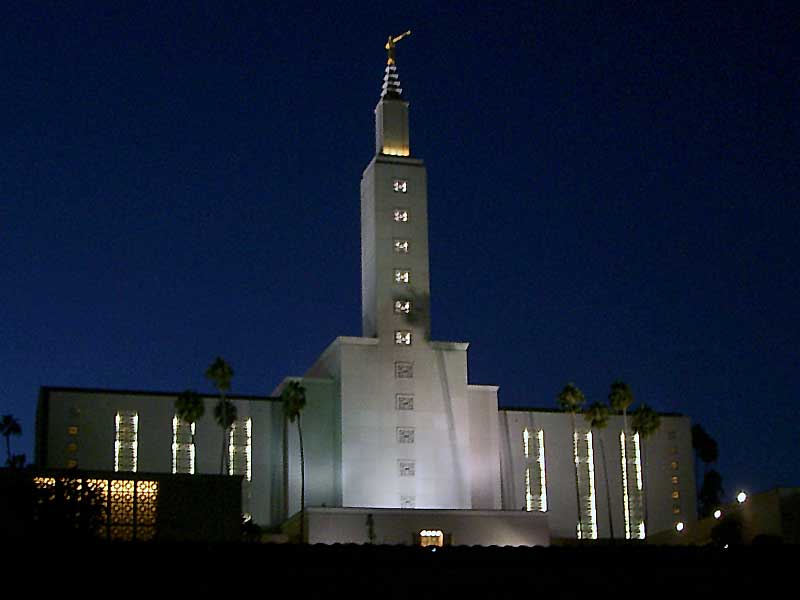
I was really pleased, while in the Los Angeles California Temple on Saturday, to run into Gurcharan S. Gill, who retired many years ago from teaching in the Department of Mathematics at Brigham Young University. I hadn’t recognized him, but he came up to me and we had a pleasant conversation in the temple’s celestial room.
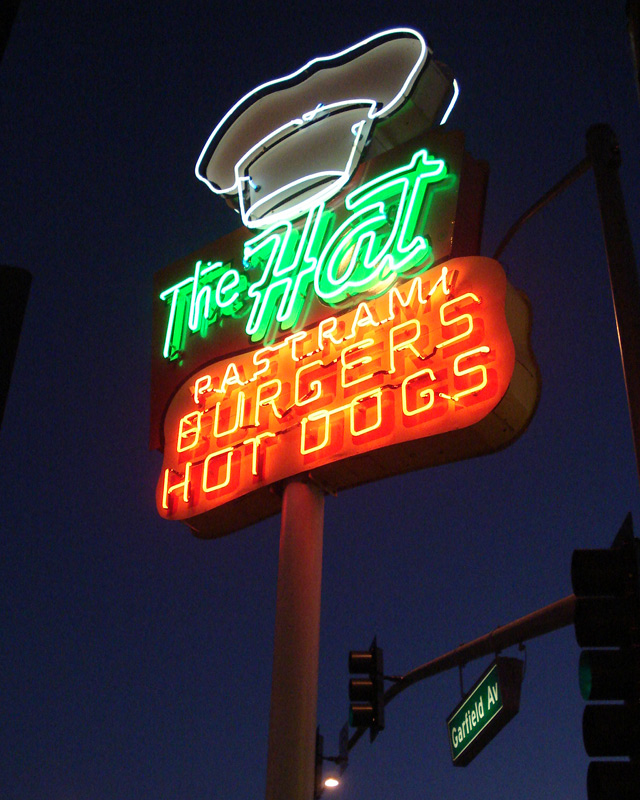
I’m trying to be completely open about my eating habit, an unfortunate addiction that has drawn considerable derision and a fair amount of entirely justifiable condemnation from some of my anonymous online critics. Yesterday, for example — and I’ve resolved to make no attempt to conceal the sordid reality of my compulsion to consume food (and to do it pretty much every day) — I took my wife and our visiting friend to The Hat, on Rosemead Boulevard in Temple City, for lunch. While there, openly and in full view of others, I ate a pastrami dip sandwich. I’ve been eating their pastrami dip sandwiches since childhood, although that tradition actually began at the location in Alhambra, on Valley Boulevard. Only later did my brother and I begin occasionally to visit the location in Temple City where, quite flagrantly, we would indulge our reprehensible appetite for lunches composed of food. As justification, I can only offer in my defense that I really like The Hat’s pastrami dip sandwiches, and that eating them once or twice a year is a way re-connecting, in a slight way, with my memories of my now-departed parents and only sibling.
Yesterday evening, upon leaving the temple, we drove down to San Pedro, where we visited the home and studio of an Egyptian artist who now lives in the United States. He and his late (American) wife were two of our closest friends during the years that we lived south of Cairo. The visit was harmless enough, I suppose, but, afterwards, we went out to dinner with him and his daughter and son-in-law and their daughter, and, yes, I relapsed: I ate food. Again.
Not only that, but — full disclosure — my wife and I and our visiting Utah friend had a seafood lunch one day at the Rusty Pelican in Newport Beach and . . . well, I liked it. Do I need to go into rehab?
Posted from Newport Beach, California






 Ad-Free & Subscriber Log-In