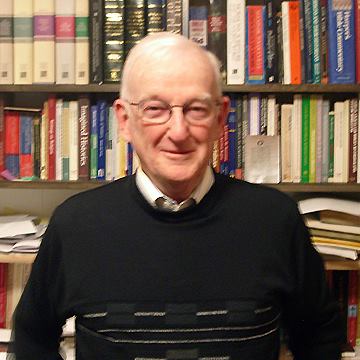
Professor Louis C. Midgley earned a Ph.D. in political science from Brown University with a focus on political thought and what might be called “political theology.”
Part of our book chapter reprint series, this article originally appeared in Steadfast in Defense of Faith: Essays in Honor of Daniel C. Peterson, edited by Shirley Ricks, Stephen D. Ricks, and Louis Midgley. For more information, go to https://interpreterfoundation.org/books/steadfast-in-defense-of-faith/.
“Daniel C. Peterson is a superb editor, expert writer, and solid scholar as well as a genuine friend. I am pleased to honor him with an essay that I hope he and others will find fresh and interesting.
I will begin by telling the story of my first chance—or perhaps providential—encounter with some of what David Hume (1711–76) published on politics, about which he wrote much, and then on what he often called “religion.” I have found that my opinions on politics, as I will indicate, have been strongly influenced by Hume. I will identify his opinions first about some of these human things that have come to fit rather snugly my own way of setting out and explaining politics and then also his critical appraisal of what is known as “natural theology,” which I hope to demonstrate is consonant with the grounds of Latter-day Saint faith.”
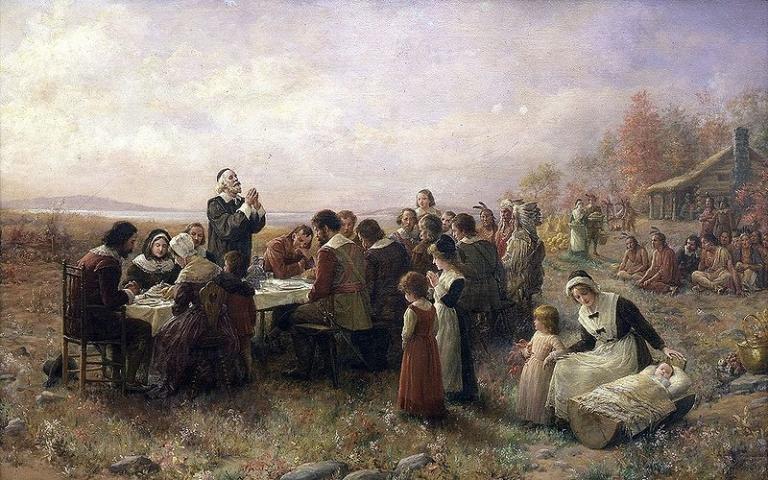
“The First Thanksgiving at Plymouth,” by Jennie A. Brownscombe (1914) Wikimedia Commons public domain. Although it was Christians who first celebrated a Thanksgiving festival in America, there is nothing in the concept of Thanksgiving that restricts it to Christians. But it may, in sense, require theism for its full meaning.
I share links with you to three articles that were recently published for Thanksgiving in Meridian Magazine:. The first is a rather odd one that I myself wrote. It’s weirdly personal, and I’m afraid that I can’t really recommend it. The other two, though, are worth reading:
And here below are five other articles that I myself published for previous iterations of the American Thanksgiving holiday. Perhaps you’ll find a sentence or two from one of them to be worthwhile?
-2011-
Autumn harvest festivals were and are common across Europe, and, as every American schoolchild once learned, our modern Thanksgiving celebrations descend from a meal shared between Massachusetts Pilgrims and Native Americans in 1621.
It was not until 3 October 1863, however, that a uniform national holiday was established by presidential proclamation. Writing well into the Civil War, Abraham Lincoln declared that
“The year that is drawing towards its close, has been filled with the blessings of fruitful fields and healthful skies. To these bounties, which are so constantly enjoyed that we are prone to forget the source from which they come, others have been added, which are of so extraordinary a nature, that they cannot fail to penetrate and soften even the heart which is habitually insensible to the ever watchful providence of Almighty God.”
After enumerating a substantial and very specific list of material blessings, Lincoln continued.
“No human counsel hath devised nor hath any mortal hand worked out these great things. They are the gracious gifts of the Most High God, who, while dealing with us in anger for our sins, hath nevertheless remembered mercy. It has seemed to me fit and proper that they should be solemnly, reverently and gratefully acknowledged as with one heart and one voice by the whole American People. I do therefore invite my fellow citizens in every part of the United States, and also those who are at sea and those who are sojourning in foreign lands, to set apart and observe the last Thursday of November next, as a day of Thanksgiving and Praise to our beneficent Father who dwelleth in the Heavens. And I recommend to them that while offering up the ascriptions justly due to Him for such singular deliverances and blessings, they do also, with humble penitence for our national perverseness and disobedience, commend to His tender care all those who have become widows, orphans, mourners or sufferers in the lamentable civil strife in which we are unavoidably engaged, and fervently implore the interposition of the Almighty Hand to heal the wounds of the nation and to restore it as soon as may be consistent with the Divine purposes to the full enjoyment of peace, harmony, tranquility and Union.”
It is a remarkable document—and not only for Abraham Lincoln’s characteristic eloquence.
One is struck, for example, by Lincoln’s sense of gratitude even amidst horrible death, destruction, and tragedy. The great battle at Gettysburg had concluded precisely three months before, and Lincoln himself would fall as one of the Civil War’s last victims only eighteen months later. Yet he calls for national thanksgiving to God.
It’s also impossible to miss the overt religiousness of the statement, and difficult to imagine a similar document emerging from any recent White House. Lincoln writes without embarrassment of God’s grace and paternal care, and, perhaps even more notably today, of our sins and “perverseness and disobedience,” recognizing an authority far higher than his own that rules all human affairs and overrules all human power.
And this authority, Lincoln plainly understands, is a Person. Lincoln doesn’t merely advise his fellow citizens to be satisfied that their fields are productive and to be happy at good weather. He counsels them to recognize a living, willing, conscious Being behind those “gifts,” and to thank that Being for them.
To recognize a divine Person behind nature and human history, to perceive an ultimate and inconceivably powerful Will beneath and beyond the shifting phenomena of our lives and the world, is a characteristic mark of the religious attitude—and submission to that Will, and gratitude to that Person, are among the virtues advocated by all religions of the Abrahamic tradition and most religions worldwide.
Anybody can be happy with his or her material state, satisfied that things are going well, relieved that they’re not going as badly as they could have gone. And everybody should, if possible, devote Thanksgiving Day to strengthening relationships with family and friends. (Most of us, nowadays, eat so very well throughout the year that the Thanksgiving meal in itself is, relatively speaking, unimportant. This isn’t just “Turkey Day”; Lincoln’s proclamation says nothing about food.)
But thanks can only meaningfully be given to persons. Thus, if Thanksgiving is to be practiced as the sixteenth president of the United States—perhaps our greatest—advised, it must expressly involve gratitude to God.
-2012-
William Ernest Henley’s famous Victorian-era poem “Invictus” provided the title and the theme for Clint Eastwood’s inspiring 2009 film about Nelson Mandela. It also provided the memorable claim “I am the master of my fate: I am the captain of my soul.”
It’s a stirring assertion, and, in a very real sense, true. A great proportion of what we are and do rests upon our own decisions.
But not everything, and perhaps not the most important things. Henley’s claim is also false and misleading.
As I write, a friend and neighbor is recuperating from a catastrophic fall that lacerated his face, took out most of his teeth, broke major bones everywhere in his body, and very nearly killed him. As he plunged groundwards, he certainly wasn’t the master of his fate, and he’s scarcely more so as he lies in a hospital bed. Those who’ve surveyed the spot where he landed, closely bordered by objects that could instantly have ended his life, regard his survival as a miracle, and he himself, speaking with difficulty, testifies to it.
“I thank whatever gods may be,” says Henley, “for my unconquerable soul.”
Thirty years ago, my wife and I traveled with our infant son from southern California to her parents’ house in Denver, Colorado, where the whole extended family were gathering for a Christmas trip to Florida. We participated in a “Messiah” sing-along and then went home to prepare for our flight to Orlando the next morning.
But then came what’s been called “the Christmas Eve blizzard of 1982.” Stapleton International Airport closed at 9:30 AM on 24 December, remained closed for fully thirty-three hours, and then, for several days thereafter, was open only for severely limited operations. Ten-foot-high snowdrifts were left throughout greater Denver, highways into and out of the city were shut down, power outages darkened large portions of the metropolitan area, roofs collapsed, supermarkets closed because their employees couldn’t get to work, hospitals were reduced to minimal staff on emergency power, and snowmobiles dominated suburban streets.
It was astounding to me, and revealing, to realize how easily simple snowfall could shut down a major modern city quite accustomed to seeing it.
We’re plainly not entirely the masters of our fates, the captains of our souls. Rather, as Elder Orson F. Whitney (d. 1931) of the Quorum of the Twelve Apostles put it in “The Soul’s Captain,” his response to “Invictus,” “Men are as bubbles on the wave, as leaves upon the tree.”
We’re fragile creatures. A few days without food, even fewer without water, a few minutes without oxygen, and we’re gone. If our hearts miss just a few beats, none of our plans, ambitions, schemes, or careful investments will mean a thing. And, in the end, no matter how we fight it, we’ll die.
Our comfort and survival in the meantime depend upon cycles of evaporation and precipitation that few of us really understand, and we rely upon complex networks of exchange and transportation that very few of us could begin to explain.
The ground on which most of us live and where our food is grown was cleared of rocks, trees, and stumps by millions of hardworking people whose names we’ve forgotten. Our cities—big and small—feature large buildings erected by generations of construction workers to whom we’ve probably never given the slightest thought.
We owe a debt of gratitude that we can never repay. “For behold, are we not all beggars? Do we not all depend upon . . . God, for all the substance which we have, for both food and raiment, and for gold, and for silver, and for all the riches which we have of every kind?” (Mosiah 4:19). The Book of Mormon’s Amulek wisely counsels us that we should “humble ourselves even to the dust, and worship God, in whatsoever place we may be in, in spirit and in truth; and that we live in thanksgiving daily, for the many mercies and blessings which he doth bestow upon us” (paraphrased slightly from Alma 34:38).
In the United States of America, where many of us are gathering together as families and friends for the Thanksgiving holiday, this is an exceptionally appropriate day for us to remember the debt that we owe to those who’ve preceded us and to God, “in whom we live, and move, and have our being” (Acts 17:28).
-2013, with the late William J. Hamblin-
American traditions of Thanksgiving are generally associated with Puritan harvest feasts in early colonial times, and particularly with the one in October 1621, when Chief Massasoit and about 90 other Native American men joined slightly more than 50 European immigrants at Plymouth Colony, in today’s Massachusetts, for a communal meal. Abraham Lincoln’s formal proclamation of a late-November “Day of Thanksgiving and Praise” came just 150 years ago, in 1863. However, religious festivals of thanksgiving associated with the agricultural cycle, thanking God for a bounteous harvest – essential to life through the winter — are much more ancient and universal, and can be found in most religious traditions of the world. In ancient agrarian societies, where survival ultimately depended on rain and on the fertility cycles of local plants and animals, a failed harvest could swiftly bring widespread disaster and death. Accordingly, a bountiful harvest was received with gratitude.
The sacrifices and festivals of ancient Israel were likewise fundamentally linked to the annual seasons of planting and reaping. One of their sacrifices was actually called the “thanksgiving” (Hebrew “todah”). As described in Leviticus 7:11-15, the thanksgiving offering was an entire meal, including fried cakes, bread and meat. Furthermore, it was commanded that “the flesh of the sacrifice of the peace offerings for thanksgiving shall be eaten the same day that it is offered.” That is, the ancient Israelite thanksgiving sacrifice was a sacred feast, a meal in which the food offerings were symbolically shared with God but were literally eaten by the sacrificer. In ancient Israel, such a “holiday feast”—as we now describe it—was actually a “holy-day feast.”
One of the fundamental psalms sung by the Levite choir each day at the temple was “O give thanks unto the Lord, for he is good, and his mercy endures forever” (Psalms 106, 107, 118, 136, 138; 1 Chronicles. 16:7, 34, 23:30; 2 Chronicles. 5:13, 7:6; Nehemiah 12:8). One could enter the Israelite temple only if one “entered the gates with thanksgiving” (Psalms 100:4 95:2). Psalm 50 describes the characteristics of the “thanksgiving sacrifice” (50:15): “he who offers thanksgiving (Hebrew “todah”) glorifies me” (50:23; cf. Psalm 116:17). When Jeremiah prophesied of the future restoration of Jerusalem and its temple, which was to come following the Babylonian captivity, he predicted that the returning Jews would “bring thank offerings to the house of the Lord” (Jeremiah 17:26), singing “songs of thanksgiving” (Jeremiah 30:19). Jeremiah likewise prophesied that in Jerusalem should again be heard “the voice of joy and the voice of gladness, the voice of the bridegroom and the voice of the bride . . . as they bring the thanksgiving sacrifice (Hebrew “todah”) into the House of the Lord” (Jeremiah 33:11).
In the New Testament, Christ is twice described as giving thanks in the context of a sacred meal. At the feeding of the 5000, he took the loaves and fish and, “having given thanks, he broke them and gave them to the disciples, and the disciples gave them to the crowds” (Matthew 15:36; Mark 8:6; John 6:11). In the old Israelite thanksgiving sacrifice, the people were to bring food to the temple and give it to the priests, who would then offer it to God. Now, in a paradoxical reversal of the old order, Christ, as God incarnate, brings the food, offers thanks, and gives it to his apostle-priests who then offer it to the people. The old order of the thanksgiving offering is thus reversed.
The same reversal of roles is found at the Last Supper, where, at the Passover dinner, Jesus gives thanks and shares a sacred meal with his apostles (Matthew 26:37; Mark 14:23; Luke 22:17, 19; 1 Corinthians 11:24). Christ’s atoning sacrifice has thus become a “thanksgiving offering.” Although in the Latter-day Saint tradition we tend to call our commemoration of the Last Supper the “sacrament,” in ancient Christianity it was referred to as the Eucharist— the “thanksgiving”. This is because Christ is described as having “given thanks” at the Last Supper—in Greek, “eucharistesas.” (Still today, the modern Greek equivalent of “thank you” is “efkharisto.”) Thus, for Latter-day Saint Christians, the sacrament is our commemoration of the archetypal thanksgiving sacrifice and meal of ancient Israel, of which our modern Thanksgiving holiday is only a pale shadow. Appropriately, too, for many Americans Thanksgiving kicks off the serious holiday season that culminates in Christmas, which recalls God’s greatest gift to us, his Son.
-2014-
Many years ago, a friend (now deceased) told me about a very high-ranking Church leader (also now deceased) who had been asked to address a group of local senior service missionaries and their wives at their annual Christmas dinner.
As the program proceeded, various stories were related to illustrate the great things that this group of devoted volunteers had accomplished during the year then nearing its end. Unfortunately, the Church leader, still waiting to offer his concluding remarks, was growing concerned at what struck him as the evening’s self-congratulatory tone.
Finally, his turn came to speak. He had been allotted roughly half an hour, but he jettisoned his prepared text. Instead, he simply opened his scriptures to Mosiah 2:20-21, and read it to his audience:
“I say unto you, my brethren, that if you should render all the thanks and praise which your whole soul has power to possess, to that God who has created you, and has kept and preserved you, and has caused that ye should rejoice, and has granted that ye should live in peace one with another—
“I say unto you that if ye should serve him who has created you from the beginning, and is preserving you from day to day, by lending you breath, that ye may live and move and do according to your own will, and even supporting you from one moment to another—I say, if ye should serve him with all your whole souls yet ye would be unprofitable servants.”
He then bore a brief testimony of Christ and sat down. The rebuke was quiet but unmistakable, and my friend had remembered it for years by the time he told me about it.
Today is a day for giving thanks—uniquely and officially so in America, but appropriately so everywhere—for the remarkable blessings that we enjoy. We have far more to be grateful for than we can begin to recognize or enumerate, and it should leave us deeply humble.
We enjoy food, nourished by soil and weather we didn’t create, that we neither planted nor harvested. It’s brought to us via roads and rails and ships constructed by people whose names we don’t know, and we prepare it with fuels and implements that we didn’t produce.
We communicate worldwide virtually for free. Films, computers, television, and radio put almost unlimited information at our fingertips, including remarkable ways of researching family history.
We benefit from a level of nutrition, health, and comfort that would have been unimaginable to our ancestors, many of whom suffered throughout their lives from rotten teeth and incurable ailments. Only a few generations ago, even the simplest diseases stymied the best physicians. Dentists and surgeons did their work without sterilization or anesthesia. But, until fairly recently, there were no hip replacements or arthroscopic knee surgeries anyway, and, not very long before that, there were no aspirin tablets and no corrective lenses. If you had a headache, you simply endured it until it went away. If your eyes or knees went bad, you lived with it until you died.
Prior to a couple of centuries ago, all transportation was on foot, or on or behind an animal, or blown by the wind. Ramses II, Augustus Caesar, Queen Elizabeth I of England, and George Washington all traveled roughly the same way. Today, by contrast, we cruise along comfortably in climate-controlled bubbles at speeds they never knew, listening to the Beatles (including John Lennon and George Harrison, who’ve been dead for years) or to the Vienna Philharmonic.
We typically take this all for granted. We even complain about it. Several years ago, I found myself wedged between two strangers on a flight from Chicago to Salt Lake City. The flight attendant gave me only pretzels, and the flight dragged on for more than four hours! Suddenly though, I thought of the handcart pioneers. Only 150 years before, they had followed essentially the same route, thousands of feet below me, over rivers, through brush and rocks, under rain and sometimes snow, requiring several months to complete their journey. My whining might not have impressed them favorably.
And the Gospel is on earth again. In other words, to put it flippantly, we’ve won the cosmic lottery.
Praise God, from whom all blessings flow;
Praise him, all creatures here below;
Praise him above, ye heavenly host;
Praise Father, Son, and Holy Ghost. Amen.
A very happy Thanksgiving to everyone.
-2015-
Although American Thanksgiving Day began as a harvest festival, it’s not about eating. Most of us eat quite well—often too well—every day, so meals aren’t special. It’s not even really about family. As its name implies, it’s about giving thanks.
And we have much for which to be thankful.
Why is there a universe in the first place? Why is it so precisely fine-tuned as to produce us? The great twentieth-century atheistic astrophysicist Sir Fred Hoyle concluded, rather grumpily, that the whole thing is “a put-up job,” that “a superintellect has monkeyed with physics, as well as with chemistry and biology.” “As we look out into the universe,” wrote the Anglo-American mathematical physicist Freeman Dyson, of Princeton’s Institute for Advanced Study, “and identify the many accidents of physics and astronomy that have worked together to our benefit, it almost seems as if the universe must in some sense have known that we were coming.”
Ours, says the British physicist Paul Davies, is “a Goldilocks Universe.” It’s “just right.” And so is the globe on which we live, as demonstrated in recent books bearing such titles as “Privileged Planet” and “Rare Earth.”
Our bodies are phenomenally complicated; our brains, some scientists say, are the most physically complex objects in the known universe. Stars and galaxies are simple in comparison.
Most readers of this column enjoy the privilege of American citizenship, or of something rather like it. There are, today, a number of free countries that respect human rights. But many are unfree and oppressive. There are many prosperous nations, too—but also many that are very poor. We should be mindful of those less fortunate than ourselves, but also grateful for the blessings that we enjoy and not complacent about them.
Although most of us are isolated or insulated from the production of food and take it for granted, we have easy access to diets of a richness and variety that would have been unimaginable even to our relatively recent ancestors and to many in the world still today.
Gutenberg’s printing press and, now, ebooks and the Web and powerful search engines, grant us easy access to vast treasuries of knowledge. Cell phones and cheap and instant Internet communications keep us in contact, wherever we are. As we hurtle along in climate-controlled automobiles or jet aircraft, we listen, if the mood strikes us, to concerts by U2, or Taylor Swift, or the Berlin Philharmonic. And we lament journeys of several hours that, not so long ago, would have required uncomfortable days if not miserable and dangerous weeks. GPS systems guide us at every step, taking us from driveway to driveway, thousands of miles away.
Of course, no technical marvel changes life’s fundamentals. We still love family and friends. We still lose them. We become sick and, despite superb healthcare (including antibiotics and surgical procedures unknown to our grandparents), we die. We suffer from the human evils of oppression, crime, cruelty, and war. We endure mental and emotional illnesses, and virtually all of us know someone whose life has been damaged or even ruined by the scourge of drugs.
So, more than for anything else, we who’ve been privileged to learn of the Gospel of Christ should be thankful for his atonement and resurrection, which can mend all broken things and make all good things eternal. The power is not ours, but his. I close with powerful words from two hymns, the first from Rudyard Kipling and the second a Latin text derived from Psalm 115:1 and most recently set to memorable music by the great film composer Patrick Doyle:
God of our fathers, known of old,
Lord of our far-flung battle-line,
Beneath whose awful Hand we hold
Dominion over palm and pine—
Lord God of Hosts, be with us yet,
Lest we forget—lest we forget!
The tumult and the shouting dies;
The Captains and the Kings depart:
Still stands Thine ancient sacrifice,
An humble and a contrite heart.
Lord God of Hosts, be with us yet,
Lest we forget—lest we forget!
Far-called, our navies melt away;
On dune and headland sinks the fire:
Lo, all our pomp of yesterday
Is one with Nineveh and Tyre!
Judge of the Nations, spare us yet,
Lest we forget—lest we forget!
“Non nobis, Domine, non nobis, sed nomini tuo da gloriam.” “Not unto us, O Lord, not unto us, but to thy name give the glory.”















 Ad-Free & Subscriber Log-In