


I’m pleased to report that Episode 3 of our Becoming Brigham series — Shorthand and Bloodstains, Part 2 — has now appeared online. I hope that you’ll enjoy it. New installments of Becoming Brigham will be posted every Monday over roughly the next year and a half.
And, incidentally, a new video has now gone up on the Interpreter Foundation’s YouTube channel: “Becoming Brigham Fireside”
In other Latter-day Saint film-making news — I mentioned Emmaus Road Media in yesterday’s blog entry — Scot and Maurine Proctor, of Meridian Magazine, are busily at work creating a series of documentaries focused on the Prophet Joseph Smith: “Packing our Cold-Weather Gear for the Joseph Smith Documentaries Project”

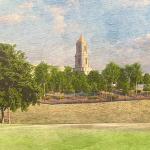
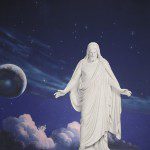
(Wikimedia Commons public domain image)
I voiced a bit of frustration in yesterday’s blog entry about the difficulty of getting the word out about Becoming Brigham. Doing so reminded me of an experience that I had during each of my last two or three semesters of teaching at Brigham Young University. For both the midterm exam and the final exam in my Humanities 242 class (“The Humanities of Islam”), I always included a multiple choice question about the year AD 622.
Why? you might ask. AD 622 is the year of the Prophet Muhammad’s Hijra or “emigration” from Mecca to Medina. As such, it’s commonly regarded as the year of his transition from prophet simpliciter to prophet-statesman, and as the year of the birth of the Islamic state, which is of pivotal importance not only to the evolution of the religion of Islam but to world history more generally. It is so important, in fact, that it has become the base-year of the Islamic lunar calendar. Not, interestingly enough, the year of Muhammad’s birth, nor the year of his prophetic call, nor the year of his death, but the year in which he moved from Mecca to Medina. In the so-called Hijri calendar, years are calculated from AD 622 — but, since it’s made up of lunar months, you can’t arrive at the Hijri date simply by subtracting 622 from the current Gregorian year. (That would be too easy!)
Anyway, I thought the date important enough that I began to emphasize it repeatedly in lectures, and to promise students that it would definitely be on both the midterm and the final.
Nevertheless, despite my repeated comments about the date, and despite the fact that the correct answer was always available there right before them in the multiple-choice format, out of a given class of forty to sixty students, five or six would always get the answer wrong.
So, my last several times, I would tell them that five or six students always got the question wrong and then I would have them chant the date two or three times and would ask several students to explain to the entire class why the date was significant. I would write it on the board, circling and underlining it for emphasis. I would promise them that it would absolutely, certainly, be on the exam. I pointed out that there was nothing about the concept of AD 622 that was complicated or abstruse. I would crack jokes about the date. I would suggest that maybe I should simply fail anybody who couldn’t answer the question, however well they did otherwise on the test. I would do this every other week or so.
When the midterm exam was turned in, each and every time, five or six members of the class would be unable to answer my question about AD 622. When we went over the midterm questions in class, I would single this one out for special attention and would then promise them that it would, without fail, be included in the final exam. And then, when I graded the final exam, five or six members of the class — and not necessarily the same individuals as those from the midterm — would fail to recognize the date of AD 622. I found it utterly mind-boggling.
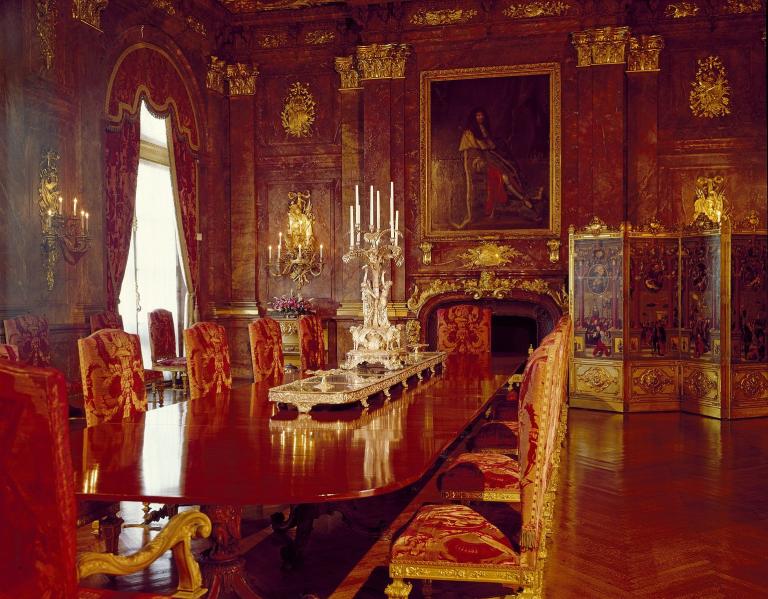
My wife and I went up to an Italian restaurant in the Salt Lake Valley on Saturday night, in celebration of the birthday of a sister-in-law. (Yes, I admit it: I ate food again. Eating is a reprehensible habit — especially when the addict actually enjoys it — but it’s also a powerful one, and surprisingly difficult to overcome.) However, I hasten to add that no Interpreter Foundation funds were used to pay for either the drive to and from the restaurant or the food itself.
I really enjoyed this recent BYU forum address by Dr. Francis Collins, and I heartily recommend it to you: “The Road To Wisdom: On Truth, Science, Faith and Trust.”

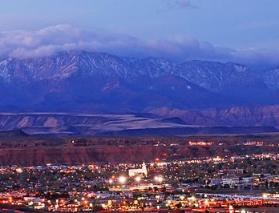
I like to check in from time to time on construction photos from the site of the future Cody Wyoming Temple, to see how uncannily accurate the predictions made by its vocal opponents have proven to be. The temple, they said, would block views of the night sky. It would hide the surrounding mountains. It would loom threateningly over the town of Cody itself, oppressing the residents of that quaint western. village with its sheer vast 9,950-square-foot bulk. And now we have irrefutable photographic evidence that their predictions were tragically correct. The once-beautiful skyline of Cody is dominated by the temple, the sky has been completely hidden from view, and, for months now, nobody has been able to see either the Absaroka Range to the west, the Bighorn Mountains to the east, or the Owl Creek Mountains to the south.
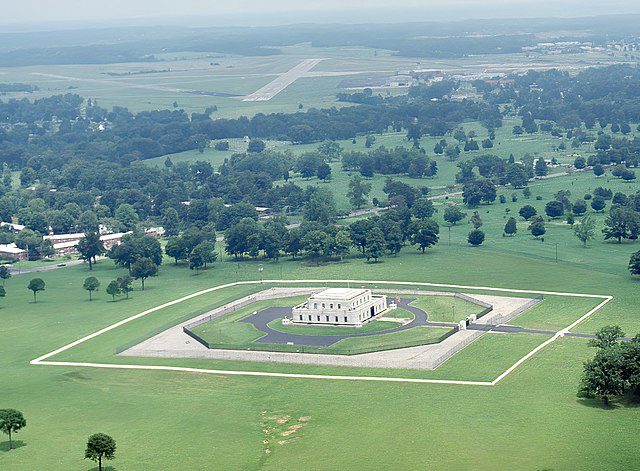
(Wikimedia Commons public domain photograph)
If you decide to read through this longish article that I’ve retrieved from the Christopher Hitchens Memorial “How Religion Poisons Everything” File™, I suggest (for the sake of your physical, mental, and emotional health) that you take occasional breaks to lament, vent your grief, walk off your outrage, and/or punch the wall in frustration at its chronicle of theistic crimes against humanity: “What the Church does to help thousands in the United States each year: Donations, self-reliance initiatives and service have blessed families and communities across the country”







 Ad-Free & Subscriber Log-In