


Have you visited becomingbrigham.com yet? Four episodes of our new series of mini-documentaries have already gone up online; a fifth will drop on Monday. Don’t fall too far behind.
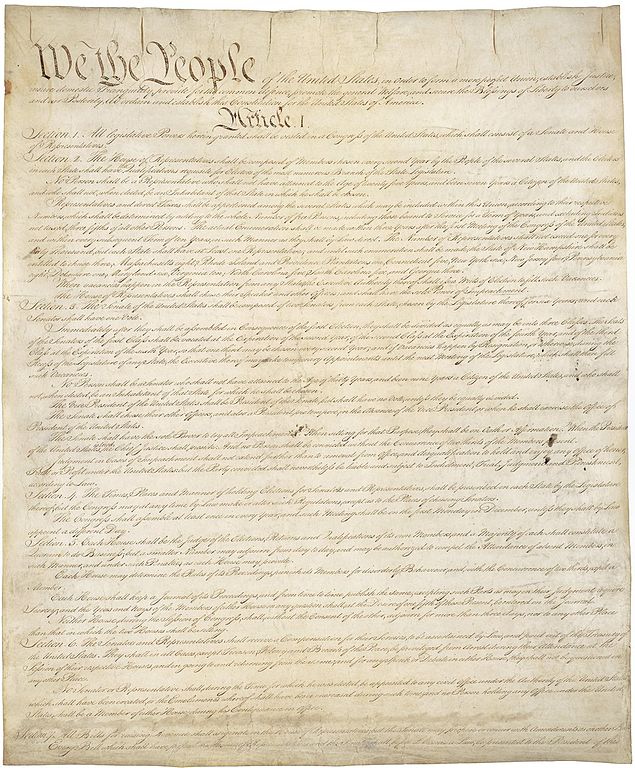
I saw recently that the highly respected Latter-day Saint historian and recent editor of BYU Studies Steven C. Harper has announced his intention to devote some time over the next while to comment upon the Constitution of the United States. He reasons that, since Latter-day Saints believe the Constitution to be divinely inspired, paying close attention to it seems a part of his religious duty.
I was struck by this and, although I don’t necessarily intend to give the subject systematic or sustained attention, I thought that — for reasons not unlike Professor Harper’s — I might make at least a few occasional comments on the topic . Today, I’ll very briefly allude to two aspects of the Constitution that have always struck me and that I think have been somewhat ignored.
1.
I think it significant that Article 1 of the Constitution isn’t about the Executive Branch of the Federal Government. It isn’t about the Presidency. Today’s imperial presidency, something that has been developing for many decades but has risen to a new high in the second Trump administration, is not, I think, what the framers of the Constitution had in mind.
Article 1 of the Constitution is about the Legislative Branch. The will of the people is to be expressed through Congress. The president isn’t even supposed to be popularly elected. That’s why we have the Electoral College, although it is, today, merely a shadow of what it was intended to be.
I don’t think that the Swiss model is applicable to the United States, and I don’t advocate its importation or adoption. But I do feel some degree of wistfulness for a system in which an educated and articulate Swiss citizen told me, when I asked him who the president of Switzerland was, told me that he couldn’t quite remember, that it was either Nellio Cellio or Cellio Nellio. In fact, during that year — the presidency of Switzerland’s seven-member Executive Council rotates annually — it was Nello Celio, from the Italian-speaking Swiss canton of Ticino, south of the Alps.
Strictly speaking, the president of Switzerland is actually the president of the Swiss Confederation, and primus inter pares, first among equals, on the Executive Council of the Confederation. The formal name of the country isn’t really Switzerland at all but, instead, in German, Schweizerische Eidgenossenschaft; in French, Confédération suisse; in Italian, Confederazione Svizzera; in Romansh, Confederaziun svizra — all of the preceding four are official, national, spoken languages (used by, respectively, more than 60% of the population, approximately 23%, roughly 8%, and less than 1%, most of the latter of whom also speak German) — and, in Latin, Cōnfoederātiō Helvētica.
I thought it wonderful that here was a country, Switzerland, in which the news cycle didn’t focus continuously on the country’s president, as if he were some sort of emperor. It was and is a country, too, in which the citizenry seemed to be far more involved in local and regional politics in its twenty-six cantons (states or provinces) and far more aware of local leaders and politicians than oriented toward federal matters — as (I think) the Framers of our Constitution intended the United States of America to be. (Why do we use singular verbs with the plural subject United States? When did we begin to do that? At the time of the civil war? My impression is that, in the antebellum period, we were more prone to say that “The United States have” or “The United States are” than to say, quite ungrammatically, “The United States has” or “The United States is.” We really did regard the United States as a federal republic rather than as a unitary state.
I later learned that Edward Gibbon, justly famous for his wonderful six-volume History of the Decline and Fall of the Roman Empire (1776–1788), originally wanted to write a History of Switzerland because of his admiration for Swiss freedom and democracy. He worked on that project in the 1760s but ultimately abandoned the effort, leaving it unfinished and unpublished. I can well understand Gibbon’s affection for Switzerland.
Years later, living in Egypt, I was negatively impressed by the fact that every evening’s television news broadcast necessarily began with several minutes of video footage about the رئيس جمهورية مصر العربية, the President of the Republic, visiting a rural village or praying in a mosque or addressing a bored and uncomfortable group of rubber-stamp legislators crammed too tightly together in the People’s Assembly and applauding obligatorily after every presidential sentence. Egypt, in my view, has never entirely outgrown the idea of a pharaoh.
2.
Given some of what I wrote above, I’m a strong believer in federalism, and it should be no surprise that I didn’t like President Trump’s recent description of the states as mere functional subordinates of the federales (“Trump says states are agents of federal government in elections”) and that I can’t endorse his calls to “nationalize elections.”
My opposition to the federalization of, well, just about everything is of ancient date. It goes back a very long way. I recall seeing a sign on Valley Boulevard, in Rosemead, California, back before I was married. It announced that the improvements on the street were being funded by some sort of federal program. The “improvements” consisted of replacing ordinary crosswalks — painted lines on an asphalt surface — with red bricks situated flush with the street, and placing planters and trees along the sidewalk in such a way that, I estimate, 20% of the parking spaces along the side of the street would be eliminated.
Now, it wasn’t that I opposed such “improvements.” They seemed fairly unobjectionable to me, perhaps even attractive. But I could not see why they should be a federal project, involving federal money derived from taxing shopkeepers in Boston and farmers in Iowa. If ever there were local matters, to be decided upon locally and paid for by local residents, such street projects surely seemed local to me. Ideally, too, for purposes of prudent spending and sound governance, I think that costs and benefits should be as closely connected as possible, so that voters can make intelligent and grounded decisions.
Which is a very hasty and summary way of leading up to another part of the Constitution, the Tenth Amendment (which was ratified in 1791 as part of the Bill of Rights), which I think is almost completely neglected.
The powers not delegated to the United States by the Constitution, nor prohibited by it to the States, are reserved to the States respectively, or to the people.
The federal government of the United States is now fully involved in almost every aspect of state and local life, in agriculture and education and housing and road construction and healthcare and everywhere else, in ways that I find difficult to square with the Tenth Amendment.














 Ad-Free & Subscriber Log-In