


The Catholic Church recently won a legal battle with Washington State, requiring clergy to report child abuse. Does the final judgment on Senate Bill 5375 protect kids from further abuse when disclosed in Confession? Let’s take a look.
What is Senate Bill 5375 (SB5375)?
Lawmakers in Washington State proposed an amendment to Senate Bill 5375 in May 2025. The amendment required priests to report all instances of child abuse, even if disclosed during Confession. Here is an overview of the bill:
- Original Law Change (May 2025) – SB 5375, signed by Governor Bob Ferguson, expanded mandatory reporting laws to include clergy. It eliminated the clergy-penitent privilege under RCW § 26.44.030, meaning priests would be legally required to report child abuse even if disclosed during confession.
- Penalties for Noncompliance – Violating the law could result in a year in jail and a $5,000 fine.
- Legal Challenge and Injunction—Catholic bishops and Orthodox clergy filed suit against the state, claiming that the amended law violated First Amendment religious freedom statutes as it violated the Seal of Confession.
- Federal Court Ruling (October 10, 2025) – Judge David G. Estudillo issued a permanent injunction, barring enforcement of SB 5375 “as to the Sacrament of Confession.” The court found the law burdened sincere religious practice and was not applicable
- Settlement Terms – Washington State agreed not to enforce the law against confessional communications. Clergy must report abuse they learn outside of confession, but the law protects the confessional seal.
Will The New Bill Protect Victims of Child Abuse?
I wrote about this proposed amendment on May 20, 2025, entitled Child Abuse: The Debate on the Seal of Confession. In my previous article, I endorsed legislation that compelled priests to break the Seal of Confession when someone disclosed child abuse. I still support the original amendment to break the Seal of Confession. I realize this could be a slippery slope – “well, if it’s ok for child abuse, why not …(name your crime).”
One positive outcome of the amended bill is that Washington State now requires clergy to report child abuse they learn outside the confessional. I was surprised to learn that clergy weren’t always required to report abuse to authorities when they discovered it outside the confessional, since I had assumed they were. This was not the case previously, but it is now. Thirty-three additional states do not mandate the clergy to report child abuse learned outside of the confessional. I believe that the vast majority of clergy would report these instances of abuse that they find out about outside of Confession. Even so, we should not risk allowing a child to remain in an abusive situation by failing to report it. Therefore, clergy must disclose what they learn outside the confessional. This change will help protect victims of child abuse.
What About Child Abuse Disclosed in the Confessional?
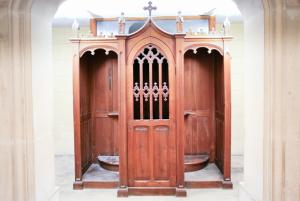
The big issue I have is not reporting child abuse disclosed during Confession. This may allow further abuse of the child victim. From what I have learned in Jesus’ teaching and getting to know him intimately as a disciple, I can’t imagine that he would be supportive of protecting the seal of confession at the expense of the welfare of a child. To me, this feels like a “Pharisee moment.” By that, I mean observing the letter of the “law” without regard for the people impacted. Catholic theologians and canon lawyers developed the seal of confession centuries after Jesus’ time as part of sacramental theology. I do not believe that respecting clergy-penitent privilege does anything to protect the innocent children being victimized by abusers. I think the Church got this wrong.
The Beatitudes
The Beatitudes were intended to express the spirit of the written law. They revealed its deeper purpose of mercy, humility, and righteousness rather than mere legal compliance. Jesus used them to fulfill and transform the Law’s intent, not to abolish it. Rather than listing prohibitions, the Beatitudes describe the character of those who live under God’s reign:
- Matthew 5:17 – “Do not think that I have come to abolish the Law or the Prophets; I have not come to abolish them but to fulfill them.”
- Jesus used the Beatitudes to restore the heart behind the commandments: compassion, justice, and spiritual dependence.
Jesus and the Law
Several moments in the Gospels show the Pharisees enforcing the letter of the law without regard for mercy, healing, or human dignity:
- Healing on the Sabbath – Jesus healed a woman who had been crippled for 18 years and a man with a withered hand, both on the Sabbath. The Pharisees condemned Him for “working on the Sabbath.” Jesus responded in Luke 13:15-16: “The Lord said to him in reply, ‘Hypocrites! Does not each one of you on the sabbath untie his ox or his ass from the manger and lead it out for watering? This daughter of Abraham, whom Satan has bound for eighteen years now, ought she not to have been set free on the sabbath day from this bondage?“
- Tithing Herbs but Neglecting Justice – “Jesus rebuked the Pharisees for obsessively tithing mint, dill, and cumin. Matthew 23:23 – “Woe to you, scribes and Pharisees, you hypocrites. You pay tithes of mint and dill and cummin, and have neglected the weightier things of the law: judgment and mercy and fidelity. [But] these you should have done, without neglecting the others.”
- The Woman Caught in Adultery – The Pharisees brought a woman caught in adultery, citing the Law of Moses, which commanded stoning. They said this to trap Jesus. John 8:7 – “But when they continued asking him, he straightened up and said to them, ‘Let the one among you who is without sin be the first to throw a stone at her.” They all left without stoning her.
Please share your thoughts about this article in the “Comments” section.
Peace
If you like this article, you might enjoy:
Trafficking Trends: Understanding The Current Crisis
Perseverance in Times of Opposition
ICE and the Eucharistic Procession in Chicago














 Ad-Free & Subscriber Log-In