

Guest writer: Pilgrim.
On the Art of Changing Everything While Changing Nothing
Introduction
There is a peculiar kind of courage, rarely celebrated and rarely named, which consists in the courage to be vague. It is not the courage of the martyr who dies for a proposition. It is not even the courage of the controversialist who, at least, has the decency to say something definite enough to be wrong. It is, rather, the courage of the document, the long, luminous, beautifully footnoted document, which gestures toward a revolution while insisting, on every third page, that it is doing nothing of the sort.
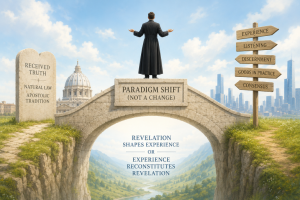
Study Group 9 of the Synod on Synodality, whose Final Report was released in May 2026, is a masterwork of this genre. It proposes a “paradigm shift” while carefully explaining that paradigm shifts are actually a form of fidelity. It critiques the derivation of praxis from “pre-packaged doctrine” but assures us this critique is itself deeply traditional. It listens, with great warmth, to men living in same-sex relationships, and presents their self-understanding as theologically instructive, while noting, in a subordinate clause, that it is not asserting a new doctrine. [1] But what is most important to understand from the outset is that the dispute this document represents is not, at its core, about homosexuality. It is about theological epistemology, about whether Revelation shapes experience, or experience reconstitutes Revelation. Everything else follows from that question.
The Paradigm Shift That Is Not a Change
To understand what the document is doing, one must first understand what it says it is not doing. It is not, the authors insist, attempting “to hide real difficulties or to force the issue to assert a new doctrine.” [2] It is merely proposing a shift, a “paradigm shift,” to be precise, in “the way of interpreting and expressing the proclamation of the Gospel and the mission of the Church.” [3]
Now, the careful reader will notice that a shift in the way of interpreting a teaching is, in most fields of human inquiry, considered a change to the teaching. If a judge announces a “paradigm shift” in how she interprets contract law, the lawyers in the room do not lean back in their chairs and relax, satisfied that nothing has changed. They reach for their pens. It is worth pausing on why this analogy is apt. Interpretive frameworks are not neutral containers; they determine which considerations are visible, which analogies are permitted, and which conclusions become available. A new hermeneutic is not a new lens on the same object. It is, structurally, a new object.
The key move is this. The report consistently frames the existing Catholic approach to moral theology as excessively “deductive,” as a cold machine that generates principles in the abstract and applies them to human lives regardless of what those lives actually contain. Against this, it proposes an “integrative” logic that begins with experience, listens to the “goods” already present in that experience, and increasingly allows theological reflection to be shaped by practice rather than norming it from the outset.
The task, therefore, is to rediscover a fruitful circularity between theory and praxis, between thought and experience, recognising that theological reflection itself proceeds from the experiences of ‘good’ inscribed in the sensus fidei fidelium. [4]
This is presented as a recovery of something ancient. And in a narrow sense, it is true that Catholic theology has always attended to experience. The lived holiness of the saints has always illuminated doctrine. But there is a difference between experience illuminating doctrine and experience constituting doctrine. The saints deepened the Church’s understanding of prayer, of love, suffering, and joy. They did not overturn her understanding of what marriage is. The report consistently elides this distinction. This is not a minor oversight. It is the hinge on which the entire argument turns.
Defenders of the report would no doubt argue that experience here functions not as a source rivalling Revelation, but as the privileged site in which Revelation is encountered and discerned historically. This is a serious objection, and it deserves a serious answer. The question, however, is not whether the distinction can be articulated in a foreword. It is whether the distinction retains any operative force in the methodology that follows. Consider what the document actually does with it. In practice, when experience and received doctrine conflict, the report’s instinct is not to subject experience to doctrinal correction but to suggest that the doctrine may not have been “fully received.” The community’s discernment of goods present in practice becomes, structurally, the criterion against which doctrinal formulations are measured rather than the other way around. A distinction that cannot survive its own application is not a distinction at all. It is a courtesy.
None of this means doctrine develops only by mechanical repetition. Catholic tradition includes real development, deepening, and renewed articulation. The question is whether development clarifies what was already implicitly contained within the deposit of faith, or whether it reconstructs moral meaning through historically conditioned experience. The former is how the Church came to articulate Trinitarian theology, the perpetual virginity of Mary, and the full dignity of the human person. The latter is what Veritatis Splendor was specifically written to resist. [5]
The Apostles Go to the Council – the Analogy That Does Too Much Work
The document’s controlling biblical image is drawn from Acts chapters 10 through 15, the account of the Council of Jerusalem, at which the early Church discerned, under the guidance of the Spirit, that Gentile converts need not be circumcised according to the Mosaic law. The authors present this as the template for how the Church ought now to approach “emerging issues,” including the experience of Catholics with same-sex attractions. [6]
It is a striking choice, and not an innocent one. The implicit analogy is plain. Traditional Catholic sexual doctrine today stands in the role that circumcision law stood in the first century. It is, on this reading, a culturally conditioned, historically provisional religious regulation, sincere, perhaps even well-intentioned, but ultimately destined to be transcended by a Church mature enough to listen to the Spirit’s newer and wider promptings.
The difficulty, and it is a serious one, is that circumcision belonged to what Catholic theology has always called the ceremonial law, the liturgical and ritual observances proper to Israel as a people, which were fulfilled and superseded in Christ. Augustine held it. Aquinas held it. Within the classical Catholic moral tradition, the distinction between ceremonial precepts, judicial precepts, and moral precepts has always been foundational, precisely because different categories of law have different relationships to Revelation and to human nature.
Catholic sexual ethics has never been classified within moral tradition as a ceremonial regulation of the Mosaic type. It is grounded in creation, in the natural law inscribed in the human body, and in the consistent apostolic tradition from the beginning. One can dispute that grounding, but one cannot pretend that the Acts 15 analogy addresses it. The analogy does not refute the traditional position. It simply changes the subject. Very elegantly. Very confidently. And without acknowledgment.
The Courage to Misrepresent Courage
Among the more striking moments in the document is its treatment of Courage International, the only Vatican-approved apostolate specifically dedicated to accompanying Catholics with same-sex attractions according to the Church’s own teaching. The report, drawing on one of its two appended testimonies, describes Courage as a group that “pushed for reparative therapy” and thereby “had the effect of separating faith and sexuality.” [7]
This does not accurately describe Courage‘s institutional mission. Courage‘s stated purpose is to assist persons with same-sex attractions “to live chaste lives in accordance with the Roman Catholic Church’s teaching,” through five spiritual goals centred on chastity, prayer, the sacraments, and companionship. It is not, and has never been institutionally, a psychological orientation-change programme, though its early associations with organisations such as the National Association for Research and Therapy of Homosexuality, and the presence of conversion therapy advocates at some of its conferences, created genuine ambiguity that Courage itself has since worked to dispel. The document’s only quoted source on this is a single testimony from a former member. That one person’s experience may have been painful, and one does not wish to dismiss it. But a document that presents itself as practising careful discernment ought to know the difference between an institution and one person’s account of it, and ought, at minimum, to signal the distinction to its readers. It does not. The only orthodox apostolate operating in the field is redescribed as harmful, without qualification, leaving the field clear for approaches more congenial to the document’s conclusions.
What is most telling is the asymmetry. The report listens at length to those who found Courage damaging. There is no corresponding testimony from those who found it life-giving, and there are many. A methodology that advertises itself as listening, but listens only in one direction, has not practised discernment. It has practised selection, and then labelled the result pastoral sensitivity.
The selection runs deeper than the asymmetry of testimony. One of the two men whose testimony is presented as a “case in listening” is the same man whom Fr. James Martin publicly blessed in New York City on 22 December 2023, the day after the release of Fiducia Supplicans, and whom Martin subsequently described as a friend. Unsurprisingly, Martin has been among the most prominent and jubilant public welcomers of the Study Group’s conclusions.
The problem is not only that the listening ran in one direction. In a methodology where testimony functions as a source from which theological reflection proceeds rather than merely illustrative material, the weighting of that testimony is not a presentational choice. It is a doctrinal one.
A methodology that presents itself as open discernment ought at a minimum to be transparent about the provenance of the evidence it selects. Two testimonies are a slender empirical base. Two testimonies, one of which originates in the social orbit of the document’s most vocal external advocate, is something rather different.
Sin Redefined, Quietly
The most theologically consequential sentence in the document appears in the summary of the first testimony, presented approvingly as an expression of spiritual growth:
…sin, at its root, does not consist in the (same-sex) couple relationship, but in a lack of faith in a God who desires our fulfilment. [8]
The document does not flag this as controversial. It presents it as that person’s discovery, a liberation from a cramped and fearful understanding of sin, toward a fuller, more relational one. And one can acknowledge what is partially true in it. Yes, the deepest root of all sin is a disordering of the soul’s relationship with God. Yes, pastoral attention to same-sex attracted Catholics ought to be far more than a recitation of prohibitions. Yes, grace is already mysteriously at work in every person the Church encounters.
The sentence does not say these things. It relocates the moral centre of the analysis away from the sexual act itself and toward the subjective experience of alienation or trust. This is not a deepening of Catholic teaching on sin. It is a replacement of one of its load-bearing elements. Current Catholic teaching holds that same-sex sexual acts are objectively disordered regardless of the subjective intentions or spiritual condition of those involved, a position expressed consistently from Persona Humana in 1975 through the Catechism today. [9] The document does not argue against this teaching. It simply presents a testimonial that assumes the contrary and passes on without comment. It does not, to be precise, formally endorse the sentence as Church teaching. And that is precisely the problem. A methodology which treats uncorrected testimony as a source from which theological reflection proceeds structurally invites the reader to receive it as legitimate insight, while preserving formal deniability. The problem is not the endorsement. The problem is the absence of correction.
There is a broader tendency at work here worth naming plainly. The modern habit of relocating sin entirely into failures of compassion, cruelty, or oppression, while finding nothing sinful in the acts that earlier generations consistently condemned, does not represent a more sophisticated moral theology. It represents a narrowing of the moral field to what the surrounding culture finds acceptable, dressed in the language of pastoral development. The sentence quoted above is a nearly perfect specimen of this tendency, and the document’s failure to notice is, at minimum, instructive.
Authority Redesigned
Perhaps the deepest structural change proposed by the document concerns the role of authority in the Church. The report is explicit. The proper role of authority, in a synodal Church, is “first and foremost, that of listening, setting the discernment process in motion, and accompanying it to reach the expression of a consensus.” [10]
This sounds humble. It sounds, in fact, like the opposite of clericalism, which is presumably the point. But consider what has been removed. Authority in classical Catholic ecclesiology is ordered toward the transmission and protection of revealed truth, a truth that precedes the community, that is not produced by the community’s discernment, and that binds the community whether or not it reaches consensus about it. The magisterium may listen in order to understand more deeply how revealed truth is to be proclaimed and lived, but it does not derive doctrine from communal consensus. It receives, guards, and hands on what was entrusted to the Apostles.
The document’s vision of authority as primarily a facilitator of communal discernment is not, in itself, without Catholic precedent. The deeper difficulty is what happens when this vision is married to the epistemological framework described above. If experience is the source from which theological reflection proceeds, and doctrine is what emerges from the community’s discernment of the goods present in practice, then the authority that convenes and accompanies the process is not guarding a deposit. It is managing a procedure whose conclusions are, structurally, open. And an authority whose function is procedural rather than custodial cannot, by that function, protect the faithful from conclusions that depart from what was received. It can only note that the process was well-conducted. That is a different thing from a teaching office. It is, in fact, a different ecclesiology, one in which the Church’s relationship to revealed truth is not receptive but generative, not custodial but creative. Once one sees this, much else in the document becomes legible.
The Pattern
It would be unfair, and incorrect, to say that the document is simply a manifesto for the abandonment of Catholic teaching on sexuality. It is more sophisticated than that, and more interesting. It contains real Catholic goods, genuine pastoral tenderness, a proper insistence on the dignity of every person, a healthy critique of clericalism, and some genuinely illuminating pages on synodal discernment.
The problem is not any single sentence, taken in isolation. The problem is the cumulative direction of the methodological framework, and a five-stage pattern that orthodox Catholic observers have learned, with some justification, to fear. First, retain doctrinal language formally. Second, reframe pastoral categories around experience-first discernment. Third, delegitimise orthodox pastoral approaches. Fourth, normalise new practices institutionally. Fifth, render prior doctrine practically inert, still formally asserted, but no longer operationally effective.
This sequence is not a prediction or an inference about hidden intentions. It is a documented trajectory. The German Synodal Path offers the clearest recent example, though the analogy is not without its limits. The Synodaler Weg operated under an explicitly binding mandate, with lay-clerical parity and direct challenges to magisterial authority that SG9 does not formally replicate. The structural resemblance lies not in the institutional arrangements but in the methodological logic. Once experience becomes the primary source from which theological reflection proceeds, the process tends to supply its own conclusions. Beginning in 2019 with language of listening and discernment, and with formal assurances that doctrinal matters lay outside its competence, the process moved within three years to producing texts calling for the blessing of same-sex unions, the restructuring of priestly authority, and the ordination of women deacons. None of the participants in the early stages needed to intend the later stages. The methodology carried the logic; the logic supplied the conclusions. The Anglophone observer need not look only to Germany. The trajectory of the Episcopal Church’s engagement with sexual ethics between the Lambeth Conference of 1998 and the present tells a structurally similar story, at a different pace and with a different theological idiom.
One need not look far for a smaller illustration. The Study Group‘s own titular vocabulary offers a small but telling example of the pattern in motion. The issues under consideration were originally designated “controversial.” Before publication, the word was changed to “emerging.” Fr. James Martin, who celebrated the report’s release with undisguised enthusiasm, noted the substitution himself, apparently without irony. The change is not cosmetic. “Controversial” locates the question in a field of settled doctrine against which a position is being contested. “Emerging” relocates it to an open horizon toward which the Church is naturally developing. The conclusion is not stated. The conclusion is assumed, in the choice of a single word, before the argument begins.
To be clear. The report itself does not explicitly endorse this trajectory, and it would be unfair to suggest that its authors consciously intend each of these stages. The concern is rather that its methodological premises make such a trajectory structurally likely, in the same way that certain architectural decisions make a building likely to behave in particular ways under stress, regardless of the architect’s intentions.
Study Group 9 is a contribution to stages two and three. It is not a declaration. It is, in the language the document itself favours, an “emerging” development, something that has not yet declared itself fully, but which is moving in a direction that those with eyes to see can already discern.
Conclusion: The Gospel That Is Always New and Never Different
There is a genuine insight buried somewhere in this document, struggling to get out. The Church does sometimes preach the Gospel in a manner that is more legal than liberating, more condemning than accompanying, more comfortable with abstract categories than with actual human beings. The critique of a merely deductive, impersonal pastoral approach is not without substance. Courage International itself, whatever the mischaracterisations of this report, would be the first to acknowledge that chastity lived in isolation, without friendship, community, or joy, is not the full vision the Church proposes.
But the answer to a bad application of doctrine is not to subordinate doctrine to experience. The answer is better doctrine, better pastors, better accompaniment, accompanied by the full, costly, demanding announcement of what human beings are made for and what it costs to get there. The Church has never believed that the Gospel conforms to human experience. She has always believed, stubbornly and at great expense, that human experience is invited, and able, to be conformed to the Gospel.
That is what is finally at stake in this document. Not the pastoral question of how the Church accompanies gay Catholics, a question that deserves far better than it has usually received, and on which much legitimate development remains possible. But the prior question of whether the Gospel judges culture, or culture judges the Gospel. Whether Revelation shapes experience, or experience reconstitutes Revelation. Whether doctrine is a gift received and guarded, or a process managed and evolved. These are not just Catholic questions. They are the defining questions of Western Christianity in this century, and how the Catholic Church answers them will shape the answers of every communion that looks to Rome, whether in agreement, in argument, or in sorrow.
These questions were old when Vatican II addressed them. They were old when Veritatis Splendor addressed them in 1993. [11] The great Catholic tradition has answered them, with remarkable consistency, in one direction. Study Group 9 proposes, with great elegance and many footnotes, that the time has come to answer them in another way.
It does not quite say so. The revolution that dares not speak its name is still a revolution.
References
- Study Group 9, Theological Criteria and Synodal Methodologies for Shared Discernment of Emerging Doctrinal, Pastoral, and Ethical Issues, Final Report of the XVI Ordinary General Assembly of the Synod of Bishops (2025), III.2.3.
- SG9, III.2.3.
- SG9, I.1.1.
- SG9, III.2.3.
- Pope John Paul II, Veritatis Splendor (1993), §§46–53.
- SG9, Introductory Notes, §3.
- SG9, Annex A.2.
- SG9, III.2.1.
- Congregation for the Doctrine of the Faith, Persona Humana (1975), §8.
Catechism of the Catholic Church (1992), §2357. - SG9, II.1.2.
- Pope John Paul II, Veritatis Splendor (1993), §§46–53.
Thank you!
Read The Latin Right’s other writing here.
Please visit my Facebook page and IM your questions (and follow my page) or topics for articles you would like covered.












 Ad-Free & Subscriber Log-In